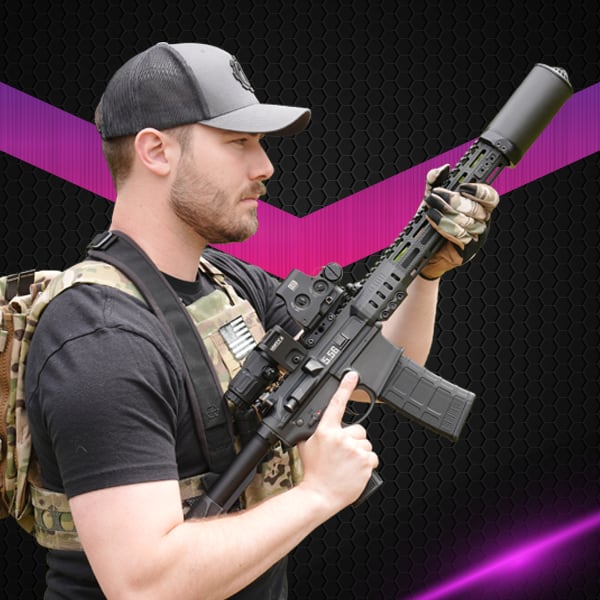
The hosts from Classic Firearms introduce retired Navy SEAL Jim Foreman from Ferro Concepts and Action On Consulting to configure a bare Radical Firearms RF-15 AR-15 for defensive and battlefield-style use. Jim explains he retired from the Navy SEALs five years earlier after 27 years of service, with roughly 20 of those years at SEAL Team Six. He now works at Ferro Concepts and runs Action On Consulting, focusing on tactical instruction and leadership training. The hosts note they have trained with Jim and other SEALs and emphasize his experience in combat and rifle setup. The goal of the segment is to see how he would equip a budget-friendly, barebones RF-15 into a practical self-defense and fighting rifle.
Jim starts with barrel length and optics. He likes a 16-inch AR-15, noting the same approach works on a 14-inch gun while still keeping it viable as a close-quarters weapon. His first priority is a low power variable optic, specifically a 2.5–10x style LPVO, to cover general engagement distances. For close-range work, he prefers a red dot mounted on top of the scope rings at 12 o’clock rather than on a 45-degree offset. He explains that a top-mounted red dot keeps the same shoulder position and head movement as the LPVO, avoiding the need to cant the rifle or twist the neck. Bringing the rifle up with a slightly higher head position lets him see the dot and target clearly with a consistent motion.
They install an EOTech Vudu 1–10x LPVO using a MAC mount and add an Aimpoint Acro red dot on top of the scope. Jim notes some shooters prefer the red dot toward the front of the scope, but he likes it mounted toward the rear; either position can work as long as the shooter trains with it. He reiterates that the red dot sits about an inch above the LPVO, giving nearly identical eye relief and a simple upward head movement for close-quarters shots. The host confirms that eye relief feels natural and that transitioning from the LPVO to the red dot is intuitive. Jim also addresses mechanical backup sights: if rail space allows, he recommends adding flip-up iron sights as a tertiary backup in case both the LPVO and red dot fail, though the current setup has run out of rear rail space.
The rifle comes with B5 Systems furniture and an M-LOK handguard. Jim replaces the slimmer B5 stock with a B5 Bravo stock. He points out the Bravo’s side “wings” that accept small plugs for storing spare batteries, such as CR123 cells for night vision devices. Jim then explains his approach to mounting the scope about 2¼ inches forward of the charging handle. With the stock fully extended, that distance gives him ideal eye relief in both prone and standing positions. If the scope were mounted farther back, he would have to shorten the stock and tuck his head more, which he finds less consistent. To standardize cheek weld, he sometimes tapes a small piece of soft ear pro to the stock as a tactile index point. By indexing the corner of his lip to that pad, he can achieve the same cheek placement every time, a technique he has seen designated marksmen and bolt-gun shooters use.
Jim describes how a 16-inch AR-15 like this RF-15 can function as a precision tool as well as a close-quarters rifle. He notes that with proper setup he has used a 16-inch rifle with a dope card to make reliable body shots at around 700 yards. On his own rifle, he ran a 700-yard dope, a consistent cheek weld, and the same type of optic arrangement being discussed. At the same time, the rifle remained suitable for close work inside structures and for general patrolling. He emphasizes that the top-mounted red dot is critical for rapid engagements from very short distances out to roughly 100 yards, allowing both eyes open shooting without hunting for perfect eye relief through the LPVO. The configuration lets him transition from 5-yard room distances to extended ranges without changing platforms.
Next, Jim adds a sling and foregrip. For the sling, they install QD hardware at the rear and a Blue Force Gear wire loop at the front. Jim likes the wire loop because it can be detached and reattached around various mounting points without removing the sling from the rifle. The sling itself is a Ferro Concepts Slingster with an adjustable pull tab. The host demonstrates how smoothly the adjustment handle slides, tightening and loosening the sling with minimal effort. Jim explains why he mounts the front sling attachment farther back instead of at the very front of the handguard. A forward-mounted sling can interfere with future light or laser placement and can press on a tailcap or pressure pad, causing unintended light activations. It also tends to get in the way during magazine changes. Mounting the sling farther back keeps the forend clear for controls and accessories.
For the foregrip, Jim installs a BCM vertical grip on the handguard. He prefers a foregrip on longer rifles because it improves control when transitioning from outdoor distances into close-quarters environments. He contrasts gripping the handguard alone with using the foregrip: if the support hand is wrapped directly around the rail, an opponent can more easily push the muzzle off line or knock the rifle out of the hand. With the BCM foregrip, he gains leverage and better retention. Entering a room, he can drive the rifle forward with the foregrip, maintain control of the barrel, and, if necessary, deliver a muzzle strike to an aggressor’s head while keeping the weapon oriented safely. If someone tries to push the barrel away, the foregrip gives him the ability to resist and move in, reducing the chance of losing control of the rifle or exposing his sidearm.





















 Loading...