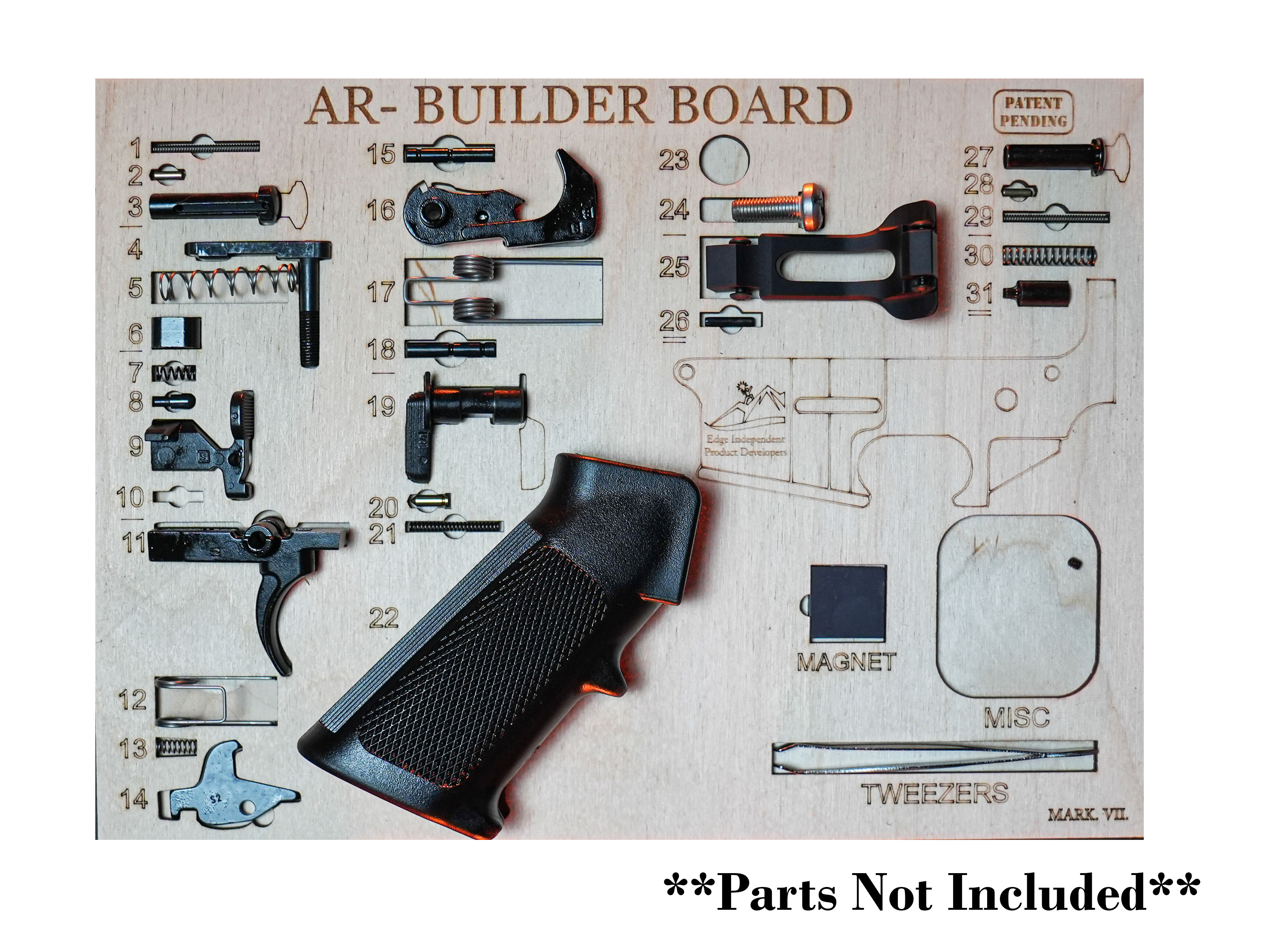
The video opens with a neatly organized AR-15 parts kit laid out on a dedicated AR Builder Board, contrasting it with the chaos of loose parts in bags or tackle boxes. Every component has a labeled spot and is arranged in build order, supported by a printed legend that matches each part to its step in the assembly process. Brandon, the inventor from Indianapolis and a competitive shooter, explains that pandemic-era parts shortages forced builders to source components from multiple vendors, often arriving unlabeled or poorly identified. Traditional gun mats and generic organizers did not clearly distinguish similar-looking pins, springs, and detents, leading to confusion and mistakes. This frustration pushed him to design a system that visually separates and labels each part, making it easy to identify and track during the build. The hosts introduce the AR Builder Board as a way to simplify AR-15 lower assembly, reduce lost parts, and turn the process into an approachable, confidence-building project for new shooters, families, and experienced builders alike.
The story then shifts to how the AR Builder Board evolved from a simple foam template into a complete instructional system. Brandon describes starting with cut foam that held each lower receiver part in a specific location, arranged in the exact order needed for assembly. Over time, this concept was refined into a durable board with clearly printed labels, part outlines, and a numbered sequence that walks users through 31 steps, from a stripped lower receiver to a fully functional lower. To support different learning styles, he created both live-action and animated videos that correspond to each step, ensuring builders can see exactly how every spring, detent, and pin is installed. The system has been tested and endorsed by military units, law enforcement, and competitive shooters who value repeatable, error-resistant assembly. The hosts highlight how the board doubles as a training aid, making it easy to teach new shooters or family members how an AR-15 lower works while keeping all the tiny components visible and under control on the bench.
The video next focuses on how the AR Builder Board functions in real build classes and home workshops. Instructors use the board to keep students’ parts organized, dramatically reducing the chance of losing small items like detents and springs that often launch across the room. The presenters list the basic tools needed to assemble an AR-15 lower: needle-nose pliers, a razor blade, a set of punches, and a small hammer, along with the lower parts kit, buffer tube assembly, and stripped lower receiver. Optional tools include a vise, lower receiver blocks, and other bench aids, but the system is designed so most builders can start with common household tools. Due to YouTube’s restrictions on detailed firearm assembly, the hosts explain they cannot show the full step-by-step build on this platform. Instead, they direct viewers to their Rumble channel, accessible via QR codes included with the AR Builder Board. Those codes link to comprehensive live-action and animated videos that match the printed diagram and numbered steps, ensuring a foolproof build process.
After the off-camera assembly guided by the AR Builder Board, the presenters reveal a fully built, functioning AR-15 lower that was constructed from the parts previously laid out on the organizer. They review the tools actually used during the build, including an armorer’s wrench for the buffer tube and castle nut, a screwdriver or bit driver for the pistol grip screw, and improvised slave pins to help align tricky components like the trigger and hammer. A staking tool for the castle nut is mentioned as optional but recommended for duty or hard-use rifles. The hosts emphasize that most of these tools are inexpensive and often already found in a typical toolbox. With the lower complete, they highlight one of its biggest advantages: multi-caliber compatibility. A single AR-15 lower can host uppers in 5.56, 7.62x39, .300 Blackout, .300 Hammer, .458 SOCOM, pistol calibers like 9mm, .40, and .45, single-shot .50 BMG uppers, and dedicated .22 LR setups for inexpensive training or youth shooters.
The final portion of the video moves to the range to prove the versatility of the AR-15 lower built on the AR Builder Board. The shooters start with a 5.56 upper installed on the completed lower and confirm proper semi-automatic function, stressing that incorrect assembly can cause malfunctions or injury. They note that a misbuilt lower can effectively turn the rifle into an unreliable, bolt-action-like setup instead of a smooth semi-auto. After finishing with 5.56, they swap to a 7.62x39 upper, changing only the upper receiver and magazine while keeping the same lower and even the same sight settings. The rifle runs well, demonstrating that the lower seamlessly supports the new caliber. Next, they convert the platform to 9mm by installing a 9mm upper and a Sylvan Arms magazine conversion block, allowing the lower to accept Glock-pattern 9mm magazines. The hosts point out 9mm’s low recoil and suitability for ranges that prohibit rifle calibers, and mention that .22 LR conversion kits offer even more affordable training options, all starting from the same user-built lower.





















 Loading...