The video opens by setting the goal of finding a favorite Canik pistol through side-by-side comparison and live fire. Canik is introduced as a Turkish manufacturer based in Istanbul, with production facilities and ranges in Samsun. Its pistols are used by Turkish military, police, and special forces, and have gained popularity in the United States since around 2013 for reliability, attractive styling, and especially strong factory triggers. The early TP9 series is highlighted, starting with the TP9 DA double-action model and the TP9 SA single-action variant. Their trigger systems are explained, including how the DA model has a longer pull and reset while the SA offers a crisper, lighter break. Emphasis is placed on how soft and clean these triggers feel compared to many competitors, establishing the baseline that later Canik generations will build upon.
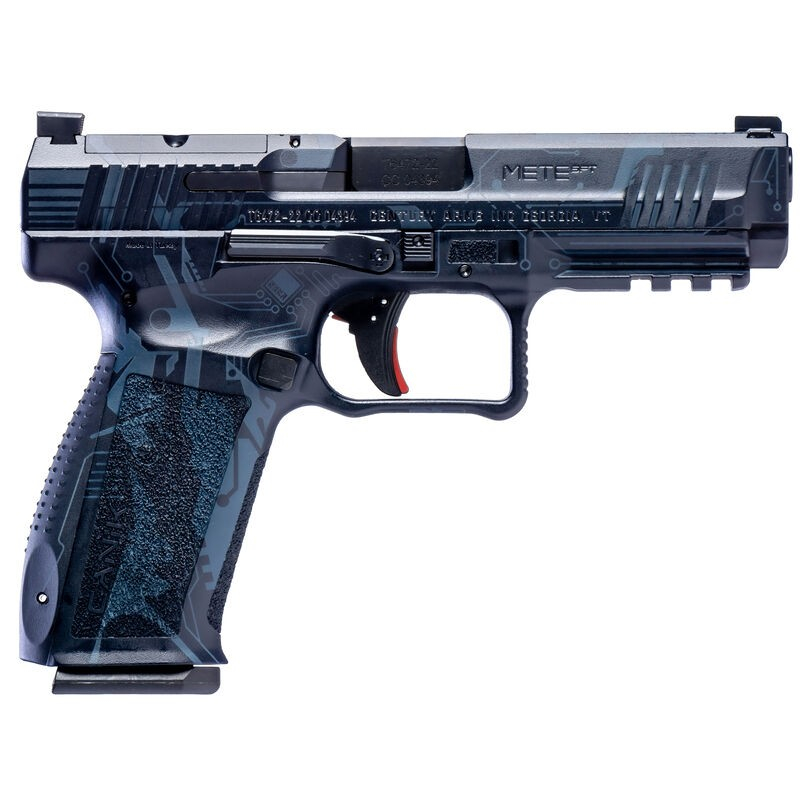
Attention shifts to the evolution of the TP9 line into more modern configurations. The TP9 SF is shown as a striker-fired pistol without an optics cut, representing a straightforward duty-style handgun. The TP9 SFX extends the slide and barrel length, adding an optics cut to support competition or tactical use, and is positioned as a performance-oriented upgrade over the SF. A Mete SFX model in striking blue Cerakote is then introduced, praised for its aggressive yet comfortable grip texture and eye-catching finish. The name “Mete” is explained as having heroic significance tied to a Turkish government program, giving the series cultural weight beyond its technical features. This Mete SFX includes an optics-ready slide and modern sighting system, signaling Canik’s shift toward modular, red-dot-ready pistols that appeal to both enthusiasts and practical shooters.
The video moves into the newest performance-focused models: the SFX Rival and Mete SFX Pro. These pistols are described as having futuristic, aggressive styling with extensive slide cuts and optics-ready configurations. The Pro variant adds a threaded barrel, making it suppressor-ready and clearly aimed at competition and advanced users. A Rival is shown equipped with a Swampfox red dot, underscoring its role as a turnkey competition setup. A detailed trigger comparison follows between the standard SFX, the SFX Rival, and the Pro. The Rival’s full aluminum trigger is highlighted for its exceptionally crisp break and short reset, feeling like an aftermarket upgrade straight from the factory. The Pro’s similar but polymer trigger is also praised, while the standard SFX trigger is framed as very good but not quite as refined. This section establishes how Canik has progressively refined trigger quality across its lineup.
Focus turns to concealed carry options within the Canik family. The TP9 Elite Sub Compact is introduced as a smaller, higher-capacity option that still maintains much of the shootability of the larger TP9 models. It offers a 15-round magazine with the option of a 13-round flush-fit mag, giving flexibility between capacity and concealment. The newer Mete MC9 micro compact is then compared directly. The MC9 is slimmer with a shorter barrel, designed to disappear more easily under clothing while still providing a strong 13-round capacity in a very small package. Its dimensions and grip profile are emphasized as ideal for smaller-handed shooters or those prioritizing deep concealment. The discussion sets up a tradeoff between the slightly larger, more hand-filling Elite SC and the thinner, more concealable MC9, previewing later live-fire impressions and carry preferences.
Live-fire testing begins with the Mete SFX in Cyber Blue, which is framed as a favorite defensive-oriented pistol. Its trigger is noted as slightly heavier than the pure competition models, which is presented as an advantage for defensive use while still remaining smooth and predictable. The gun shows a strong, consistent ejection pattern and reliable cycling at around 15 yards, reinforcing confidence in its duty role. The SFX Rival and Rival Pro are then evaluated on the range, both with a red dot and with iron sights at roughly 15–18 yards. Their extremely light, competition-tuned triggers allow fast, accurate strings of fire, with the shooter commenting on how easy it is to stay on target. A standard Mete SFX with a slightly longer barrel and a red fiber optic front sight is also tested, demonstrating reliable out-of-the-box performance and excellent sight visibility, especially compared to older TP9 models.
The older TP9 SF and TP9 SA are brought back to the line for comparison. Recoil and ergonomics feel familiar and controllable, but their plain white front sights prove harder to track than the newer red fiber optic setups on Mete and Rival pistols. This leads to more misses, and a simple fiber optic front sight upgrade is recommended to modernize these earlier guns. A TP9 variant with a double-action trigger is then examined in detail. Its DA pull has unusually long travel and a very late break compared to other Caniks, causing some shots to go off later than expected and resulting in misses until the shooter adapts. Returning to the SFX Rival and Mete SFX Cyber Blue, the video highlights how their crisp triggers, clear sights, and balanced ergonomics translate into tight groups on an 18-yard C-zone-style target, reinforcing why these models stand out in the lineup.
Attention shifts back to the smaller carry guns on the range. The TP9 Elite SC subcompact is tested with its 15-round magazine and optional 13-round flush-fit mag. Despite its reduced size, it performs impressively, with accuracy and control that may rival the SFX Rival at typical defensive distances. The shooter notes that the subcompact’s grip and balance make it surprisingly easy to shoot well. First-time impressions of the Mete MC9 micro compact follow. The MC9 offers a 12+1 capacity, for 13 rounds total, in a smaller and slimmer frame. While its compact grip can feel short or cramped for larger hands, the extended 15-round magazine dramatically improves control and comfort. For shooters with bigger hands, the Elite SC or MC9 with an extended mag is preferred, while the MC9’s minimal footprint makes it attractive for smaller-handed users or deep concealment roles.
The closing section weighs concealability against ergonomics and shootability across the Canik lineup. Smaller pistols like the TP9 Elite SC and Mete MC9 are acknowledged as easier to conceal, but their short grips can feel too small without extended magazines, especially for larger hands. Even so, the video notes that these subcompact and micro compact models can be shot almost as accurately as full-size guns, though full-size pistols remain more comfortable and manage recoil better. After initially leaning toward the subcompact, the final concealed carry choice becomes the Canik MC9 paired with a 15-round magazine, combining a slim profile with a more secure grip. For a full-size or range-focused option, the blue “Cyber” Canik Mete SFX is selected as a go-to gun. The video concludes by presenting this MC9 and Mete SFX combination as an ideal personal setup and inviting viewers to share their own experiences with Canik pistols.





















 Loading...