The video opens with Josh explaining how his professional background drives product development at US Arms Co. He spent 13 years as a law enforcement officer in Georgia and 17 years in the Army, giving him extensive real-world experience with duty rifles and precision weapon systems. The Classic Firearms hosts describe first meeting Josh and his team about a year and a half earlier at the Surviving Man event, where they were introduced to US Arms Co rifles and immediately noticed their refinement and performance. That encounter led to an ongoing relationship and this in-depth manufacturer review. Josh emphasizes that his time in uniform shapes how he evaluates reliability, accuracy, and durability, ensuring that every rifle is built for hard use rather than just benchrest shooting. This sets the stage for a discussion of how US Arms Co blends end-user experience with advanced manufacturing to create purpose-built platforms for law enforcement, military, competition, and serious civilian shooters.
Josh details how US Arms Co actually began as an airline parts manufacturer long before entering the firearms market. The company produced highly precise components for major aerospace clients such as Boeing, using four- and five-axis CNC machines and routinely holding tolerances within five-thousandths of an inch. After mastering that demanding environment, they decided to apply the same aerospace-level precision, quality control, and documentation to firearms. Based in Monroe, Georgia, US Arms Co is only about eight years old as a gunmaker, but it brings decades of machining and engineering experience from the airline industry. This heritage informs their philosophy: build lightweight, accurate, and durable weapon systems that can withstand real abuse. Josh mentions models like the Ozreal PRS rifle as examples of how they translate aerospace tolerances into practical, field-ready precision rifles that feel like mature designs despite the company’s relatively young age in the firearms world.
The discussion shifts to how US Arms Co approaches precision and continuous improvement. The hosts note that although the company is new, its rifles feel like well-refined, mature platforms. Josh explains that their standard is for rifles to print very small groups at 100 yards, not just meet loose milspec expectations. Achieving this requires meticulous machining and a willingness to embrace failure as part of research and development. He describes how they intentionally push designs until something fails, then analyze what went wrong to refine processes and tolerances. A specific example involves a 300 Blackout rifle with a carbine-length gas system that initially struggled with reliable cycling. Instead of blaming users, US Arms Co listened to customer feedback, identified that spring pressure was too high, and adjusted the system to improve reliability. This illustrates their philosophy of tuning gas systems, springs, and components based on real-world data, ensuring that both bolt guns and gas guns deliver consistent performance under varied conditions.
Attention turns to the company’s bolt-action line and the design goals behind a featured PRS-style rifle. Josh explains that accuracy, durability, and manageable weight were non-negotiable requirements. Rather than building a 28-pound behemoth like some Barrett or old MTU-contour setups, they targeted an overall weight around 11 to 11.2 pounds. This allows shooters to move between positions quickly in PRS-style matches or field scenarios without sacrificing stability. He stresses that true precision starts with barrel and receiver geometry: barrel runout and bore centerline must be effectively zero, and the barrel shoulder, receiver shoulder, and recoil lug all need to be perfectly square. If those surfaces are not aligned, the rifle will string shots as it heats up. Their performance standard for this platform is 0.5 MOA or better. The design also accounts for durability, so the rifle can withstand drops, maintain zero, and function as a practical working tool rather than just a static range gun.
The hosts walk through the bolt gun’s component choices and real-world performance. The rifle wears an X2 Dev Group Orion 6.5 titanium suppressor, chosen for its lightweight construction and sound reduction, and an Eotech Vudu 5–25x optic with an H59 reticle. That reticle allows shooters to use holds for elevation and wind instead of constantly dialing, speeding up engagements at varying distances. The chassis is an original J Allen stock design, now produced by MDT, providing a rigid, ergonomic foundation. The barrel is a 1:7 twist 416R match-grade tube in a #5 or #6 contour, balancing rigidity with reduced weight for better handling. Up front, an MDT air or feather light fully adjustable bipod is mounted to a long Arca rail, enabling quick repositioning along barricades or tripods. Using PRS and law enforcement Ozreel rifles in .308 and 6.5 Creedmoor, they report consistent hits at one mile with nine different shooters, accounting for Coriolis effect and roughly 2 mils of spin drift on the 6.5, demonstrating the system’s long-range capability.
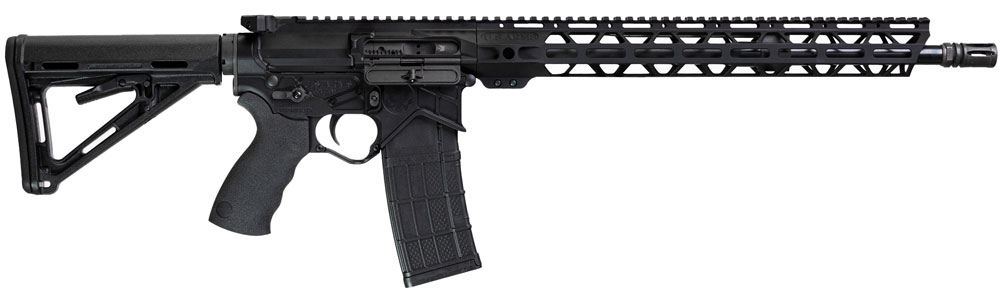
The conversation transitions from bolt guns to US Arms Co’s gas-operated platforms, particularly the Champion AR-15 used in the Snipers Unknown Challenge. In that event, the typical sniper and spotter roles are split, with the spotter often carrying a semi-automatic rifle to engage multiple targets rapidly. The Champion filled that role and helped secure top finishes in matches like Snipers Unknown and a DMR sniper competition. Josh emphasizes that US Arms Co designs and manufactures its own components rather than relying on off-the-shelf parts. A highlight is their proprietary, patented M905 Talon muzzle brake. Its design borrows from jet turbine and thrust-vectoring principles, using carefully engineered internal and leading-edge radii, multiple chambers, and four vectored ports per side at a 60-degree throw. These features capture and redirect muzzle gases more efficiently, controlling recoil and muzzle rise so shooters can stay on target and track impacts more easily during rapid strings of fire.
Josh dives deeper into the M905 Talon’s performance, explaining that the four vectored ports per side are angled at 60 degrees to cone and redirect a fixed volume of gas for maximum mechanical advantage, similar to jet engine thrust vectoring. This geometry yields dramatic recoil mitigation, with claims of roughly a 94 percent reduction in felt recoil compared to a standard AR-15 equipped with a milspec A2 flash hider. He notes that even a short 10.5-inch full-auto platform can be fired one-handed with minimal movement when using the Talon. The discussion then moves to the Gen 2 Champion rifle. It features a match-grade 223 Wylde chamber that is specifically cut and fitted to its corresponding bolt, with chamber tolerances held within about 0.003 inches. This is much tighter than typical SAAMI and field gauge ranges. US Arms Co sets an accuracy rubric of 0.5 MOA or better for the Gen 2 Champion, contrasting it with common milspec expectations around 3 MOA and comparing its precision favorably to their Azrael model.
The hosts highlight the construction of US Arms Co’s AR-platform rifles, starting with the proprietary handguard. Designed in-house, it uses extensive lightening cuts to reduce weight while preserving structural rigidity, and is machined from 6061 aluminum. The upper and lower receivers are 7075 billet, providing strength and consistency beyond typical forged sets. Josh then introduces their patented Cam Lock system on the Champion model, which addresses a common AR-15 issue: play between the upper and lower receivers. He explains that standard pivot and takedown pin tolerances can allow about 0.008 inches of movement over a 6.250-inch span, potentially introducing around 3.8 MOA of inherent error through torsion, pitch, and yaw. Unlike an Accu-Wedge, which simply pushes the upper away from the lower, the Cam Lock functions as a mechanical bedding system. It pulls and locks the receivers together at the flat and rear radius, eliminating slop and improving consistency shot to shot, especially under hard use or when using magnified optics.
In the final technical segment, US Arms Co explains its unconventional approach to barrel nut torque. While the industry standard often cites a minimum around 35 foot-pounds, they torque their barrel nuts to approximately 100 foot-pounds. Josh argues that this higher torque improves barrel seating, enhances overall system stability, and is critical for maintaining consistent accuracy. Because the handguard is fully free-floated, all stresses from accessories, barricade loading, and sling tension are transmitted through the barrel nut and receiver interface. Proper torque ensures the gas tube aligns correctly, the handguard remains rock solid, and the point of impact does not wander over time. They claim that with quality optics, ammunition, and this build methodology, the rifles will hold zero even after months of sitting in a safe. The video closes with mutual appreciation between US Arms Co and Classic Firearms, mention of plans to shoot the rifles, grab lunch, and record a podcast, and thanks to viewers for following the collaboration.





















 Loading...