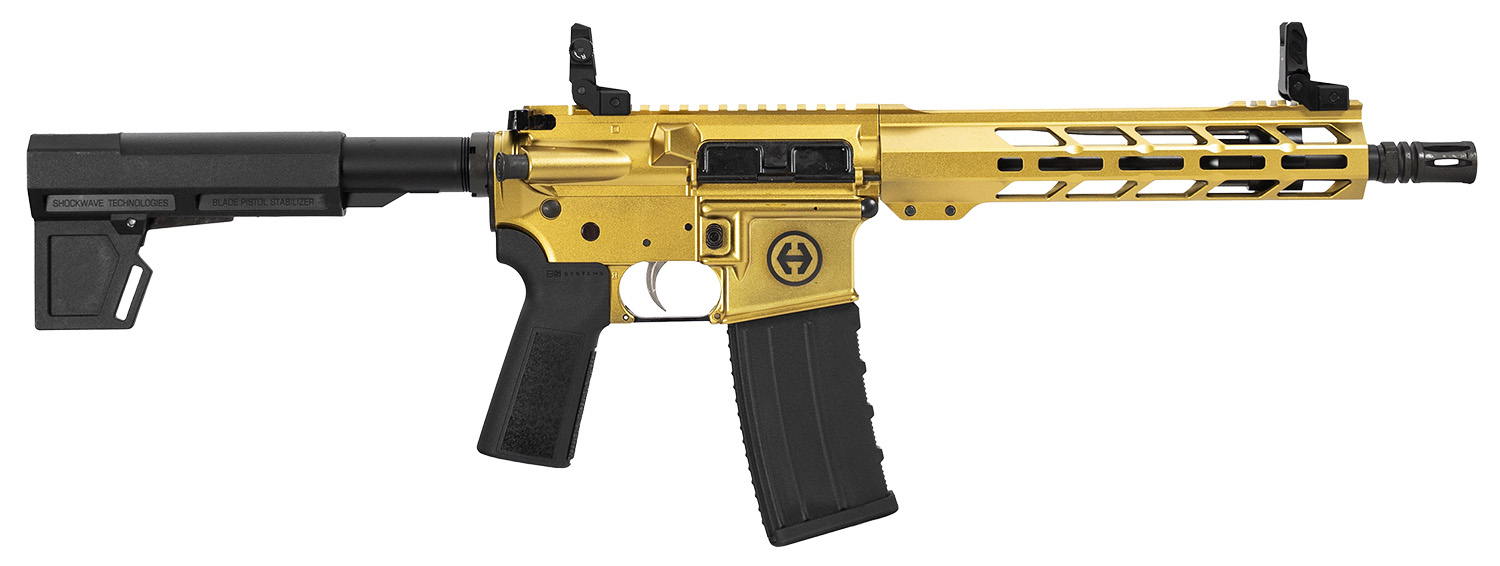
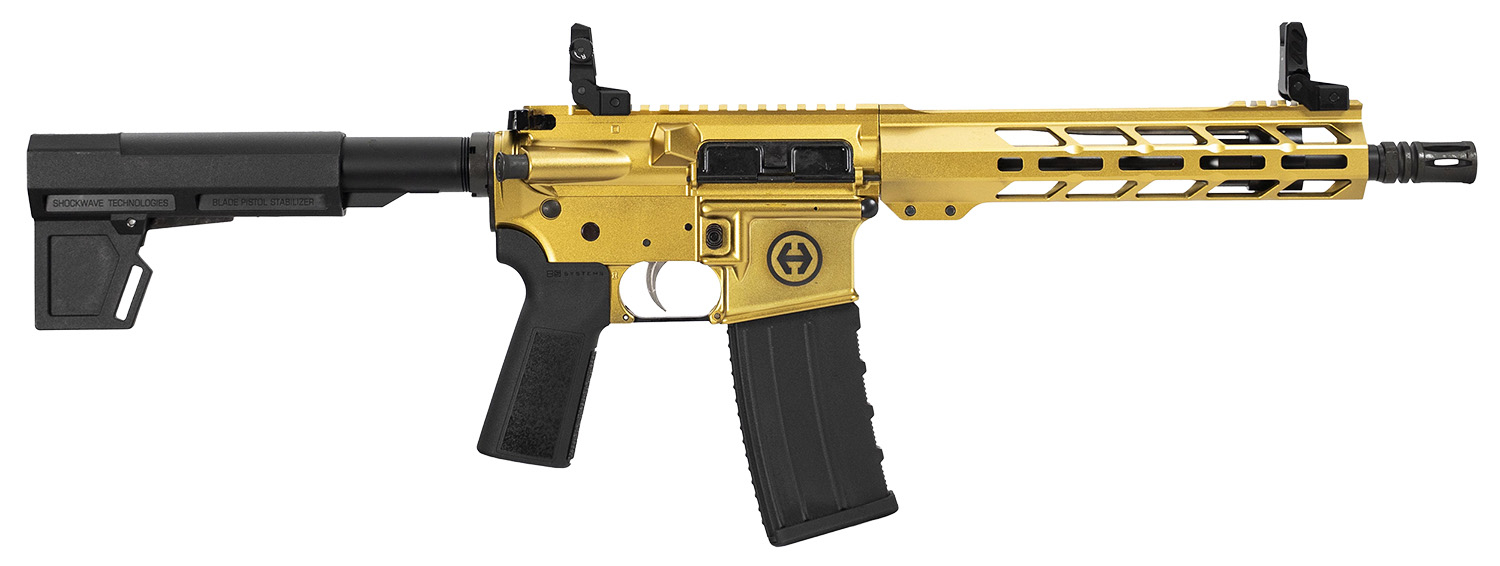
The video introduces two Hi-Point HP-15 AR-style pistols finished in gold, one chambered in .300 Blackout and the other in 5.56 NATO. The hosts explain that the goal is to walk through how the pistols are alike, where they differ, and to help viewers decide which configuration might suit them better. They outline the plan to cover specifications, then move through the guns from muzzle to brace, verifying listed tech specs on camera. Both pistols share the same general layout and dimensions, with only minor differences beyond caliber and magazines.
Both HP-15 pistols feature 10.5-inch barrels with a 1:7 twist rate. Aside from caliber and magazines, the platforms are essentially identical. Each pistol comes equipped with an upgraded B5 grip instead of a basic A2-style grip, providing improved ergonomics compared to many budget-oriented builds. Both include aluminum flip-up sights from UTG that lock positively into place with a distinct click. Unloaded weight is stated to be around 4.25 pounds, a figure the hosts plan to verify later. The gas system is pistol length on the .300 Blackout model, while the 5.56 NATO version uses a carbine-length gas system.
The hosts note that the .300 Blackout pistol uses a pistol-length gas system, while the 5.56 NATO pistol uses a carbine-length system, likely based on how each caliber performed during testing. Both uppers and lowers are described as being made from 7075-T6 aluminum. The barrels are listed as 4150 chrome moly vanadium steel. Most of the visible gold-colored metal components are also aluminum. Magazine differences stand out: the 5.56 pistol ships with a UTG 5.56 magazine featuring a pass-through window and a blue follower, while the .300 Blackout pistol includes an unbranded magazine with a white follower that is simply marked as made in the USA. Thread pitches differ as expected, with 1/2x28 on the 5.56 barrel and 5/8x24 on the .300 Blackout barrel.
Both pistols come with an adjustable brace, which the hosts point out is not always found on lower-priced AR-style pistols. Unlike some fixed or set-screw designs, this brace locks into position and adjusts using a lever that is pulled with the index finger while gripping it like a pistol grip. Controls are standard mil-spec style: a magazine release on the right side, a bolt catch on the left, and a safety selector on the left. The upper receiver’s Picatinny rail is numbered, allowing users to note exact sight positions for removal and reinstallation. The handguard rail is not numbered, so accessories mounted there would need to be visually aligned or marked by the user.
The hosts discuss the bold gold finish and how it contrasts with more minimalist, all-black builds. One host prefers understated setups but still acknowledges that the gold HP-15 pistols are visually striking and would stand out on a wall or at the range. They note that taking a gold 5.56 pistol with a muzzle device into an indoor range will draw attention and questions from other shooters. Despite the playful appearance, they emphasize that the pistols remain functional tools, with practical upgrades such as the adjustable brace, B5 grip, and included sights. The gold finish is presented as a fun aesthetic choice layered onto a usable AR-style pistol platform.
To verify dimensions, the hosts measure overall length with the braces fully collapsed and then extended. Because the two pistols share the same receivers, barrel length, and brace design, they are effectively the same size. With the brace collapsed, overall length is reported at roughly 26.5 inches. With the brace extended, overall length is about 29.5 inches. They decide that measuring height is less critical due to the presence of flip-up sights and typical AR-15 proportions. The focus remains on confirming that both the .300 Blackout and 5.56 versions match the advertised length range and are essentially twins in terms of external dimensions.
The hosts move to a scale to compare actual weights, weighing the pistols without magazines to minimize variables. The .300 Blackout pistol comes in around 5.58 pounds, while the 5.56 NATO pistol weighs about 5.43 pounds in one reading, then approximately 5.74 pounds in another configuration. The .300 Blackout pistol measures about 5.85 pounds in a later check. They note that the differences are small but real, and somewhat counter to expectations, since the 5.56 model has a longer gas system tube while the .300 Blackout barrel likely has slightly more steel due to its larger bore. Overall, both pistols fall into a similar weight range, with only minor variation between calibers.
The video transitions into trigger pull testing for both pistols. Before using the gauge, the hosts confirm that the chambers are clear and the safeties are set appropriately. They prepare to record multiple trigger pull readings to see how the triggers compare between the .300 Blackout and 5.56 NATO models. An initial pull on the .300 Blackout pistol registers around 3.7 pounds, though the host notes that the reading may be slightly light due to finger placement and a minor slip on the trigger shoe. Further pulls are planned to get a more representative average for each pistol’s trigger weight.





















 Loading...