The video opens with host Kai introducing guest Jim Foreman, a retired Navy SEAL with 27 years of service and SEAL Team Six experience. Jim’s post-military work with Farrow Concepts, Zenith Firearms, and Active Crisis Consulting establishes his ongoing involvement in high-end tactical training and equipment. Kai frames the episode as a head-to-head “top five showdown” of fighting guns, loosely structured as an FBI versus Navy SEAL comparison. Rather than a strict organizational doctrine breakdown, the matchup uses the reputations of the FBI and SEALs as recognizable benchmarks for serious combat firearms. The tone is professional but conversational, setting expectations that each slot in the top five will be justified by real-world use, reliability, and mission fit. This introduction positions the list as a practical, experience-driven look at what seasoned professionals trust when lives are on the line, while also hinting at friendly rivalry between federal law enforcement and special operations perspectives.
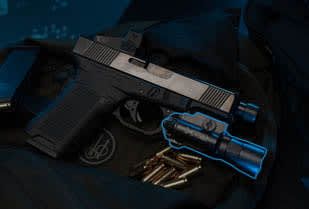
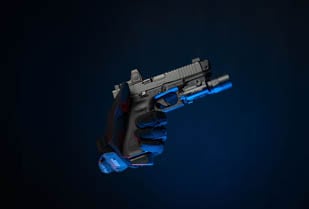
For the number five slot, the showdown starts with service pistols. Kai selects the Glock 17/19M platform, highlighting the FBI contract Glock 19M and its influence on the Gen 5 Glock design. He notes that this MOS-derived configuration reflects extensive FBI testing and requirements, making it a benchmark duty pistol with modern ergonomics, improved internals, and optics-ready capability. Jim counters with the SIG P226, the classic Navy SEAL sidearm for decades. He emphasizes its proven reliability in harsh environments like sand and saltwater, where corrosion and fouling can quickly disable lesser handguns. Jim points out the decocker-only operation as a feature that simplifies use under stress while maintaining safety. He also clarifies that, in SEAL operations, the pistol is a secondary weapon, typically reserved for confined spaces, prisoner handling, or as a backup when a primary long gun is unavailable or goes down, rather than being the main fighting tool.
At number four, the conversation shifts from sidearms to heavier support and battle rifles. Jim chooses a 40mm standalone grenade launcher, referencing platforms like the H&K 40mm. He explains that, in rough or mountainous terrain such as Somalia and Afghanistan, indirect fire becomes crucial. A 40mm launcher allows engagement of enemies behind cover, over ridgelines, or in defilade positions where direct rifle fire is ineffective. Jim stresses its value for area denial, signaling, and delivering explosive or specialty munitions at standoff distances. Kai responds with the SIG MCX Spear chambered in 7.62x51 NATO (.308). He highlights running this rifle for about three years with strong reliability, praising its reach and terminal performance. The 7.62x51 caliber is noted for better barrier penetration and the potential to defeat certain types of body armor compared to intermediate cartridges, making the Spear a serious contender for a primary fighting rifle in demanding engagements.
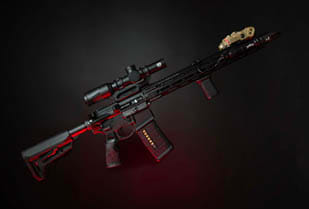
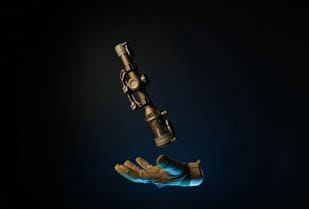
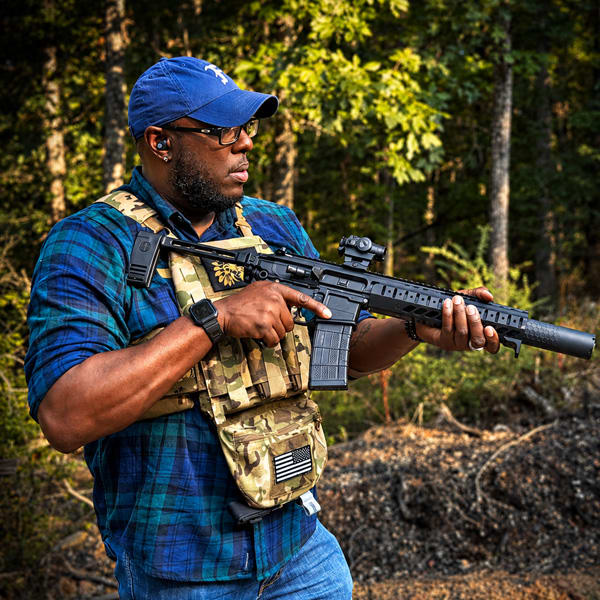
The number three slot contrasts a compact personal carbine with belt-fed squad automatic weapons. Kai presents his personal SIG MCX Rattler LT in 300 Blackout, configured for close-quarters and suppressed use. He details its setup: a collapsible brace for minimal overall length, a SIG Romeo AT optic mounted on a Unity riser for faster target acquisition, an SMS laser for aiming in low light or with night vision, and a Cloud Defensive weapon light for illumination. The rifle is suppressed with a Q Trash Panda, emphasizing reduced signature, and carried with a Ferro Concepts Slingster sling, which he notes was a gift from Jim. Jim counters with the M249, specifically the SOCOM Mark 46 variant, and also mentions the M60E3 and Mark 48 as related belt-fed options. He explains their role as squad automatic weapons providing high-volume suppressive fire from the point element. Practical field tips, like taping the muzzle to keep sand out, underline the realities of keeping these guns running in harsh environments while they anchor a team’s firepower.
Near the end of the video, the speakers explicitly frame Navy SEALs and the FBI as performance benchmarks for fighting firearms. They stress that these organizations are not chosen for tribal loyalty but because they are widely recognized and respected for rigorous selection, training, and equipment standards. By anchoring the top five lists to SEAL and FBI perspectives, the showdown gains context: viewers can imagine how elite military special operations and premier federal law enforcement might prioritize different capabilities. This segment reinforces that the earlier pistol, rifle, launcher, and machine gun choices are grounded in real operational demands rather than purely theoretical preferences. The hosts underline that the comparison is meant to be accessible, using well-known institutions so that even casual viewers understand the stakes and credibility behind each firearm’s inclusion in a professional-grade fighting gun lineup.
The discussion transitions into a strong call for audience participation. The hosts repeatedly invite viewers to share their own top five fighting guns or “showdown guns” in the comments. They emphasize that the SEAL versus FBI framing is just one way to structure the debate and that many valid configurations exist depending on mission, environment, and personal experience. Viewers are encouraged to think through their own lists as if they were equipping for serious combat or a high-stakes head-to-head matchup. The repetition of this prompt underscores that the video is meant to spark conversation, not present a definitive, one-size-fits-all answer. By asking for specific ranked lists, the hosts aim to gather a wide range of perspectives on pistols, carbines, precision rifles, support weapons, and specialty platforms that others would trust as their primary fighting tools.
As the outro continues, the hosts keep circling back to the idea of a “showdown gun.” They urge viewers to think not only in terms of generic favorites but in terms of firearms they would actually bring to a decisive confrontation. The phrase “top five fighting guns or showdown guns” is repeated in slightly varied forms, reinforcing the central theme of the episode. The focus is entirely on engagement: no new models or calibers are introduced here. Instead, the speakers stress that the two organizations discussed—Navy SEALs and the FBI—serve as recognizable yardsticks, and now it is the audience’s turn to apply that mindset. Commenters are asked to list their own five-gun lineups, effectively turning the comment section into a community-driven comparison of combat-ready setups and personal doctrines for serious defensive or offensive use.
In the final moments, the language becomes almost mantra-like as the hosts play with the phrase “top five fighting gun or a showdown gun.” They appear to be clarifying that a fighting gun list can be oriented toward real-world duty use, while a showdown gun list might emphasize direct, head-to-head performance in a hypothetical matchup. The phrase is repeated, shortened, and emphasized, drawing attention to the intended role of each firearm in a list. This segment functions as a closing emphasis rather than new content, reminding viewers to be deliberate about why they choose each weapon. The audio then devolves into truncated fragments of “showdown gun,” breaking down to single syllables and letters, suggesting either a stylistic echo effect or a minor glitch. No additional firearms, accessories, or technical details are added, leaving the audience with a lingering focus on the core concept of what truly qualifies as a fighting or showdown gun.










 Loading...