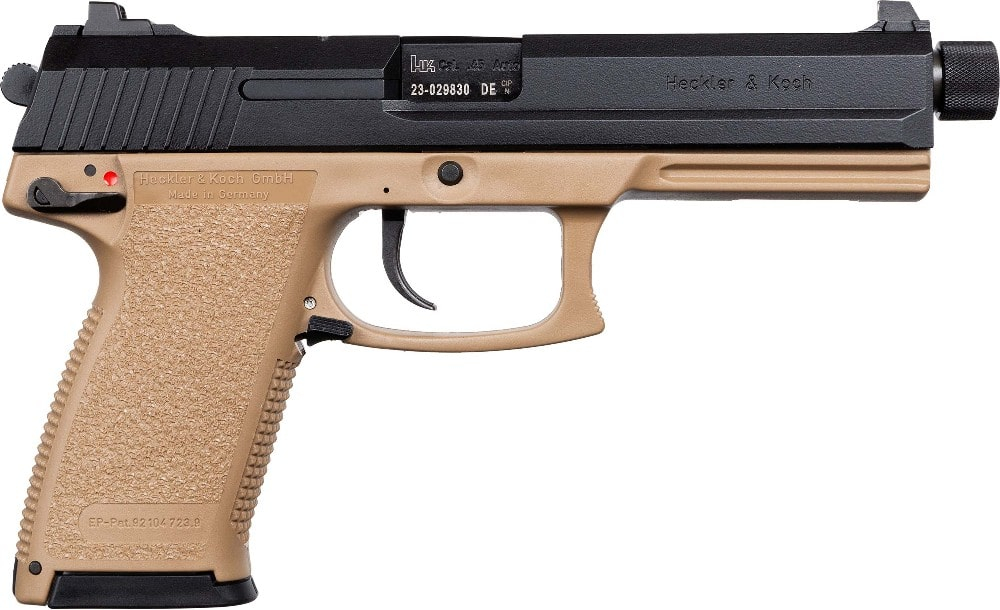
The video opens with an overview of the Heckler & Koch Mark 23, better known as the MK23, and its origins in the early 1990s. Developed around 1991 and officially fielded with SOCOM in 1996, the MK23 was purpose-built for the Offensive Pistol Program, where it became the first choice. The host describes it as an oversized, tank-like .45 Auto/.45 ACP semi-automatic pistol designed for serious combat use rather than concealed carry. Key specs highlighted include its double-action/single-action operation, a long 5.87-inch threaded barrel ready for suppressor use, and a 12+1 capacity. The pistol features a decocker and manual safety, giving users multiple carry and readiness options. Emphasis is placed on the MK23’s reputation as a heavy-duty sidearm engineered for extreme reliability and durability, reflecting its intended role in demanding special operations environments where size and weight are secondary to performance and robustness.
The focus then shifts to the MK23’s distinctive frame and accessory setup. Instead of a standard Picatinny rail, the pistol uses a proprietary accessory rail that was originally paired with a dedicated deployment kit. This kit included a purpose-built suppressor and a compact laser aiming module, often referred to as a LAM. The host explains how the front frame hole is not cosmetic; it interfaces with the original light and laser combo, allowing activation through that unique mounting system. This design reflects the era and the specific SOCOM requirements that drove the MK23’s development. The video contrasts this older, specialized approach with more modern platforms like the USP 45, which adopted more conventional accessory mounting and saw use with units such as BORTAC and Customs and Border Patrol. The segment underscores how the MK23’s rail and LAM system were tailored to offensive, suppressed operations rather than general-purpose duty carry.
Next, the video covers the MK23’s user interface and handling characteristics. It features fully adjustable three-dot sights, allowing precise zeroing for different loads and distances, which suits its role as an offensive handgun often paired with a suppressor. Controls are laid out with an ambidextrous safety, making it accessible for both right- and left-handed shooters, and the familiar HK-style ambidextrous paddle magazine release at the trigger guard. The trigger is described as smooth and predictable in both double-action and single-action modes, contributing to accurate shooting despite the pistol’s large size. Ergonomically, the MK23 is acknowledged as big and heavy, but that mass helps manage .45 ACP recoil and reinforces its “built like a tank” reputation. The pistol typically ships in a hard case with two 12-round magazines. The host notes that these magazines are relatively expensive compared to more common platforms, which is an important consideration for buyers planning to stock up on spares.
The final portion of the video emphasizes the MK23’s reliability record and operational niche. The host references testing where the pistol reportedly fired around 23,000 rounds without a malfunction, a figure that helped secure its selection for SOCOM. This extreme endurance is tied directly to its design as a heavy-duty pistol for heavy-duty situations. The MK23 is highlighted as having performed exceptionally well in maritime interdiction roles, which were a primary design focus. Its robust construction, corrosion-resistant components, and reliable function in harsh, wet environments made it particularly suited for boarding operations and special missions at sea. While acknowledging the pistol’s size, weight, and higher overall cost, the video points out its strong stopping power in .45 ACP and undeniable cool factor as reasons it still appeals to enthusiasts and professionals. The segment closes by inviting viewers to share their own experiences with the MK23 in the comments before a brief sign-off.





















 Loading...