The video opens with the hosts openly admitting they are tired of flat-range, static paper targets that never move or think back. To shake things up, they bring in Jordan from TOAST Targets, alongside Kyle and Aaron from Class Farms, and roll out a tablet-controlled moving target system. On screen, Jordan shows how the targets tuck in and out of cover, mimicking human movement instead of just standing still. Using the tablet, he adjusts motion patterns, speeds, and exposure times, demonstrating how quickly the system can change from slow, predictable presentations to fast, randomized behavior. The hosts emphasize that this is not just a gimmick; the system allows different target shapes and configurations so instructors can build specific training protocols. The early discussion frames TOAST as a way to bridge the gap between sterile range drills and the chaotic, dynamic nature of real gunfights, setting the tone for the rest of the video’s live-fire demonstrations.
Jordan explains how his path to designing TOAST Targets started far from the range. He grew up in Huntington Beach, played linebacker at Edison High School, then went on to UCLA and eventually the Pittsburgh Steelers. After an injury ended his football career, he still craved adrenaline and competition, which led him into paintball. On the paintball field, he noticed a huge disconnect between traditional static shooting drills and the fast, unpredictable gunfights he was actually experiencing. Standing on a flat range punching holes in motionless paper did not translate to success when opponents were sprinting, leaning, and snapping in and out of cover. That realization pushed him to experiment with moving target concepts that could better simulate real opponents. Over time, those ideas evolved into a robust, tablet-driven system designed to force shooters to track, time, and lead targets under pressure instead of simply shooting at a fixed silhouette.
The conversation shifts to why moving targets are so much harder than traditional drills and how that difficulty can be harnessed for better training. The hosts point out that most shooters are comfortable on a flat range but quickly fall apart when a target starts to move, disappear, or use cover. To address this, they outline a controlled skill progression, starting with slower, more predictable presentations and gradually increasing speed and complexity. Jordan breaks down the TOAST acronym: Tactically Offensive Automated Systems Target. He explains that the system’s development has been heavily influenced by feedback from combat veterans and experienced operators who wanted more realistic, reactive training tools. Rather than just making targets wiggle, the goal was to replicate human-like behavior—peeking, ducking, and shifting laterally—so shooters must read timing, manage exposure windows, and make decisions. This philosophy underpins both the full-size units and the new compact version introduced next.
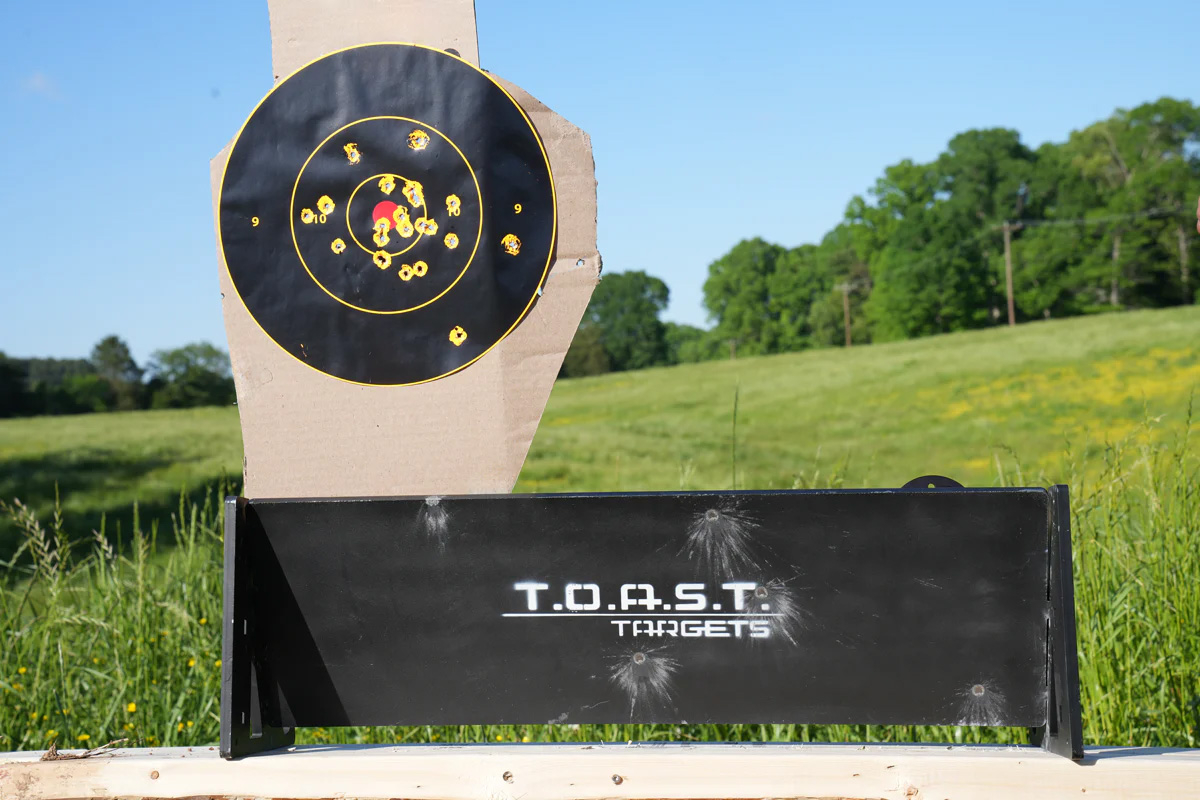
Jordan introduces the TOAST Mini as a smaller, more affordable, and portable version of the full system, aimed at individual shooters, small departments, and non-institutional users. He announces an introductory price of $900 for the first 100 units, a $300 discount from the $1,200 MSRP, joking about optional artwork add-ons. The Mini is described as an 18-inch moving target platform that can shift side-to-side, pop out left or right, stand vertical, and move up and down. It is built with bullet-resistant construction and rated to stop up to .308, while remaining compact enough for local ranges or even backyard setups where safe. The platform accepts common cardboard silhouettes like IPSC, USPSA, and IDPA torsos, which can be stapled to wood or plastic backers. At the range, they set up two TOAST systems side by side, both controlled from a single tablet, and note that up to 20 units can be run simultaneously. They configure a pattern where two vertical targets pop up at varying angles, with hide time at 1.5 seconds, exposure at 0.5 seconds, and speed at 50%, then prepare for a friendly pistol competition using guns like a stock M&P 2.0.
The hosts explain that the TOAST Mini can take various target materials, from cardboard silhouettes to plastic stapled onto wood, but heavier military-style green Ivan targets are reserved for the mil-spec unit due to motor limitations. They outline a dual-target drill where two pop-up targets appear from behind cover, and the shooter must hit each one at least once before they drop. Shooters can choose to engage left-to-right or right-to-left, but the emphasis is on fast transitions and timing shots only when the target is actually exposed. They run the drill from low ready or even a hip-start position to add difficulty. During one string, a shooter realizes mid-run that he forgot ear protection but decides not to stop, pushing through the discomfort to complete the drill. Afterward, they walk downrange to inspect the targets, noticing low initial hits and several rounds impacting the wooden support instead of the scoring zone. The shooter explains how he adjusted his point of aim during the string, resulting in more centered hits toward the end.
Back at the targets, the group counts hits versus total rounds fired, discounting any shots that only punched through wood rather than the actual scoring area. They compare results to determine who performed better in terms of accuracy and consistency, not just raw round count. This leads into a discussion of engagement tactics: only shoot when the target is genuinely exposed from behind cover, rather than trying to game the system by blindly sending rounds through obstacles. They joke about the idea of hosing through cover, but reinforce that the training value comes from disciplined timing. The TOAST Targets team then highlights new software capabilities that allow on-the-fly updates and highly customizable motion profiles. A notable addition is a “peek” behavior where the target briefly exposes only a small portion, such as a head, before moving away again. To showcase the system’s flexibility, they run a faster AR-focused drill with shorter exposure times and reduced intervals behind cover, staying within a 28-round limit to satisfy YouTube guidelines. Afterward, they comment on how challenging the brief exposures are and how critical it is to account for sight offset when shooting around plywood cover.
The shooters use a plywood-backed target to visualize mechanical offset, emphasizing that their red dot never appeared on the plywood itself, yet impacts clearly show where rounds actually landed relative to the optic. This helps them understand how much to hold to avoid hitting cover when shooting close to barricades. They then count and compare hits on paper, joking about miscounts, keyholing, and double-tap-looking impacts while confirming that their totals are surprisingly similar. To settle bragging rights, they plan a “rubber match” drill focused specifically on consciously managing offset, discussing the idea of a dedicated peep-shot mode for scenarios like air units or snipers engaging very brief target exposures. Finally, they crank the TOAST system up to maximum speed with continuous movement, forcing shooters to engage only what they can realistically track. Targets whip in and out, and they acknowledge plenty of misses, but also highlight how enjoyable and demanding the drill is. The max-speed run underscores how quickly shooters can be overwhelmed if they fall behind the target’s rhythm.
After proving the system’s raw difficulty, the group turns to scenario-based training and sets up a hostage drill using the TOAST Mini. They designate one target as the hostage and another as the hostage taker, clarifying that the goal is to neutralize the bad guy without hitting the innocent. The moving platform allows them to stack targets and add shoot/no-shoot images, creating a more realistic decision-making problem than a simple silhouette. As the drill runs, the targets pop in and out, and the shooters react, sometimes landing questionable hits. On review, they joke about apparent shots on the hostage, referencing movie logic from films like Speed to argue that shoulder hits might be survivable. They count hits on both the hostage and the bad guy, teasing each other about liability, lawsuits, and hypothetical payout per shot. Despite the humor, the takeaway is that the system effectively exposes poor shot placement and forces accountability when precision matters under time pressure.
The instructors plan a highly advanced drill designed to push both shooters and the TOAST system. Each shooter will fire 90 rounds, requiring three magazines and multiple mag changes under pressure. They configure a more complex target presentation where the TOAST units not only pop vertically but also from the left and right, creating three distinct engagement points at full speed. This setup demands rapid target acquisition, lateral transitions, and constant awareness of which target is currently exposed. The drill is essentially a high-intensity mag dump with structure, forcing shooters to manage recoil, reloads, and movement while staying ahead of the targets’ randomized motion. During the run, one rifle suddenly experiences a serious malfunction: the gun appears clear but is stuck on fire with a dead trigger and cannot be made safe in the normal way. Recognizing the problem mid-drill, the shooter immediately transitions to a sidearm as a practical field solution, demonstrating how the TOAST scenarios can surface real-world equipment issues under stress.
After the advanced drill, the team dives into diagnosing the rifle malfunction that occurred mid-string. They explain that the gun had to be partially disassembled and a prying tool used to clear the issue, which initially looked like a serious mechanical failure. On closer inspection, they discover a blown primer from a bad round lodged under the safety, preventing the selector from moving and effectively locking the fire control group. This confirms that the malfunction was ammunition-related rather than a problem with the ADM-built rifle or its Geissele-style trigger setup. The discussion highlights how high-round-count, high-stress drills can reveal issues that might never appear during slow, casual shooting. The shooter’s decision to immediately transition to a pistol rather than fight the malfunction on the clock is framed as a realistic response, mirroring what would be expected in a defensive or duty context when a primary weapon suddenly goes down.
The hosts reflect on how the TOAST Targets system drives stress inoculation by forcing rapid transitions and split-second decisions. They note that the targets can appear and disappear in the 0.15 to 0.3 second range, which is fast enough that a shooter who falls even slightly behind quickly feels overwhelmed and panicked. One shooter recalls having 16 pistol rounds during a transition sequence and later wondering how many of those actually connected on the quickly flashing targets. The experience feels like a game, but one that demands real skills in tracking, timing, and throttle control. They emphasize that the system makes it easy to turn training into competitive mini-games, where shooters challenge each other on hit counts, reaction times, and accuracy under pressure. This gamified approach keeps sessions engaging while still reinforcing fundamentals like sight picture, trigger control, and target discrimination in a dynamic environment.
In closing, the TOAST Targets representative outlines the company’s broader mission. The goal is to provide a training tool that is both fun and genuinely useful, bridging the gap between entertainment and serious skill development. He stresses that TOAST is a young company and actively looking for user feedback to refine motion profiles, software features, and hardware durability. Viewers are invited to reach out through multiple channels, including the website at toastargets.com, email, phone, and Instagram under Toast Targets or Toast Target. The team wants to hear from everyday shooters, instructors, and professional end users about what works, what does not, and what new behaviors or drills they would like to see. The video ends with an emphasis on continued improvement, community involvement, and the belief that dynamic, automated targets represent the next generation of realistic firearms training.





















 Loading...