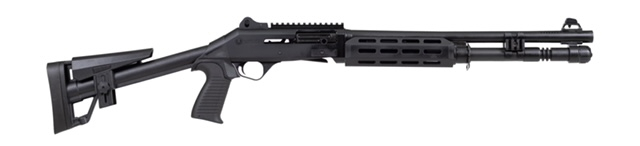
The video opens with a comparison between a standard Panzer M4 and the Panzer Arms M4 SPEED PRO Tactical Semi-Auto Shotgun. The hosts frame it as the classic option versus the upgraded version, jokingly calling the SPEED PRO the “guy she told you not to worry about.” They note that Panzer shotguns follow a traditional piston-driven design and are known as Benelli-style clones that offer strong value. The SPEED PRO is introduced as a new offering with several enhancements over the more traditional M4, including visual differences like a gray finish. The discussion sets up a detailed walkthrough of what makes the SPEED PRO distinct while acknowledging that the base M4 remains a proven, reliable platform.
Attention shifts to the M4 SPEED PRO’s barrel and forend. The hosts point out the barrel porting, visible as holes near the muzzle, and describe it as a key feature aimed at performance. Both shotguns have aluminum Picatinny rails and sling loops, but the SPEED PRO adds a modern M-LOK handguard. The M-LOK setup allows mounting hand stops, vertical grips, flashlights, and other accessories in various positions, offering more flexibility than the traditional forend on the standard M4. They then highlight scalloping around the loading area and a wide, open loading gate on the SPEED PRO, likening it to a “big mouth bass.” This design is described as making it easier and faster to load 12 gauge shells compared to the more conventional loading setup on the classic M4.
The hosts compare the controls on both shotguns, focusing on the bolt release and charging handle. The SPEED PRO features a large paddle-style bolt release intended for quicker, easier activation under time pressure, contrasted with the smaller button on the standard M4. Its charging handle is slightly larger and knurled, offering a more positive grip. They also note skeletonized cuts in the SPEED PRO’s bolt, which reduce weight and add a distinctive look. On top, both guns ride optic rails. One shotgun is set up with a compact RMR-style optic, while the SPEED PRO wears a larger optic with a circular shotgun reticle reminiscent of a halo-style ring, chosen for fast target acquisition. They mention that co-witnessing with the iron sights would depend on optic mounts, suggesting options like a Scalarworks-style mount with an RMR to see through to the sights.
Moving to the rear of the guns, the discussion covers sling mounting and stock options. The SPEED PRO includes an integrated QD sling socket, described as a useful “pro” feature, while the other shotgun relies more on traditional sling routing with a single QD point. They note that the stocks on these Panzer M4-style shotguns are generally compatible with many Benelli furniture options, allowing users to swap to different stock configurations if desired, including more traditional one-piece designs familiar to tactical and gaming enthusiasts. The hosts emphasize that, as tactical semi-auto shotguns, these Panzer models deliver strong capability for the price. They also point out that parts interchangeability with Benelli-pattern components makes it easier to source upgrades or replacements, though the M4 SPEED PRO is presented as largely ready to run straight out of the box.
At the range, the hosts set up a head-to-head comparison between the traditional Panzer M4 and the M4 SPEED PRO, acknowledging that the SPEED PRO’s configuration may offer an advantage. They decide to test what Panzer is known for: speed and reliability, using a shot timer to record times. The first drill is a seven-round string using ghost loading. They explain ghost loading as filling the magazine tube with five rounds, placing a sixth shell on the lifter by partially retracting the bolt, and then chambering a seventh round, achieving seven rounds without modifications. In the first timed run, one shooter records a 1.37-second string for seven rounds. The other shooter then runs the SPEED PRO and posts a 1.32-second time, suggesting that the upgraded shotgun may indeed offer a measurable speed advantage.
To remove bias and see if the gun or the shooter is faster, they swap shotguns. Using the same ghost-loaded seven-round setup, they repeat the timed drill. With the SPEED PRO, one shooter records a 1.34-second run, narrowly edging the earlier 1.37-second time from the standard M4. They comment on the recoil and the importance of a solid stance with a 12 gauge, noting that body weight and foundation affect control. When the other shooter runs the traditional M4, he posts a 1.37-second time, effectively matching his earlier result and showing consistent performance with that platform. The hosts interpret these numbers as indicating that the SPEED PRO is slightly faster overall, while also acknowledging that shooter skill and familiarity remain critical factors in the results.
They continue the friendly competition, aiming to beat the 1.32-second benchmark. Another series of runs produces a 1.34-second time, followed by a noticeably faster string where one shooter immediately recognizes the improvement from the feel of the run. The timer confirms a 1.22-second result, significantly quicker than the earlier times. They briefly reference the shot-to-shot splits, noting that once the shooter settles in, the splits hover around the mid-teens, roughly 0.16 to 0.17 seconds between shots. The hosts praise the trigger feel on the shotgun, stating that it contributes to maintaining those consistent, fast splits. This segment underscores how both the mechanical characteristics of the shotgun and the shooter’s rhythm combine to produce faster overall times.
In the final sequence, they push for one last set of runs to settle the friendly rivalry. One shooter posts a 1.36-second time and notes some hesitation in his trigger work, attributing the slightly slower result to a momentary lapse rather than the shotgun itself. The other shooter responds with a strong run and edges out the previous best by one hundredth of a second, reinforcing how small differences in timing can decide a competition. They acknowledge that while speed can be “bought” through features like barrel porting, enlarged controls, and optimized setups on the M4 SPEED PRO, pure skill and consistency still matter. The closing takeaway is that the Panzer Arms M4 SPEED PRO lives up to its name in timed drills, offering a modest but real speed advantage while remaining within an accessible price range for a competition-ready 12 gauge platform.











 Loading...