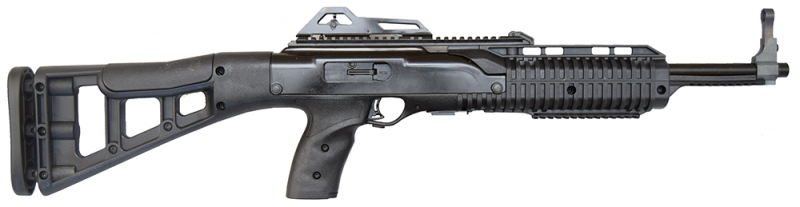
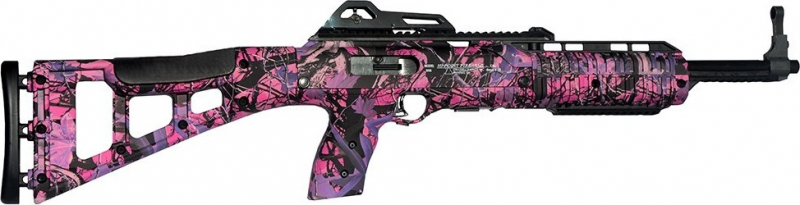
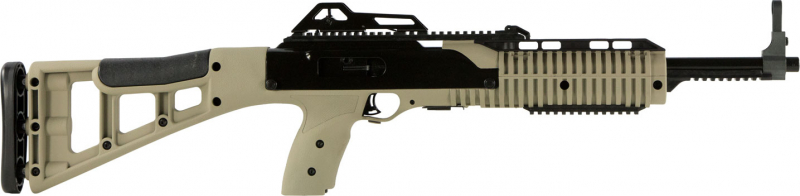
The video showcases the 16.5 inch barrel Hi-Point carbine chambered in 9mm. It is acknowledged as visually unusual, consistent with Hi-Point’s reputation for unconventional styling, but the sub-$300 price point is emphasized as an important factor for anyone considering this pistol caliber carbine. The host frames the rifle as an “oversized Yeet Cannon’s bigger brother” and then moves into a feature-by-feature walkthrough. The focus stays on practical features rather than looks, explaining how the carbine is set up for range use and basic utility while remaining budget friendly within its segment.
At the front, the carbine uses a 16.5 inch barrel with 1/2x28 threading, allowing attachment of suppressors or other muzzle devices. The front sight is notably tall to clear the large handguard. Under the barrel is a Picatinny rail, an arrangement not commonly seen on most rifles, which typically extend the rail from the receiver to the handguard instead. This lower rail can accept lights or lasers, and an additional rail section farther down accommodates vertical grips. These features give the front end multiple mounting options while keeping the basic configuration simple.
The handguard has an almost Picatinny-like pattern molded into it, providing extra texture and making the carbine easier to hold. The overall design is angular. The front sight is bolted directly to the top Picatinny rail rather than sliding on, which is specifically noted. The rear sight is mounted on that same top rail and is adjustable, with yellow reference lines to aid in alignment. Together, the sights form a straightforward iron sight system intended for typical carbine distances, with the rail allowing for potential optic mounting if desired.
The charging handle has “USA” imprinted on the end of the bolt and uses a metal, free-floating style handle that is easy to grasp and cycle. Just below it is a lever-style safety that is moved up or down to switch between safe and fire. The trigger guard is relatively small, which could be an issue when wearing thick gloves in cold environments, so the host suggests planning gear accordingly. The trigger itself has a rounded flat pad for the finger instead of a thin curved blade. There is minimal take-up before a clearly defined wall, followed by a long, smooth pull that travels nearly to the rear of the trigger guard. The reset is described as very short, giving a distinct break and quick follow-up capability within the carbine’s design limits.
The central portion of the receiver area is metal, while the front and rear sections, including the grip and stock, are polymer. The grip is wider than average, which may be challenging for smaller hands at first, but it has molded texturing that provides a secure hold and is described as ergonomically shaped. Behind the trigger is a circular magazine release that allows the magazine to drop free. The included magazine is a 10-round metal unit with witness holes to show remaining rounds. The magwell has a small front cutout so a stuck magazine can be pulled free by hand if necessary. The stock is polymer with cutouts through the center and matching texturing consistent with the handguard and grip.
At the rear of the rifle, the buttstock houses a distinctive three-spring system. The springs feel sturdy and are intended to reduce felt recoil, with the suggestion that recoil may be minimal even over extended shooting, such as several hundred rounds. The closing remarks characterize the Hi-Point carbine as a value-oriented pistol caliber carbine featuring a threaded barrel, extensive Picatinny rail space, and a recoil-mitigating stock. The discussion notes its low price point and suggests it as an option for those interested in a budget 9mm carbine, while inviting users who own Hi-Point carbines to share their experiences and reviews.





















 Loading...