At IWA 2025 in Nuremberg, Germany, Classic Firearms visits the Lucansky Arms and Orsov Manufacturing booth to look at the Stinger 9, a 9mm pistol-caliber carbine developed as a joint venture. The Stinger 9 uses a newly patented operating system called divided matter, a delayed system built around a two-part bolt. The bolt is split into separate upper and lower sections that move independently. This design is presented as a next-generation approach intended for both PCC and subgun roles, including military applications. A full-auto version already exists and has been sold to initial customers. The focus of the conversation is how this divided-mass system differs from conventional PCC operating systems and what it is intended to achieve in terms of reliability and recoil behavior.
The lower portion of the Stinger 9’s bolt is made from tungsten, chosen for its high density so the necessary mass can be achieved without a large, bulky component. The representative notes that this is a premium-grade tungsten similar to what is used in specialized submunitions for tank and artillery ammunition. Using tungsten instead of steel keeps the overall firearm more compact while still providing the mass required for the delayed system. The design aims to retain the simplicity and durability of traditional blowback systems, with few small moving parts and minimal wear. During factory reliability testing, the gun reportedly ran 5,000 rounds without cleaning. The divided-mass arrangement is said to significantly reduce felt recoil because only the steel upper portion impacts the rear first, while the recoil spring begins returning it forward before the tungsten section catches up and contacts it.
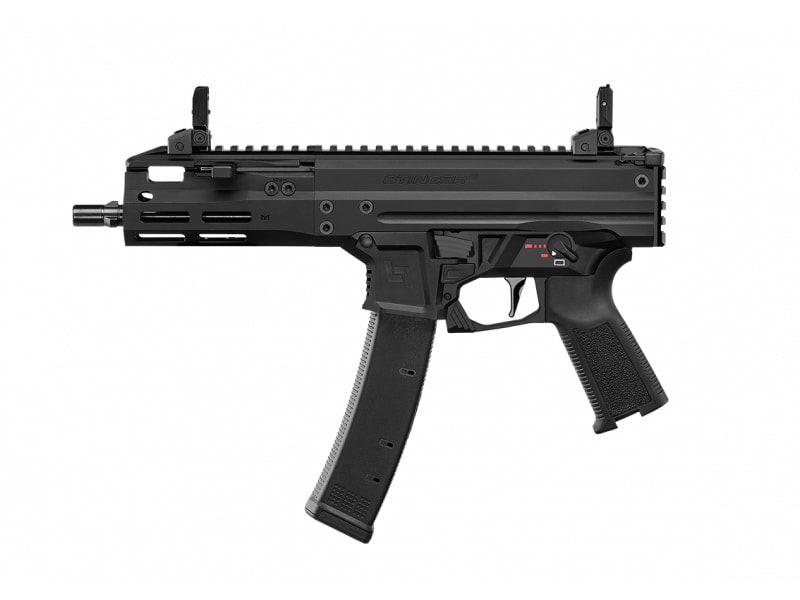
The Stinger 9 is shown in multiple configurations, including a very compact 4-inch barrel model and an 8-inch version. The design emphasizes a short overall length, with the 4-inch configuration described as smaller than some competing 3.5-inch PCCs. The handguard system is modular: two screws secure the handguard, allowing users to swap to longer or wider handguards while keeping the same barrel, or to change to a longer barrel if desired. The platform is intended to support various suppressed setups. Users can maintain a short barrel and run an extended handguard over an attached suppressor for an SD-style, more integrated appearance, or configure the gun with different barrel and handguard combinations to suit specific roles.
The Stinger 9 uses magazines based on the original CZ Scorpion pattern. The representative explains that the original Scorpion magazine was designed by Jan Lucansky, so they refer to them as Lucansky magazines. The gun is compatible with existing Scorpion-type magazines on the market, including options from Magpul and CZ. However, Lucansky Arms is developing its own updated magazine because they were not satisfied with how current offerings perform in harsh conditions. Their revised design is intended as an enhancement after roughly 15 years of the original pattern being in production. The new Lucansky magazines are not yet shown because the mold is still being finalized, but they are planned to ship with the Stinger 9 once production is complete.
One of the displayed Stinger 9 configurations uses a rear 1913 Picatinny interface with a proprietary stock design. The stock includes a reversible cheek piece that can be set to stop in the middle position or rotated 180 degrees to allow full rearward travel, depending on shooter preference. The stock is described as slim and light while still providing a comfortable cheek weld, and it can fit other compatible platforms using a 1913 rail. The Stinger 9 is fully ambidextrous, with several redundant controls to accommodate different training backgrounds. The magazine release can be actuated in multiple ways, similar to Scorpion or AK paddle releases and AR-style button releases, allowing use by finger, thumb, or trigger finger. The bolt catch and bolt release are ambidextrous, and the fire controls follow an AR-style layout with a 45-degree selector throw. The trigger uses AR-compatible components, though the hammer is lengthened to match the Stinger’s greater bolt travel.
The Stinger 9 offers dual charging options. A forward, Scorpion or MP5-style side charging handle allows an HK-style slap and can be mounted on either side, which may appeal to shooters used to European PCC layouts or left-handed users. There is also a traditional AR-style rear charging handle. Depending on configuration, users can run both, cap off the front and use only the rear, or rely solely on the AR handle in very short builds where there is no space for a front charger. At the muzzle, the gun uses a tri-lug interface. The example shown is a late prototype used for reliability testing, with visible wear and no muzzle threads, but production models will include both a tri-lug and a threaded muzzle, specified as 1/2x28. One test gun has surpassed 25,000 rounds, demonstrating long-term durability of the system and components.
Lucansky Arms plans to introduce the Stinger 9 to the U.S. market in 2025, with availability targeted for later in the year. Timing depends on ATF approvals rather than production capacity, as European sales are beginning once final molded parts, such as the buttstock components, are ready. The expected U.S. price is stated as under $1,000. To quantify recoil, the company built a dedicated test bench to measure recoil impulse, rather than relying on subjective shooter impressions. According to their data, the Stinger 9’s divided-mass delayed system produces slightly less recoil impulse than roller-delayed systems such as the Stribog. Compared with the SIG MPX, the Stinger 9 shows a bit more recoil when the MPX is new, but as the MPX’s gas port erodes, its recoil reportedly increases. After 8,000 rounds in their testing, the MPX’s recoil impulse was measured at roughly double that of the Stinger 9.




















 Loading...