What Makes .22LR Different? Grains, Calibers, and Power
The video opens by framing a broad question: how effective is .22 Long Rifle across roles like home defense, survival, target practice, and competition. The host explains that a typical .22LR load uses a 40‑grain projectile and clarifies that “grain” is a unit of weight for the bullet itself, not the brass case or powder. This sets up a comparison with more common defensive calibers. Standard 9mm loads are described in the 115–124 grain range, while .45 ACP ball ammunition often runs around 230–250 grains, showing how much lighter .22LR projectiles are. The discussion then touches on 5.56/.223, noting that although it uses a .22‑caliber bullet, the much larger powder charge makes it dramatically more powerful than .22LR. With that context, the host begins to address .22LR’s real‑world performance, acknowledging that while it is not the ideal home defense round, many people have relied on it simply because it was what they could afford or had available.
.22LR for Home Defense vs Shotguns and Larger Calibers
The focus shifts to whether .22LR is truly viable for home defense. The host reiterates that it is not the preferred option compared to 9mm, .45 ACP, or similar service calibers, but cites real self‑defense incidents where .22LR proved effective. One example involves a woman using a 10‑round .22 rifle to defend herself and her child, underscoring that shot placement and willingness to fight matter. The conversation contrasts .22LR with the often‑recommended 12‑gauge shotgun. While a 12‑gauge is powerful, its heavy recoil and extremely loud report can be intimidating or even debilitating for new or smaller shooters inside a home. This leads into a more nuanced view: .22LR may not be optimal, but it can be a practical choice for those who cannot manage larger calibers, and it is far better than having no firearm at all when facing a threat.
Training and Competition: Low Recoil .22 Pistols and Rifles
After covering defensive use, the video highlights where .22LR truly excels: training and competition. The host showcases the KelTec CP33, a .22 pistol designed with a 33‑round magazine, a full‑length Picatinny rail for optics, fiber‑optic sights, M‑LOK slots for accessories, and a threaded barrel ready for suppressors. This platform illustrates how .22LR can support serious competition and practical training with minimal recoil and noise. The discussion then moves to classic .22 options like a Henry lever‑action rifle and a .22 revolver with cocobolo grips. These firearms are praised for their virtually nonexistent recoil, making them ideal for teaching new shooters firearm safety, sight alignment, and trigger control without the distraction of heavy kick or blast. The segment emphasizes that .22LR platforms allow shooters to build fundamentals and confidence before transitioning to more powerful calibers.
Recoil-Free Practice, Collectible .22s, and the Thunderstruck
The next section dives deeper into how .22LR’s lack of recoil benefits skill development. With almost no kick, shooters can focus on a smooth, steady trigger squeeze and proper follow‑through instead of flinching from noise or impact, which is common with 9mm and larger calibers. The host then highlights the collector and competition appeal of certain .22 firearms, spotlighting the Beretta Model 76 target pistol. This all‑metal, heavy .22 is described as extremely accurate and easy to shoot quickly, making it a favorite for precision work. The video broadens out to the versatility of .22 platforms, from nostalgic lever guns and wheel guns that evoke an old‑school feel to modern variants like .22 WMR (.22 Magnum). As an example of innovation, the Standard Manufacturing Thunderstruck is shown, a compact revolver that fires two .22 WMR rounds simultaneously from separate barrels. Because it uses two distinct barrels and actions, it is not classified as an NFA machine gun, illustrating how creative .22 designs can remain legally accessible.
.22LR for Survival, Lightweight Ammo, and AR-Style Trainers
Attention turns to .22LR as a survival and evasion caliber. Fired from a 16‑inch rifle barrel, .22LR is relatively quiet compared to centerfire rounds, which helps maintain a low profile in the woods or in emergency situations. Its effectiveness on small game makes it valuable for procuring food without drawing unwanted attention. The host notes that .22LR is inherently accurate, has almost no recoil, and allows a person to carry 500–1000 rounds without excessive weight, a major advantage for hikers or anyone planning for extended time in the field. Cost is another key benefit: .22LR is far cheaper than 5.56/.223, enabling much more trigger time for the same budget. To capitalize on this, the video recommends .22‑caliber AR‑style rifles like the Smith & Wesson M&P 15‑22, which mimic AR‑15 controls and ergonomics. These rifles serve as economical training tools, letting shooters practice handling and drills without burning through expensive centerfire ammunition.
Binary Triggers, .22LR’s Roles, and Premium Rifle Giveaway
The video then showcases a Ruger 10/22 equipped with the Franklin Armory 1022‑C1 binary trigger. This trigger system is explained in detail: it fires one round on the pull and another on the release, with the reset being the hammer falling to send the next shot downrange. Despite the rapid‑fire capability, it remains a non‑NFA item, making it an accessible way to add excitement to range sessions. The host uses this example to underscore .22LR’s entertainment value, as shooters can enjoy extended, fast‑paced shooting without high recoil or ammunition costs. The broader roles of .22LR are summarized, including training new shooters, Olympic‑style and other competitions, survival applications, and even potential home defense for those who cannot manage larger calibers. Viewers are encouraged to progress from .22 to 9mm and beyond as their comfort grows. The segment then pivots to a premium giveaway: a Christensen Arms Traverse rifle in .300 Win Mag, outfitted with a Leupold VX‑3 optic, Steiner rings, and an Accu‑Tac bipod, highlighted as a top‑tier precision setup promoted in collaboration with Lunkers TV.
Giveaways, Restock Alerts, and .22 Options at Classic Firearms
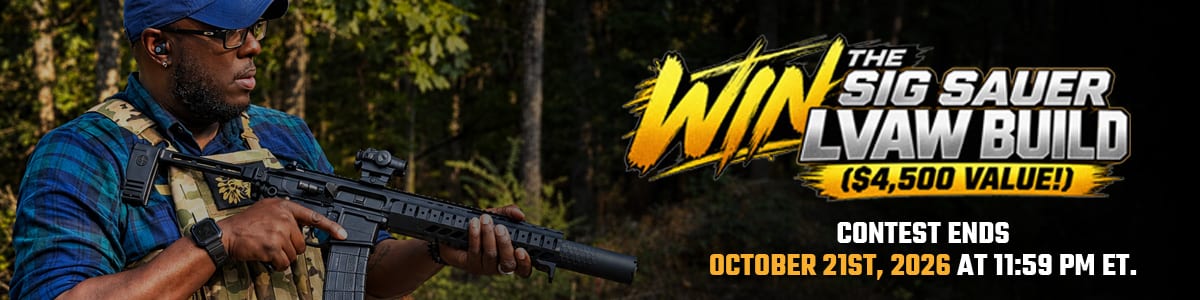
In the closing portion, the host explains how viewers can participate in ClassicFirearms.com giveaways, noting that roughly one firearm is given away each week. Visitors are directed to the homepage banner to enter for the current featured rifle. The discussion returns to the Franklin Armory 10/22 binary trigger, clarifying that it is not yet in stock but listed as coming soon. To avoid missing out, viewers are encouraged to use the site’s “notify me” email feature, which sends an alert as soon as the product becomes available. The host also points out that the site carries a wide range of .22 options, from training‑oriented platforms to fun plinkers and competition guns, reinforcing .22LR’s versatility. The video wraps up by inviting viewers to continue the conversation about .22LR’s effectiveness and favorite .22 setups in the comments, and signs off with a reminder to visit ClassicFirearms.com for products, updates, and future giveaways.



















 Loading...