The discussion centers on the Q Honey Badger pistol chambered in .300 Blackout. The hosts note that the platform was designed by Kevin Brittingham at Q, who had a role in the development of the .300 Blackout cartridge. The focus is on a compact, low-visibility firearm built specifically around this caliber. The featured configuration uses a 7-inch barrel and is intended as a lightweight, easily suppressed pistol. The conversation frames the Honey Badger as a purpose-built .300 Blackout system rather than a generic AR-pattern gun adapted to the round.
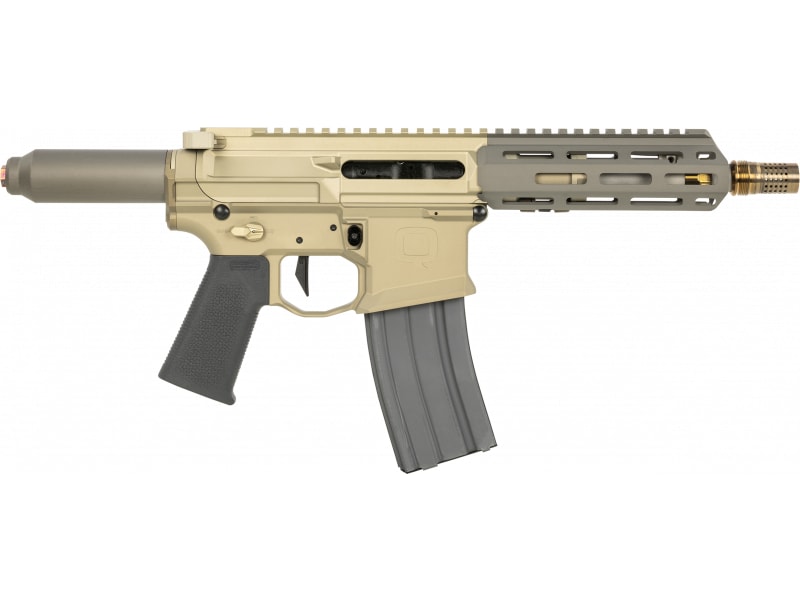
Attention turns to the Cherry Bomb muzzle device, which is closely associated with Q. The hosts explain that both the barrel and muzzle device use a taper system to improve concentricity when mounting a suppressor. This taper helps maintain alignment, reduces the likelihood of carbon seizing between the suppressor and muzzle device, and keeps the mounting surfaces cleaner, which is important on a direct impingement system that experiences added back pressure when suppressed. The overall setup is described as clearly engineered with suppression in mind from the outset, rather than suppression being an afterthought.
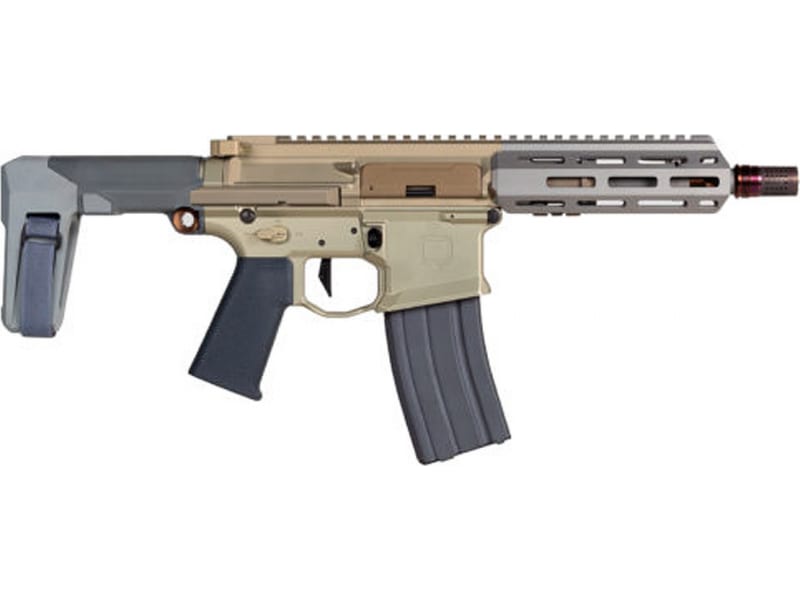
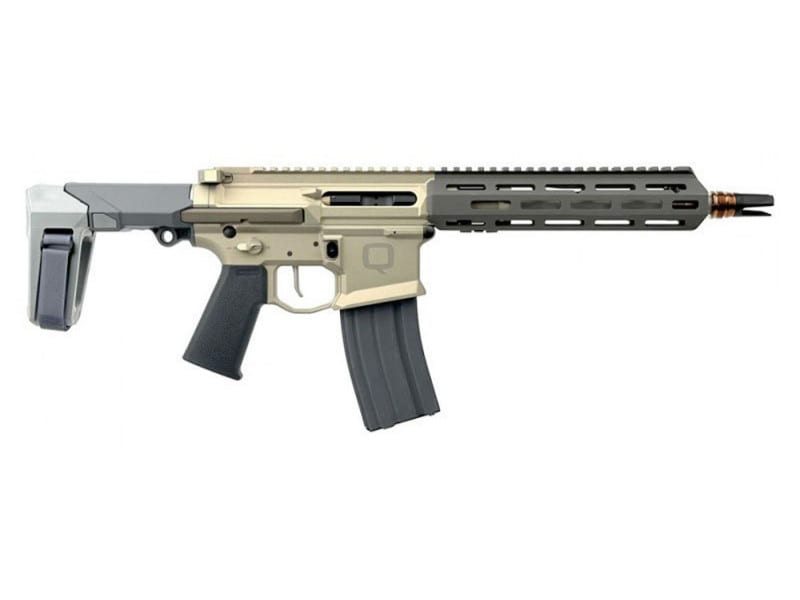
The upper features a full-length Picatinny rail for mounting optics suitable for a .300 Blackout pistol, along with M-LOK slots on the sides and bottom for attaching lights, lasers, and other accessories. The charging handle is ambidextrous and described as very smooth in operation. It is a reduced-signature charging handle developed in conjunction with Radian and Q. The hosts also highlight the bolt release, which sits nearly flush with the receiver. This low-profile design supports the Honey Badger’s low-snag, low-visibility intent by reducing the chance of accidental activation or snagging on gear.
Internally, the pistol uses a Geissele SD3G trigger. The hosts emphasize that it is not aimed at beginners, but it offers a very crisp break with minimal take-up and a short, audible reset suited to fast follow-up shots. The flared magwell is designed to make magazine insertion easier and more forgiving, effectively guiding the magazine into place. The safety selector is ambidextrous and was developed jointly by Radian and Q. It uses a 70-degree throw, chosen as a balance between speed and safety, offering a shorter movement than a traditional 90-degree selector while avoiding the potential margin of error associated with a 45-degree throw.
The pistol is equipped with a Magpul K grip, which has comfortable texturing on the sides and more horizontal-style texturing on the front and back. The grip is intended to remain comfortable during extended firing, even in hot conditions. At the rear, the Honey Badger uses Q’s proprietary brace and buffer system. The brace incorporates a two-piece captured spring assembly that supports the operating system of the platform. It offers two positions, fully closed and fully extended, which the hosts describe as sufficient for a compact, low-visibility firearm that may be used suppressed. A QD sling mount is located underneath the stock area for sling attachment.
The hosts comment on the mixed gray and tan coloration of the receiver and furniture. They explain that this appearance results from the raw anodizing process on aluminum, producing a natural golden tone and varied hues, so no two Honey Badgers look exactly the same. The barrel uses a 1:5 twist rate, chosen to stabilize a wide range of .300 Blackout subsonic loads. This fast twist is intended to keep rounds stable and maintain good accuracy, with the hosts referencing previous testing on the main channel comparing Q and SIG rifles. The configuration discussed is a 7-inch .300 Blackout pistol optimized for subsonic use and consistent downrange performance.
In closing, the hosts describe the Q Honey Badger as a 7-inch .300 Blackout pistol that stands out for its engineering and purpose-built design around the cartridge. They note that further range testing and comparison with other platforms would be needed to determine how it ranks overall, but they view Kevin Brittingham’s involvement in the cartridge and firearm as a point of confidence. The unloaded weight is mentioned at approximately 4.8 pounds, contributing to its lightweight, low-visibility role. Viewers with experience using the Q Honey Badger are encouraged to share their impressions and reviews of the platform.



















 Loading...