The video opens with a detailed introduction to the Sons of Liberty Gun Works MK1, recently selected as SOCOM’s new rifle, and the controversy that decision sparked online. The hosts clarify that SOCOM actually has two different guns: one for the main rifle contract and another for a high-capacity “high car” program. Their sample mirrors the SOCOM-issue configuration but substitutes a chrome-lined barrel for the contract’s stainless barrel, while retaining an NP3-coated bolt carrier group. Classic Firearms stresses that the rifle was purchased from SOLGW for independent evaluation, not provided as a sponsored sample. The package being tested includes a HUXWRX Flow 556K suppressor and MODTAC components, specifically a suppressor shield and Shadow Eliminator light bar. The hosts lay out a plan to test SOLGW’s proprietary heat-reduction claims by using an infrared thermometer to compare barrel, barrel nut, gas block, and rail temperatures against a Geissele URGI-style rifle after sustained firing strings.
The first structured test focuses on a Geissele-based URGI-style rifle as a baseline for heat buildup. After firing four magazines in steady strings, the hosts use an infrared thermometer to capture temperatures at key points. Around the gas block, readings climb close to 300°F, illustrating how quickly heat migrates forward under moderate firing. The rail section over the gas block exceeds 350°F, underscoring how uncomfortable bare-hand contact becomes without gloves or rail covers. The HUXWRX Flow 556K suppressor mounted on this setup shows extreme heat, with readings around 600°F at the base and the thermometer pegging at its “high” limit near the muzzle end, indicating temperatures beyond the device’s range. They also note barrel and barrel nut temperatures rising rapidly, setting a clear benchmark for comparison before moving on to the SOLGW MK1’s proprietary rail and heat-management design.
Attention shifts to the SOLGW MK1, configured with an 11.5-inch barrel compared to the Geissele’s 10.3-inch. After running four magazines through the MK1 in a similar fashion, the hosts again probe temperatures with the infrared thermometer. The gas block area on the MK1 reads around 188°F, noticeably cooler than the Geissele’s near-300°F result, suggesting some benefit from the MK1’s design and slightly longer barrel. However, the rail over the gas block still reaches the mid-300°F range, confirming that even improved setups become too hot to comfortably grip under sustained fire. The barrel nut remains cooler than the forward rail but continues to climb as heat soaks back into the receiver area. The HUXWRX Flow 556K suppressor again drives the thermometer to its upper limit, reinforcing that cans get extremely hot regardless of host rifle. The hosts conclude that gloves, rail inserts, or shields are essential for realistic firing schedules and segue into praising the MK1’s overall build quality and features.
The discussion moves from raw temperature numbers to the SOLGW MK1’s construction and handling. The rifle’s proprietary rail is highlighted for its exceptionally solid lockup to the upper receiver, which helps explain why SOCOM selected it. The rail features aggressive, built-in texturing that improves grip even when hands are sweaty or gloved, and its interface with the receiver is designed to resist flex and maintain zero for mounted accessories. The hosts emphasize that, despite the military contract prestige, the MK1 is still fundamentally an AR-15, comparable in performance to other well-configured rifles using the A5 buffer system. They note the inclusion of an NP3-coated BCG, an enhanced bolt release, and SOLGW’s A5-style receiver extension as strong value adds. Recoil can be tuned further by swapping to different springs, such as Sprinco or Geissele options, and by moving from the included T2 buffer to heavier H3 or T3 weights, especially for suppressed use, to create an even softer, flatter shooting impulse.
Cost and configuration tradeoffs become the focus as the hosts compare the roughly $2,899 price tag of the SOLGW MK1 to custom builds. They describe a hodgepodge rifle using a Sons of Liberty A5 buffer tube, a Vltor H3 buffer, a HUXWRX suppressor, and an NP3-coated BCG, paired with a URGI-style Geissele upper and a Griffin ambi lower. That setup, combined with a MODTAC suppressor shield, comes in under $2,000 while delivering similar recoil characteristics and reliability. The A5 system itself is explained as essentially a rifle-length buffer tube and spring adapted to carbine-length stocks, typically using heavier buffers. This configuration is praised for providing a consistent, soft recoil impulse both suppressed and unsuppressed, and for reducing bolt bounce. The hosts also address criticism that the MK1 lacks full ambidextrous controls, noting that many professional users actually prefer simpler, non-fully-ambi lowers for durability and familiarity, and that the MK1’s core performance matters more than ambi features.
The video revisits the A5 buffer system to clarify why it has become a preferred choice on hard-use rifles. By combining a longer, rifle-style spring with a specially sized buffer and carbine-compatible tube, the A5 setup smooths out the recoil cycle, improves reliability across different ammunition types, and mitigates bolt bounce during rapid fire. This makes it particularly attractive for suppressed configurations like the MK1 with the HUXWRX Flow 5.56K. The focus then shifts to the MODTAC suppressor shield mounted around the can. Described as a high-temperature resin shroud, the shield protects gear, clothing, and the shooter from direct contact with the extremely hot suppressor body. It also serves as an IR and thermal signature deflection device, helping manage visual and thermal mirage. The shield attaches via a coupler that can be quickly unscrewed for removal, allowing access to the HUXWRX suppressor inside without tools and supporting rapid configuration changes in the field.
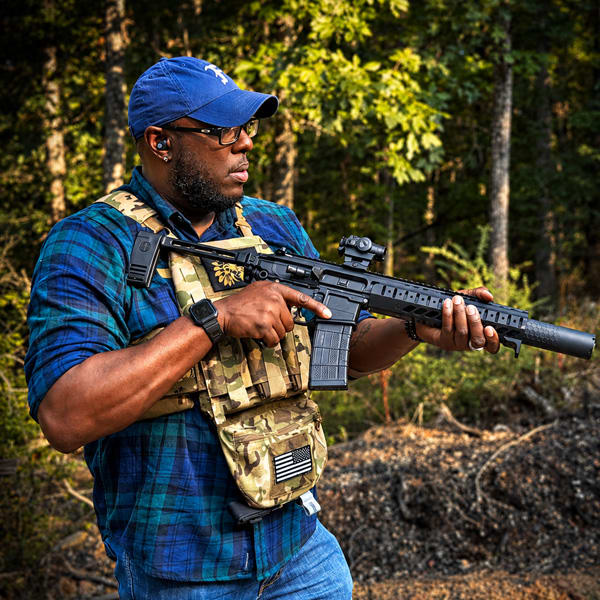
The hosts introduce the unreleased MODTAC MAX suppressor shield, a thicker-walled evolution of the original design that further improves external heat mitigation while still allowing airflow around the HUXWRX Flow 556K. They jokingly describe the combination as a tactical burrito, with the can wrapped inside the ventilated shell. The MAX shield significantly reduces mirage compared to traditional fabric suppressor wraps, which tend to trap heat and cool more slowly. Mounted alongside it is a SureFire Turbo Pro series weapon light attached via the MODTAC Shadow Eliminator light bar. This bar interfaces with M-LOK slots and pushes the light outward to clear the shield, while remaining compatible with SureFire Pro and Scout-style mounts. The Sons of Liberty handguard is praised for its integral texture, and the hosts recommend adding rail inserts or panels to further insulate the support hand from heat. A Magpul QD sling mount anchors an Edgar Sherman Design padded sling, noted for its efficient tensioning and cinching system.
Optics and ergonomics take center stage as the rifle’s sighting system is detailed. The primary optic is an EOTech EXPS2-2 mounted on a Unity riser, yielding a 2.26-inch height-over-bore that promotes a more upright, heads-up shooting posture. Behind it sits an EOTech G33 magnifier on a Unity FTC (flip-to-center) mount, which allows the magnifier to tuck down in line with the bore instead of swinging off to the side. This configuration keeps the rifle slimmer and reduces snag points when slung or moving through tight spaces. The hosts note that even optics without dedicated night-vision buttons can be used effectively with NODs when paired with the right riser height. They also touch on the pistol configuration of the MK1, explaining that it can be converted to an SBR where state law permits. The Edgar Sherman Design sling, combined with the QD mount placement, supports rapid adjustment between tight retention and loose, maneuverable carry.
The final segment emphasizes why many shooters have migrated to 2.26-inch optic heights and FTC-style magnifier mounts. By tucking the magnifier directly under the reticle line instead of offsetting it, side-mounted weight is reduced and the rifle remains more balanced around the bore, improving transitions and minimizing snag hazards when slinging the gun across the body. Unity-style risers and mounts are credited with popularizing this approach. The SOLGW MK1 AR-15 pistol is characterized as a soft-shooting, well-configured rifle whose standout features are its proprietary rail that locks solidly to the upper and its unique texturing; most other components can be replicated in a thoughtful custom build. The hosts express enthusiasm for the High CAR program, suggesting it could help AR-15 platforms remain competitive against the Army’s NGSW program. The video closes by announcing the giveaway code word “father,” tying it to Father’s Day and July 4th, and thanking viewers for watching.



















 Loading...