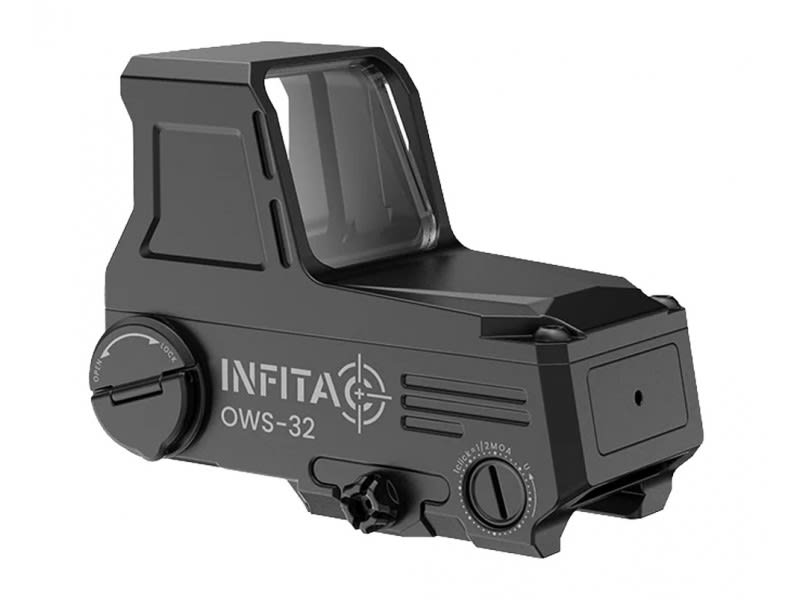
The video opens with an introduction to the INFITAC OWS-32, described as a new kind of red dot that is neither a traditional reflex sight nor a holographic optic. Instead of a standard LED reflected off a coated lens, the OWS-32 uses waveguide technology, likened to a miniaturized overhead projector that pushes light through a small aperture and expands it across the viewing window. This is contrasted with holographic sights, which rely on multiple internal mirrors and an etched reticle. The OWS-32 is confirmed as a closed-emitter design and visually resembles an EOTech-style windowed optic. Expected pricing is mentioned in the roughly $400–$500 range, though not final. The sight ships with two 16340 rechargeable lithium-ion batteries, but runtime is rated at about 1500 hours on a CR123A cell. Feature highlights include shake-awake functionality, 20 daylight brightness settings, and a dedicated night vision button, positioning the OWS-32 as a technologically distinct option in the red dot market.
The discussion moves into the INFITAC OWS-32’s control scheme and viewing characteristics. The optic offers 20 daylight brightness levels and 10 dedicated night vision settings, with a hot button that jumps directly into NV mode. Auto-brightness is available for both day and night, allowing the sight to adjust intensity based on ambient conditions. The unit is rated IP67 waterproof, adding environmental robustness. Window size is compared to an EOTech, with the OWS-32 having a slightly taller and marginally wider window that increases perceived field of view. Seven reticle options are detailed, built around a roughly 2–2.5 MOA center dot, a 65 MOA outer ring, and crosshair elements. Combinations are tailored for different roles, such as using the outer ring for shotgun patterning or the center dot for precise rifle work. Edge-to-edge clarity is reported as good, with minimal distortion attributed to the waveguide system, and the manufacturer makes a bold claim that the optic is parallax free across the window.
Attention turns to real-world optical behavior of the OWS-32. The presenters reiterate that edge warping is minimal and again note the manufacturer’s strong parallax-free claim, while implying that such claims are often optimistic in practice. Concern is raised about the slanted front glass, which appears somewhat exposed and prompts a desire for a protective shroud to guard against impacts. The dual-pane glass construction can create occasional reflections, such as catching glimpses of clothing or fingers in the window under certain angles. A key observation is a noticeable refresh rate flicker at lower brightness settings, visible across all reticle configurations. This flicker makes the reticle appear to pulse or strobe slightly. Increasing brightness significantly reduces or nearly eliminates the effect, making the reticle appear stable and constant. These observations frame the OWS-32 as optically promising but with quirks that users may need to manage through brightness selection and potential accessory protection.
The scene shifts to the range to evaluate the INFITAC OWS-32 under live fire. The optic is mounted and sighted in, with groups fired to confirm an initial zero and check for consistency. The shooters emphasize verifying that the sight holds zero through repeated strings rather than relying on a single group. They outline a plan of drills designed to stress the optic and the shooter’s understanding of it, including Clint Smith–style offset headshot drills at various clock positions around a target and movement-based exercises. These drills are intended to reveal how well the reticle supports rapid target acquisition, how mechanical offset presents at close distances, and whether the optic maintains zero under realistic firing sequences. The focus is on practical performance rather than extreme torture tests, setting up the later segments where offset, reticle choice, and field of view are explored in more detail with the OWS-32 in dynamic use.
Mechanical offset training becomes the focus as the shooters run a clock-position drill with the OWS-32. Targets are engaged at 12, 3, 6, and 9 o’clock positions to illustrate how point of aim and point of impact diverge at close range due to optic height over bore. After firing, hits are evaluated on the target, showing impacts landing above or below the intended aiming points depending on distance and hold. The explanation ties these results back to common 50- or 100-yard zeros, clarifying why close-range shots often require a deliberate holdover or holdunder. The CAT 5.56 K Cam suppressor on the 11-inch 5.56 rifle is briefly highlighted for noticeably softening the sharp report, making the training more comfortable. High round count up drills from low and high ready are then run using the OWS-32 with a single dot reticle, allowing analysis of vertical stringing, A-zone hit consistency, and how the optic’s presentation supports rapid, repeatable sight pictures under recoil.
The testing progresses as the shooters switch the INFITAC OWS-32 from a single dot to the full reticle configuration, combining the 65 MOA ring, 2.5 MOA center dot, and side crosshairs. This setup is used to further explore mechanical offset on IPSC target squares, especially under conditions that maximize potential reflections in the window. Quick up drills are run to see how rapidly the eye picks up the segmented outer circle and how easily the center dot can be driven onto target. The shooters comment that the dot is easy to track through recoil and that the large ring aids fast acquisition on close targets. The OWS-32’s open window and slightly larger viewing area are contrasted with the more shrouded feel of an EOTech, with the waveguide sight offering a less constricted field of view. These impressions suggest the reticle design and window geometry work together to support speed-focused shooting while still allowing precise aiming.
Further up-drills on an IPSC target lead into a discussion of technique for managing a short-barreled rifle. Emphasis is placed on using the support hand to pull the gun firmly into the shoulder pocket, preventing a pendulum-like swing and helping maintain a stable sight picture with the OWS-32. The optic’s reticle remains easy to follow during rapid strings, reinforcing earlier comments about trackability. The stated operating temperature range of the INFITAC OWS-32 is covered, from -22°F to 140°F, raising questions about potential thermal drift and how the sight might behave in extreme cold or heat. A quick zero confirmation is performed after the drills, verifying that the “Rift Combat Zero” has held despite the high round count session. The hosts note that while initial results are promising, more extensive durability and environmental testing will be needed to fully validate the optic’s ability to maintain zero and performance over time.
The closing segment outlines plans for long-term, realistic durability testing of the INFITAC OWS-32. Instead of dramatic stunts like dropping the optic from a moving truck, the intention is to use it as typical owners would: tossing it into bags, running classes, and exposing it to regular bumps and environmental changes. This approach aims to reveal how the waveguide system and electronics hold up over months of use. The optic is then mounted behind a magnifier to check compatibility and image quality under magnification. The view through the magnifier is described as decent, with the reticle remaining clearly visible and functional, suggesting the OWS-32 can work in a magnified setup. Interest is expressed in future testing under night vision, using nods to evaluate the dedicated NV modes in real conditions. The video concludes with the assessment that the OWS-32 appears promising and technically interesting, with more time needed to fully judge its longevity and reliability.





















 Loading...