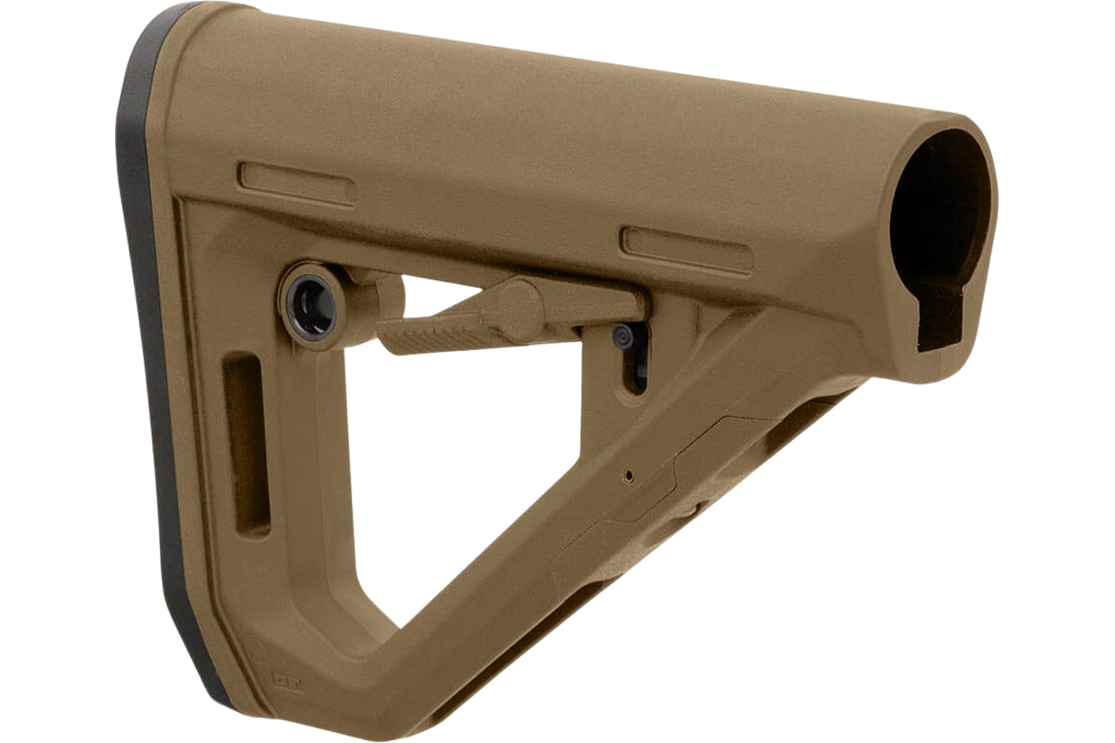
This is the Magpul DT stock, one of Magpul's newer designs with a couple of different variants. Brandon from Classic Firearms introduces the product and explains that the DT is an AR-15 carbine stock that mounts on a standard buffer tube. It uses an adjustment button so the stock can slide along the tube for length-of-pull changes. The video will cover why someone who already owns a CTR stock might still want the DT, along with its technical details and practical benefits.
The DT is designed for AR-15 platforms and installs on the buffer tube like other carbine stocks. It features an adjustment button that allows the user to move it along the tube. Compared to the CTR, the DT is a dual-tension version, while the CTR is thinner and uses a locking feature as its main advantage. The DT adds a flatter bottom surface so it can slide more smoothly over a rear bag without catching or snagging, letting it float into position. It has a thicker overall profile, adding a bit of weight but still remaining relatively light at about 9.8 ounces. The stock includes a rubber buttpad and retains familiar Magpul touches such as compatibility with cheek risers, ambidextrous QD sling points, and a sling tie-in point. The buttpad can be swapped by removing the screws if the user wants a different style.
Brandon addresses viewers who already own a CTR and wonder why they might want the DT. The CTR is slimmer and uses a dedicated locking mechanism, which is its biggest benefit, but it can still move slightly even when locked. The DT, by contrast, is built as a dual-tension design that clamps more firmly to the buffer tube to reduce wobble. It has more material and a bit more girth, giving it a sturdier feel and a flatter underside that works better on bags. While slightly heavier than the CTR, it is not considered a heavy stock overall and is intended as a more modern, refined option with improved handling and bag use.
The DT's flatter bottom surface is highlighted as a key improvement for shooters who use rear bags. Instead of catching or snagging, the stock glides more freely over the bag and settles where the shooter wants it. The added thickness gives the shooter more to grab onto without making the stock bulky. At roughly 9.8 ounces, it strikes a balance between sturdiness and light weight. Magpul's usual features are present: the ability to add a cheek riser, ambidextrous QD sling sockets, and a sling tie-in point. The rubber buttpad provides a secure shoulder interface and can be removed and replaced by unscrewing the mounting screws.
Brandon demonstrates installing his personal DT stock on his own rifle. To mount it, the user presses the adjustment button and then pulls down an internal lever slightly farther than the normal button travel. There is a small hole in the mechanism where an Allen key can be inserted to pull the lever down more easily. Once the lever is pulled down past its usual range, the stock slides onto the buffer tube. After it is on the tube, the user releases the lever and the stock locks into place. From there, it adjusts smoothly along the tube using the standard adjustment button.
On Brandon's rifle, the DT is installed on an extended buffer tube, so the stock does not sit fully flush when collapsed. He notes that on a standard AR-15 buffer tube, the DT will sit flush at the rear. He shows a Magpul DTPR stock on a standard AR buffer tube as an example of how the DT would also sit when fully collapsed on a non-extended tube. This difference matters for shooters who want the stock to collapse completely flush. Brandon points this out so viewers understand how the DT will behave on different buffer tube lengths and can choose the setup that best fits their preferences.






















 Loading...