Memorial Day Tribute and Beretta M9 Sidearm
The video opens with a Memorial Day message focused on honoring those who made the ultimate sacrifice in U.S. military service. Arlington National Cemetery is referenced as a powerful symbol of remembrance, and respect is extended to current service members as well. After this tribute, the host introduces a personal top five list of U.S. military firearms, noting that issued weapons are evolving and that future changes are expected. The countdown begins with number five, the Beretta M9, a 9mm service pistol with a mixed reputation among troops. Drawing on Marine Reserve experience, the M9 is described as reliable and effective when properly maintained. Its evolution from the 92FS through the M9A1, M9A2, and M9A3 is outlined, highlighting 15- to 17-round magazines, raised night sights, a threaded barrel for suppressors, a slimmer grip, and an accessory rail that can mount lights like the SureFire X300. Other notable sidearms such as the Colt 1873, 1911, Sig P226, Glock, and Sig M17/M18 are briefly acknowledged before moving on.
Benelli M4 Combat Shotgun in Close Quarters
The list continues with number four, represented by a Panzer M4 clone of the Benelli M4, a semi-automatic shotgun optimized for close-quarters combat. The video contrasts the fixed stock on the clone with the issued two-position collapsible stock, emphasizing how the collapsible design aids transport and maneuvering in vehicles compared to longer rifles like the M16A4. The Benelli M4 is praised for its dual gas piston system, which keeps the action relatively clean and contributes to excellent reliability under harsh conditions. Recoil is described as manageable for a 12-gauge, allowing rapid follow-up shots. Once a shooter understands how a semi-automatic shotgun behaves, it becomes possible to fire a full five-round magazine extremely quickly while maintaining control. This combination of reliability, compactness with the collapsible stock, and fast, hard-hitting fire makes the M4-style shotgun a standout choice for close-quarters military roles and earns it a place on the top five list.
M1 Garand and M14: Classic U.S. Battle Rifles
Attention shifts to the M1 Garand, chambered in .30-06, often cited using General George Patton’s famous praise as the greatest battle implement ever devised. The rifle’s distinctive en bloc clip system and the iconic sound it makes when ejecting are highlighted as defining characteristics. Viewers are cautioned not to use modern high-pressure .30-06 hunting loads in the M1 Garand, since excessive pressure can damage the operating rod and other components. The rifle’s long combat history, from World War II through later conflicts, is noted, along with its continued limited service and ceremonial presence. The discussion then contrasts the Garand with the M14, which uses a short-stroke gas piston, detachable 20-round magazines, and the 7.62 NATO (.308) cartridge. Although the M14 had a relatively short tenure as the standard-issue rifle, it has enjoyed a long service life in designated marksman and other roles. The M14 remains visible in ceremonial duties on Navy ships and in color guards, underscoring its enduring legacy alongside the Garand.
Browning M2 .50 BMG: Ma Deuce and Air Power
The video introduces the .50 BMG cartridge and the Browning M2 machine gun, widely known as Ma Deuce, as another top U.S. military firearm. Designed around the end of World War I and derived from the Browning 1919 lineage, the M2 has remained in continuous service for over a century. It is belt-fed and features a distinctive butterfly trigger at the rear of the receiver, allowing the gunner to fire with both thumbs while gripping the spade handles. The immense power of the .50 BMG round is emphasized, making the M2 effective against personnel, vehicles, and light fortifications. Historical footage and references highlight the M2’s critical role in World War II, particularly on aircraft such as the F4U Corsair, which carried six .50 caliber machine guns in its wings. Other period aircraft and calibers are mentioned to show how dominant the .50 BMG was in aerial and ground combat. The segment closes by crediting John Moses Browning’s engineering genius for creating such a durable and influential weapon system.
From M16 Adoption to Modern Flat-Top Rifles
The focus moves to the adoption of the M16 rifle in the mid-1960s as a lighter alternative to the 7.62 NATO M14. Chambered in 5.56/.223, the M16 allowed soldiers in Vietnam-era jungle warfare to carry more ammunition while reducing overall load weight. The video traces the rifle’s evolution from the original M16 and M16E1 through the M16A1, A2, A3, and A4, noting changes in pistol grips, controls, and especially the transition to flat-top receivers. The CAR-15/Colt Commando is highlighted as an early short-barreled variant with a two-position collapsible stock that preserved a similar length of pull to the 20-inch fixed-stock rifle. Modern developments such as the M4 and Mk18-style carbines are shown with full-length Picatinny rails on their flat-top uppers, replacing the old fixed carry handle. These rails enable flexible mounting of optics, lights, and other accessories. The segment underscores that reliability issues associated with early M16A1 rifles have been largely resolved, making current M16/M4 platforms highly dependable.
Mk18 as Go-To Rifle and Top Five Recap
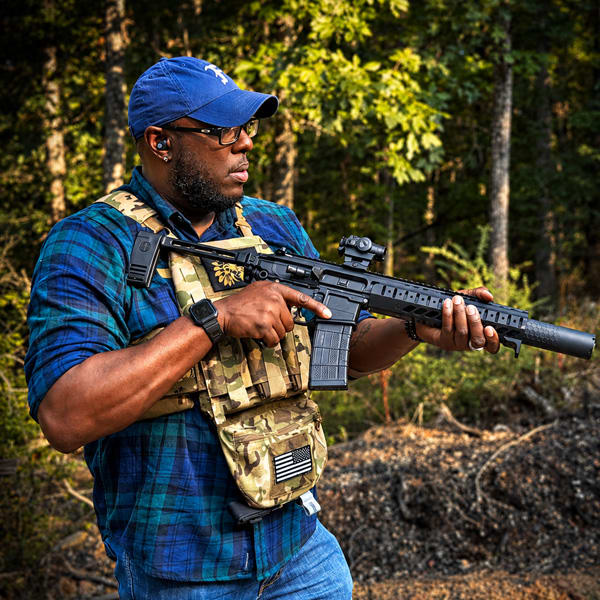
Building on the discussion of modern AR-platform rifles, the video explains how the flat-top upper on current M16 and M4 variants provides a continuous Picatinny rail. This design allows users to position optics, backup sights, and accessories exactly where needed, greatly improving ergonomics and adaptability compared to the original carry-handle configuration. The reliability of the platform since the M16A1 era is emphasized, with modern carbines considered trustworthy for high-risk or uncertain situations. The Daniel Defense Mk18, a compact, short-barreled rifle patterned after military Mk18 carbines, is identified as the primary go-to rifle for such scenarios due to its balance of size, handling, and performance. The video concludes by recapping the top five list, including the Beretta M9, Benelli M4-style shotgun, M1 Garand, Browning M2, and M16/M4 family. Brief mentions of influential designs like the 1911 and M14 acknowledge their importance, and viewers are invited to comment on which firearms they would add or remove from the ranking.




















 Loading...