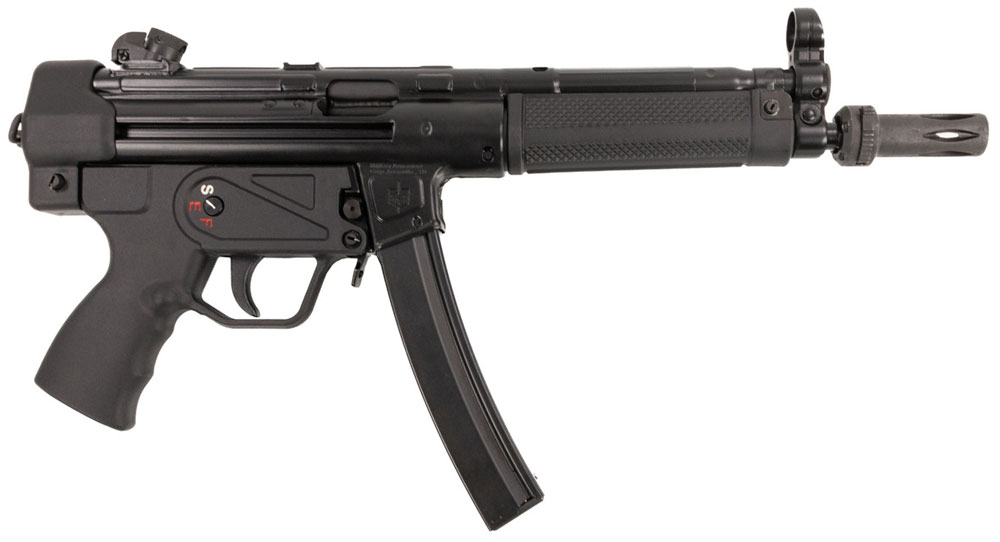
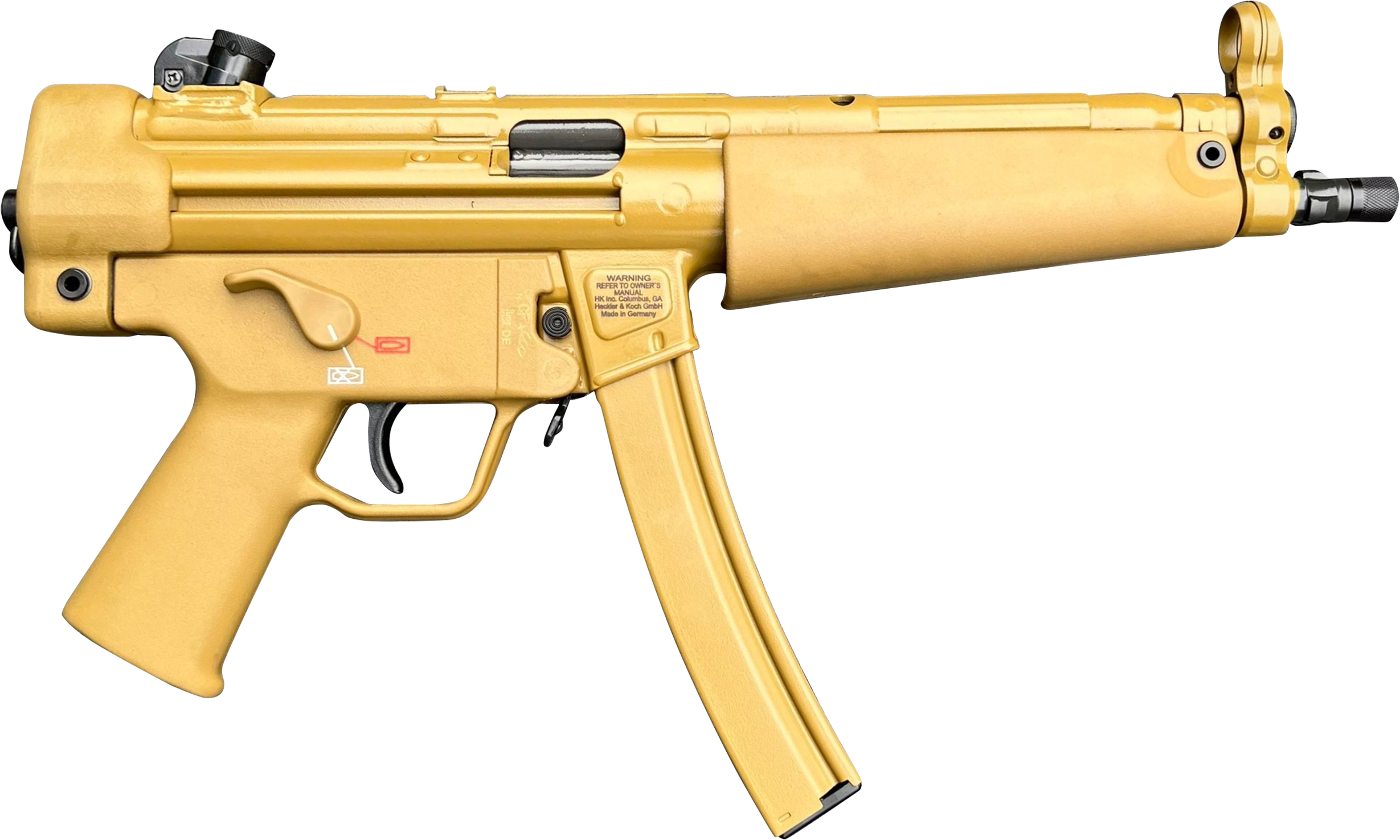
The video opens with a comparison between a $3,500 HK MP5 and a $1,000 Mac 5 clone. The hosts describe the MP5 platform as one of the most widely copied firearms, alongside the 1911, and emphasize its roller-delayed blowback system derived from the G3. They reference an HK G3 chambered in 7.62x51 (.308) developed in the 1950s, which led to 5.56 and 7.62x39 variants and eventually the 9mm MP5. The MP5 has been in service since the 1960s and has seen extensive use in conflicts and protective details. It is noted as a long-standing choice for protective security details and police departments, including continued use by the British Metropolitan Police Service.
The discussion shifts to the difference between an original HK MP5 and a Turkish-made clone, the Mac 5. The Mac 5 is positioned as a roughly $1,000 option before adding accessories or chassis systems. The hosts acknowledge that some products from Turkey can be inconsistent, but highlight that Turkish manufacturers have long experience with HK-pattern rifles and carbines. The Turkish military and law enforcement have used the G3, HK33, and MP5 since at least the 1970s, and Turkish police and military are still commonly seen with MP5s. They explain that the Turkish government has HK tooling to supply its own forces, resulting in one-to-one pattern guns that track closely with the original design. The plan is to test how the Mac 5 feels and functions against the HK on the range.
Before shooting, the hosts outline how each gun is configured. The Mac 5 is set up as a more budget-conscious build with a Sig Sauer Romeo5 Elite red dot optic featuring a multi-reticle system and a price under about $250. It wears a UTG Pro monolithic rail to provide extra space for accessories such as lights, and it is fitted with a Magpul stock. The HK SP5, described as needing no introduction, is equipped with an Aimpoint Micro T-2 optic on a Scalarworks mount. The mount is noted as an expensive, non-clamp style design. The SP5 shown is a personally owned SBR. Both guns are in SBR-style configurations and use similar stocks, allowing for a closer apples-to-apples comparison in terms of handling and recoil, even though the accessories and rails differ in weight and feel.
At the range, the hosts explain loading and handling details specific to MP5-pattern firearms. With the HK SP5, they demonstrate inserting a magazine on a closed bolt and note that a fully loaded magazine may not seat reliably unless the bolt is locked to the rear. They emphasize the importance of firmly seating the magazine and show the classic HK slap to release the bolt. They point out that MP5s do not have a last-round bolt hold-open, so the bolt stays forward when the gun runs dry, leading to a click instead of a bang. If the magazine is not fully inserted during a reload, the shooter may get repeated clicks even after charging the gun. The segment serves as a brief instructional moment on proper magazine insertion, bolt manipulation, and reload technique for roller-delayed 9mm platforms.
The HK SP5 is fired first at about 40 yards, and the shooter comments on how softly it shoots. After the last round, the bolt is manually locked to the rear, the magazine is removed, and a fresh magazine is inserted to demonstrate a reload. When the Mac 5 is fired, a malfunction occurs, which the shooter clears. They note that this is unusual based on prior experience with the gun. Despite the stoppage, the ejection pattern from the Mac 5 is described as good. The hosts then swap rifles so each can experience the other setup. One notes that the Mac 5 is not fully sighted in and is hitting a bit low, but focuses on the overall feel rather than precise point of impact. Early impressions suggest that, despite the price difference, both guns are very similar in manual of arms and general shootability.
After shooting both configurations, one host remarks that the Mac 5 actually feels like it has a better recoil impulse and recoils less into the shoulder than the HK SP5. The Mac 5 is running a Dead Air Wolfman suppressor, which is praised for being very quiet. The HK is using a different, shorter suppressor. The hosts speculate that the difference in felt recoil may be influenced by the suppressor, the heavier rail system on the HK, and the difference between the authentic HK stock and the lighter Magpul stock on the Mac 5. To isolate variables, they decide to swap suppressors between the two guns, taking advantage of the tri-lug mounting system. The goal is to determine whether the smoother feel is due to the can, the gun itself, or a combination of both.
With the suppressors swapped, they note that the HK setup sounds louder, and they attribute this in part to the ammunition going supersonic. They emphasize that they are shooting supersonic 9mm, not dedicated subsonic loads, which affects perceived noise levels. The Mac 5 is then fired with the suppressor that was originally on the HK, and the shooter again comments on a distinct, softer thud in the shoulder and a smoother bolt feel. The Wolfman suppressor is described as noticeably quieter. One of the hosts stretches the Mac 5 out to 100 yards, observing that some rounds seem to ride the line between supersonic and subsonic behavior. Throughout this segment, they focus on sound characteristics, recoil sensation, and how the suppressors and ammo interact on each platform rather than on tight group sizes.
In closing, the hosts revisit the value discussion between the roughly $3,000 HK SP5 and the approximately $1,000 Mac 5. The Mac 5 is described as difficult to fault at its price point, especially given how many companies have refined MP5-pattern clones over the years. They credit Turkish manufacturing experience with G3s, HK33s, and MP5s, noting that Turkish factories use HK tooling and work with HK to supply their military and law enforcement. One host reiterates that the difference in felt recoil between the two guns is minor and amounts to splitting hairs, even though the Mac 5 feels slightly softer and smoother to the shoulder. The HK SP5 still appeals to those who want the original name and heritage, but for someone simply wanting an MP5-style 9mm platform, the Mac 5 is presented as a compelling, cost-effective alternative.





















 Loading...