The video opens on the CF Clips channel with Brandon introducing Ryan, who helped set up the channel and now presents one of his favorite manufacturers, Sons of Liberty Gun Works. Ryan explains the historical roots of the name “Sons of Liberty,” referencing the 1765 paramilitary group that resisted British rule and taxation, and notes how the modern company embraces that legacy of resistance and individual liberty. The focus then shifts to the Sons of Liberty Gun Works Mark1, described as a modern evolution of the AR-15 platform that has been adopted by high-end SOCOM units, underscoring its credibility with elite military users. Moving to the front of the gun, they highlight the Hux Works QD flash hider used as the muzzle device. It ships with the pistol as a suppressor host for cans like the Hux Works Flow 5.56K, though no suppressor is included. The discussion introduces HUB and Hub 2.0 adapter systems and Hux Works’ own QD interface, emphasizing that these mounting standards allow broad suppressor compatibility without locking the owner into a single brand or ecosystem.
The hosts expand on the suppressor mounting system, explaining how a HuxWrx-style threading system and the Hub Adapter 2.0 can bridge hub-pattern suppressors to the QD flash hider. This approach lets shooters run a variety of cans, not just HuxWrx models, while retaining the quick-detach convenience. Attention then turns to the Sons of Liberty 10.75-inch handguard, which intentionally leaves about 0.75 inches of exposed barrel. That small section of barrel acts as an ideal standoff for QD suppressors, preventing the handguard from interfering with mounting while still maximizing usable rail length. They note that this balance between coverage and clearance is deliberate, giving shooters more real estate for support-hand placement and accessories without compromising suppressor fitment. The segment underscores how the front-end design, from the flash hider to the handguard length, is tuned for serious suppressor use and practical handling rather than just aesthetics.
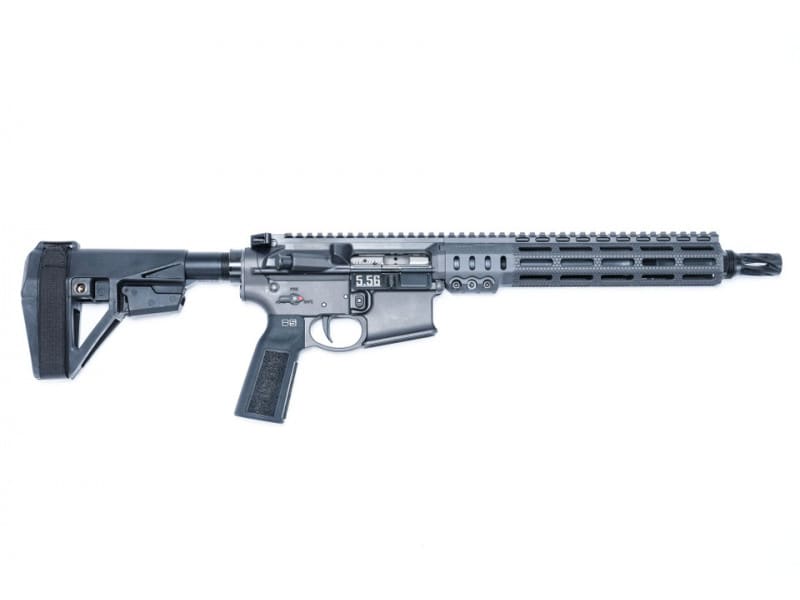
The video dives deeper into the MK1’s handguard and barrel. The 10.75-inch rail uses an evolved L89 lockup system with opposing screw directions that clamp the handguard securely to the barrel nut, creating a very rigid interface. Side venting around the barrel nut helps shed heat, improving cooling during sustained fire. The barrel is an 11.5-inch 5.56 NATO medium-contour profile with a 1:7 twist and three-groove polygonal P3 rifling, a setup the hosts plan to accuracy-test further. The handguard’s exterior features laser-stippled hexagon texturing, providing aggressive grip without needing a vertical foregrip. Integrated channels along the top of the rail serve dual roles: they act as cable management tracks for routing pressure switch wires with zip ties, and they also function as additional cooling vents around the gas tube area. Later, the hosts reiterate that this L89/Mark1 lockup is proprietary, meaning the upper and handguard are designed as a matched system and are not intended to be separated or mixed with other rail designs.
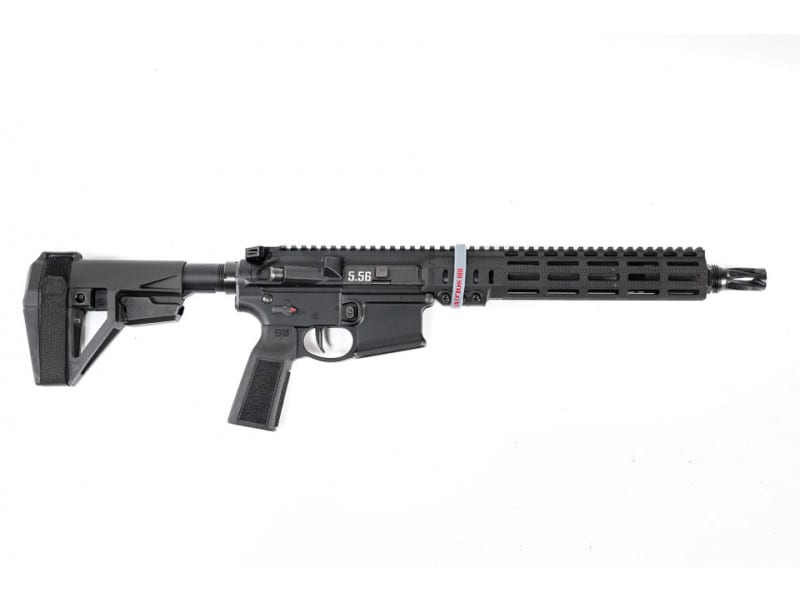
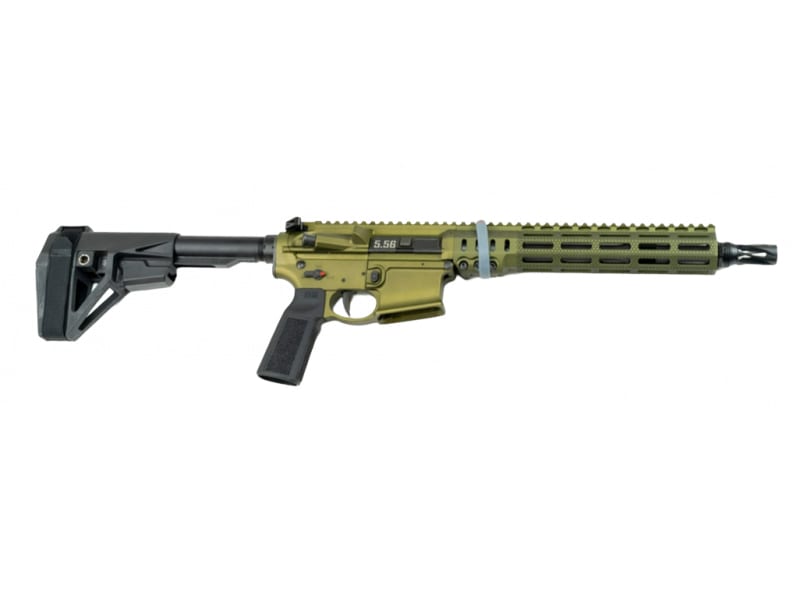
Attention shifts to the receivers and controls. The MK1 uses custom upper and lower receivers designed to work together, though the upper can be paired with certain other lowers, such as the Griffin Mark I, if a fully ambidextrous lower is desired. However, the proprietary L89/Mark1 handguard and upper should remain a set. The lower features partially ambidextrous controls, including an ambi safety and an enlarged maritime-style bolt catch that visually echoes the Sons of Liberty logo. Furniture includes a B5 grip with aggressive texturing and an SBA5 brace, chosen for control and comfort. The safety is identified as a Badger Ordnance unit with a red tab that clearly indicates the fire position. Practical markings include “5.56” on the dust cover, helping distinguish this gun from similar rifles chambered in calibers like 300 Blackout. The barrel uses 5/8x24 threads, more typical of .30-caliber platforms, which the hosts note is a SOCOM-influenced choice intended to provide thicker threading, potentially improving accuracy and durability under hard use.
The hosts highlight the VLTOR A5 buffer system, describing it as a rifle-length buffer setup packaged in a carbine-style format. Functionally, it mimics the smooth recoil impulse of an M16A2 fixed-stock system while fitting into a more compact pistol configuration. They characterize the MK1 as a compilation of favored features from various platforms, brought together in one cohesive build. The Sons of Liberty L2S two-stage trigger is praised for its smooth, refined pull, conceptually compared to well-regarded options like Geissele. A proprietary charging handle is also mentioned, designed to be slightly smaller and less snag-prone while still offering good purchase, aligning with the gun’s overall snag-free, high-grip philosophy. The segment then moves into technical measurements, with the barrel measured at roughly 26.5 inches when including the removable muzzle device. The hosts clarify that because the flash hider is not pin-and-welded, legal barrel length is measured only to the end of the threads, unlike a 14.5-inch barrel with a pinned device that reaches a legal 16 inches.
The video focuses on overall dimensions and compliance. Measuring from the buffer tube and excluding the brace and non–pin-and-welded muzzle device, the hosts confirm that the MK1 CAR pistol meets the ATF’s 26.5-inch minimum overall length requirement for adding a vertical grip while remaining classified as a pistol. With the muzzle device installed, they note an overall length of about 28.5 inches. Height with a magazine inserted comes in around 8.75 to 9 inches. On the scale, the gun weighs approximately 6.31 pounds bare and 6.62 pounds with a Magpul magazine, leading them to describe it as a notably light base gun that leaves room for optics and accessories. They then highlight the NP3-coated bolt carrier group, emphasizing its slick, low-friction surface. This coating helps the carrier glide through carbon and grime, especially beneficial when shooting suppressed, and contrasts with more aggressive designs like hard chrome sand-cutter BCGs that prioritize debris clearance over smoothness.
Discussion turns to bolt carrier group materials and the broader evolution of the AR-15. NP3 is grouped with hard chrome and DLC as one of three preferred BCG coatings, all valued for low friction, durability, and ease of cleaning. The hosts compare the AR-15’s long-lived external design to software like iOS, suggesting that most improvements over decades have been internal refinements in materials, coatings, and small components rather than radical changes in form. They then test the L2S two-stage trigger using an electronic Wheeler gauge, but readings vary from roughly 2.1 to 3.7 pounds, diverging from the manufacturer’s claimed 4.6-pound pull. This inconsistency leads them to question their technique and the reliability of the tool rather than the trigger itself. The segment concludes with strong praise for the Sons of Liberty Gun Works MK1, describing it as a “legendary” culmination of high-end AR components. While enthusiasts can build similar rifles, this model effectively assembles many sought-after features into a single, ready-to-run package.
The final segment explores the appeal of building versus buying. The hosts acknowledge that many shooters enjoy treating ARs like Legos, assembling custom rifles from individual parts. However, they emphasize that the Sons of Liberty Gun Works Mark One offers a turnkey solution backed by a company known for standing behind its products, which can be reassuring for users who prioritize reliability and support. They quickly “deck out” the MK1 in a preferred configuration, pairing FDE and gray elements with a Unity 2.26-inch height optic mount. The pistol’s anodized gray finish is described as a distinctive bluish, darker gray that differs from typical flat gray and contrasts nicely with black accents and an FDE stock or brace. The hosts also point out the factory flared magwell, which speeds and smooths reloads by guiding magazines into place. The video closes with an invitation for viewers to leave reviews and questions about their experiences with Sons of Liberty Gun Works firearms and this specific MK1 CAR pistol.



















 Loading...