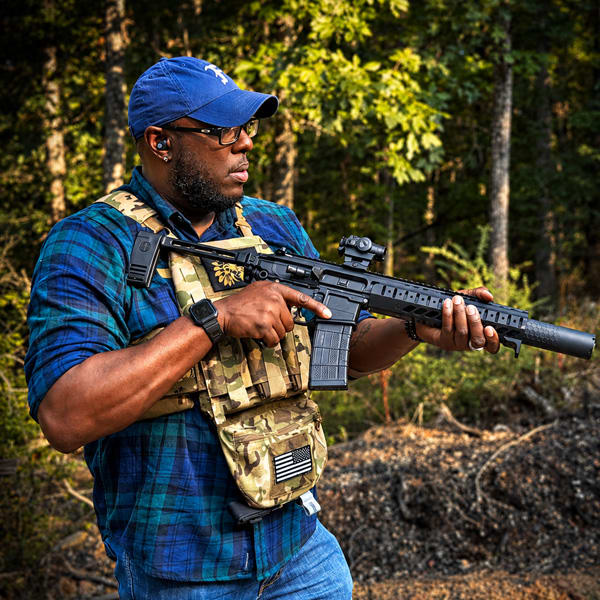
The video focuses on the Sig Sauer MCX Rattler, described here in its original configuration chambered in .300 Blackout, with a very short 5.5-inch barrel. A 5.56 version also exists, but the emphasis is on the .300 Blackout model as a compact personal defense weapon. The gun shown is set up as a pistol with a brace rather than a stock, avoiding SBR classification. With the brace folded and the suppressor removed, the Rattler can fit into a glove box, center console, or small backpack. The host notes that the MCX Rattler family has seen use with special operations units and is considered a proven, robust weapon system.
The MCX Rattler is presented as well suited for PDW roles, executive protection, and home defense. Its compact size and folding brace make it easy to stow and deploy in confined spaces such as vehicles or protective details. The host mentions that .300 Blackout has become increasingly mainstream and is used by various special operations commands worldwide, including a Rattler variant reportedly used by Delta Force and other units. For home defense, the platform is described as durable and reliable, with parts commonality within the MCX family. Reference is made to Sig testing the system to very high round counts, with only routine maintenance required, reinforcing its suitability for defensive use.
The discussion compares .300 Blackout to 9mm, using the MP5 as a familiar 9mm PDW example. A subsonic 9mm round is described as traveling at roughly 1,000 feet per second, with significantly less energy than a .300 Blackout subsonic load. The host highlights a 208-grain subsonic .300 Blackout round, traveling around 1,100 feet per second, as offering much greater terminal effect and foot-pounds of energy on target than 9mm. In this view, .300 Blackout is considered superior for PDW and defensive roles, providing better range, accuracy, and terminal performance while still allowing for subsonic, suppressor-friendly operation.
The video notes two main .300 Blackout loads used: a 208-grain subsonic round and a 145-grain supersonic Wolf steel case load. The subsonic ammunition is emphasized for its quiet report when fired through a suppressor, making it suitable for discreet or indoor use. In contrast, the 145-grain supersonic Wolf load is described as noticeably louder but offering increased effective range. The rifle is shown with a Q Trash Panda (referred to as Trashband Espresso) suppressor mounted on a Cherry Bomb muzzle device, though the suppressor is not included with the firearm. This setup illustrates how the Rattler can be configured for both suppressed subsonic use and louder, longer-range supersonic shooting.
Several accessories on the MCX Rattler are highlighted. The handstop and related components are from Driven Arms, which produces various attachments for AR-15 style platforms, and the host notes using their parts on multiple rifles. The optic is an EOTech EXPS2 holographic sight. The video contrasts user preferences for red dots versus holographic sights but emphasizes EOTech’s track record with military, law enforcement, and special operations users. The host references prior torture testing where the EOTech maintained zero even with a cracked window, countering claims that it is less durable than some competing optics. The EOTech is presented as a proven, reliable choice for this PDW configuration.
The firearm is configured with a Sig quick-deploy folding brace, keeping it in pistol form. The host notes that converting it to an SBR would allow use of a more traditional stock, which is generally preferred, but the brace works well for a pistol setup. The controls are partially ambidextrous: the safety selector and magazine release are ambidextrous, while the bolt catch and release are not, unlike newer MCX variants. The charging handle can be operated from either side. The factory trigger is demonstrated and described as surprisingly good for a PDW role, with a short, positive reset that is easy to feel and hear. The host sees no need to upgrade the trigger for typical engagement distances of roughly 100–200 yards.
The MCX Rattler uses a short-stroke piston system with adjustable gas settings for suppressed and unsuppressed fire. This allows tuning the rifle when running a suppressor like the Q Trash Panda or shooting unsuppressed. The handguard provides M-LOK slots for mounting lights, lasers, and other accessories as needed. The host characterizes the Rattler as part of the broader MCX family and views it as one of the strongest PDW options currently available, particularly in .300 Blackout. The video closes with a brief mention of the eclipse occurring during filming and a final note that the platform’s compact size, adjustable gas system, and accessory compatibility make it well suited to PDW and truck gun roles.



















 Loading...