The hosts introduce a head-to-head comparison between the new Springfield Armory Kuna 9mm PCC and the classic H&K MP5. Both guns use roller-delayed operation, but the MP5 represents the traditional, fully locked system that has earned a reputation for exceptional reliability and smooth cycling. The Kuna’s system is described as a semi-locked, roller-delayed design similar to the Grand Power Stribog, particularly the SBA3 variant, which uses its own take on roller delay. The discussion frames the MP5 as the benchmark, with decades of proven performance and very high round counts, while acknowledging that newer designs like the Kuna aim to capture some of that roller-delayed shootability in a modern package.
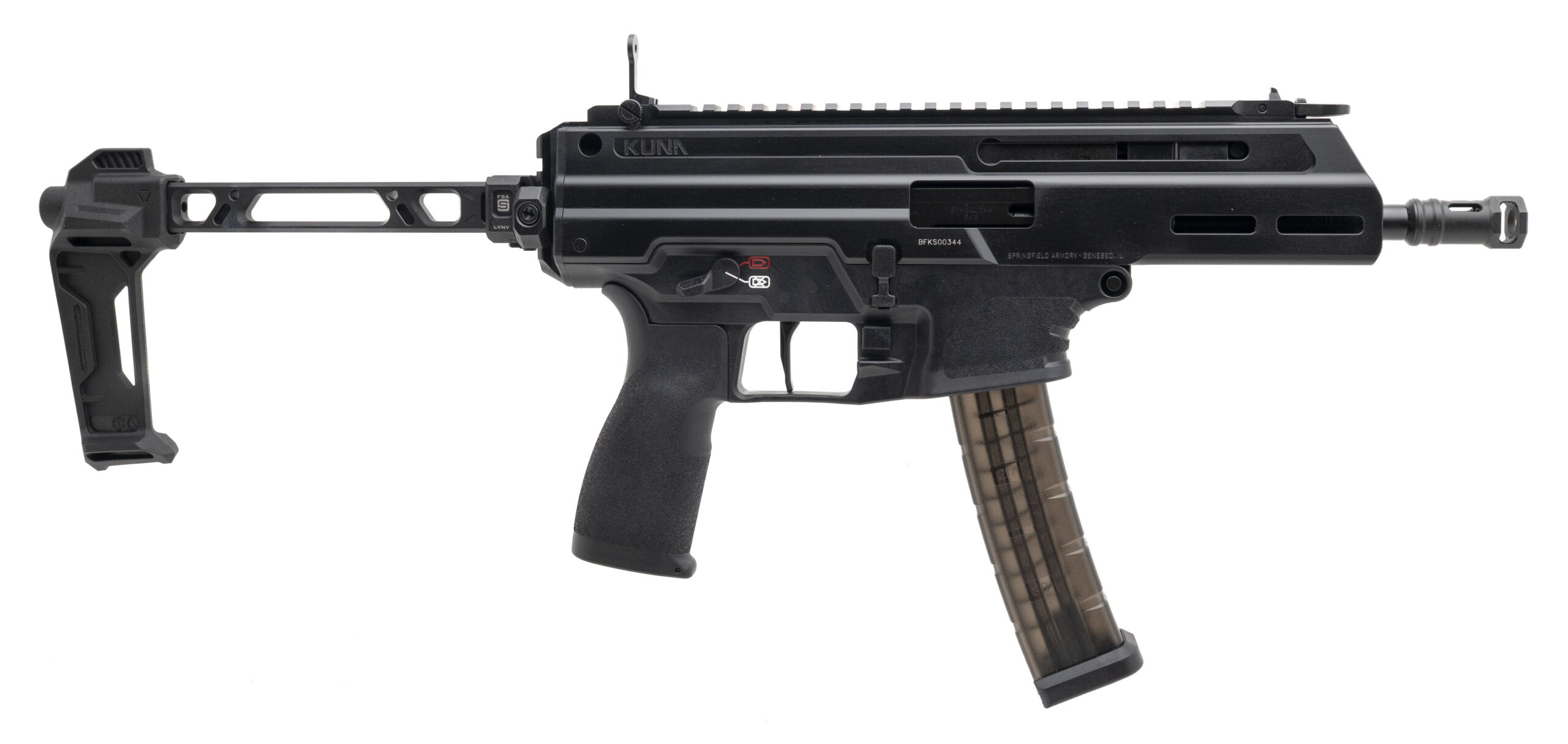
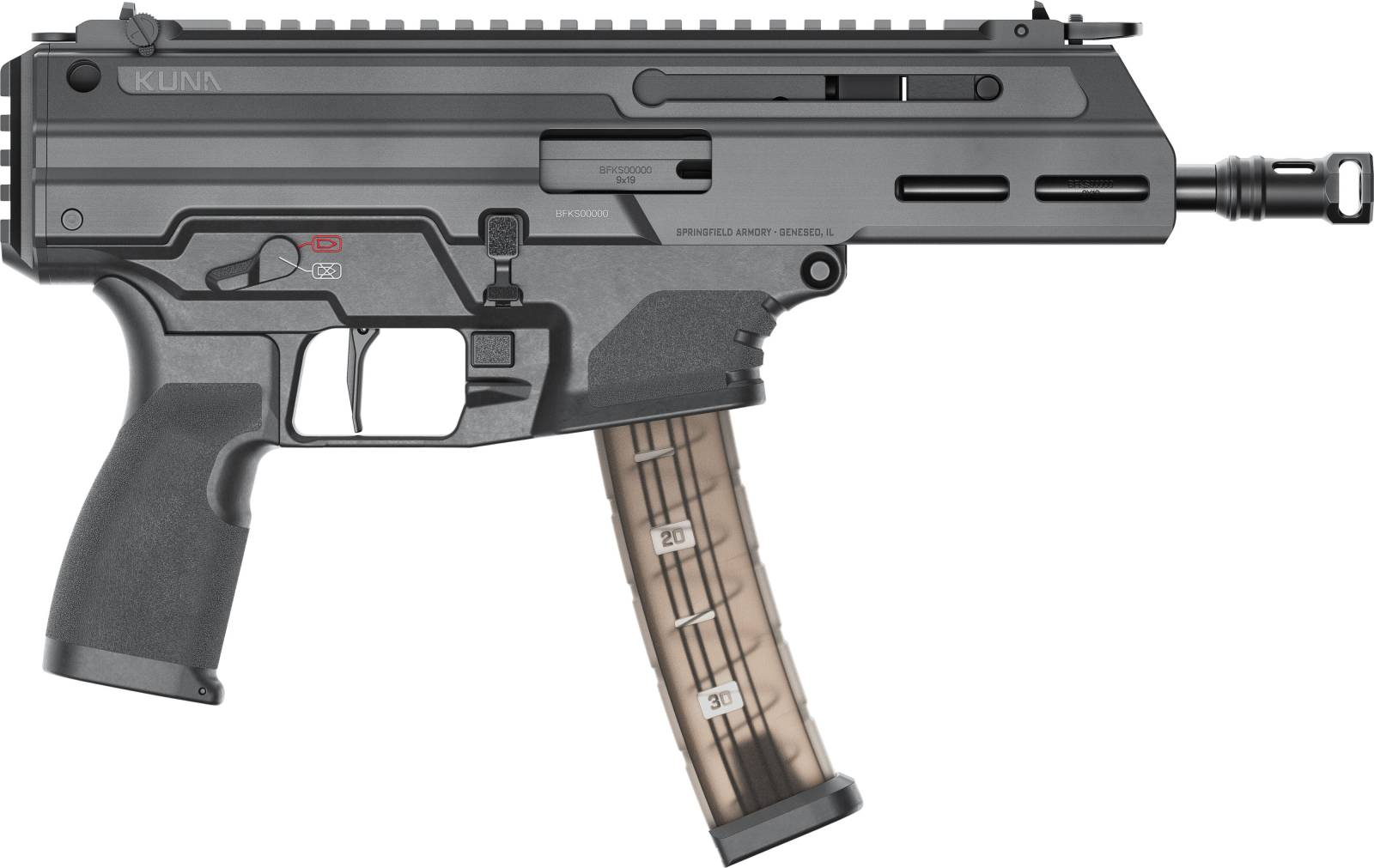
The Springfield Armory Kuna 9mm is presented with its key features and layout. It ships with a distinctive three-port, single-chamber muzzle brake intended to aid recoil management, working in conjunction with the roller-delayed action. The upper is a monolithic aluminum piece with M-LOK attachment slots and hybrid flip-up sights that can be run folded or deployed with defined front and rear sight posts. Controls are fully ambidextrous, including the bolt catch, bolt release, and magazine catch, along with a safety selector that feels stiff but likely due to being new. The gun uses a flat-face trigger and, in this configuration, a Strike Industries folding brace that comes installed from the factory. The magazines are proprietary 9mm 30-round mags, and the gun uses a cold hammer forged 6-inch barrel with 1/2x28 threading, making it suppressor ready.
The H&K MP5 is described as the traditional standard for roller-delayed 9mm subguns. It retains its classic 1960s styling with an 8-inch barrel that is threaded 1/2x28 and also set up for a tri-lug, which the hosts note as a preferred mounting system for subgun suppressors. The MP5 is acknowledged as heavier and old-school, but that weight contributes to its famously soft recoil and smooth operation, often compared to a sewing machine in terms of consistency. Its long service history and the fact that modern PCCs like the Kuna are still measured against it underscore its status as a benchmark platform. The segment closes with the plan to move to the range to compare shootability, trigger feel, recoil control, and practical performance between the two roller-delayed systems.
At the range, the shooters set up a C-zone style target at 25 yards and a larger target at 75 yards to run timed drills. The Kuna uses its proprietary magazine, which visually resembles an MPX-style mag, and both guns are loaded for five-hit strings. The Kuna is fired first to capture initial impressions, with the timer displayed for viewers. The MP5 follows, and the hosts immediately note how fast and accurate it feels at 25 yards, though they also acknowledge a few misses and plan to replay the footage to confirm hit counts. Early on, they highlight that the MP5 requires the bolt to be opened to seat a magazine securely, calling it a minor downside of the classic design compared to more modern PCC ergonomics.
Subsequent strings are fired with both the Kuna and MP5 as the shooters alternate between platforms. After reviewing hits, they discover that one of the runs produced only four hits instead of five, prompting a redo and more shooting. During these repetitions, they begin to articulate clearer recoil impressions. The MP5 is consistently described as the softer-shooting gun, with its roller-delayed system and added weight reducing felt recoil and muzzle movement. The Kuna is acknowledged as softer than a typical direct blowback 9mm PCC, but one shooter feels it is punchier at the shoulder with more noticeable muzzle rise. There is some disagreement on which gun allowed faster splits, and they suggest another versus session may be needed to settle the question of pure speed.
As the round count increases, the shooters emphasize how the MP5’s operating system and mass make it a very smooth, forgiving gun during rapid fire. They demonstrate quick five-hit strings and remark that replicating the same level of control with the Kuna is more challenging, even though the Kuna remains controllable and clearly benefits from its roller-delayed design compared to straight blowback. The MP5’s weight is repeatedly mentioned as a tradeoff that pays dividends in recoil softness. The Kuna earns praise for its smooth bolt operation and overall feel, with one shooter noting how cleanly the bolt runs and how easily it chambers rounds. Visually, the upper receiver profile is said to resemble an MP7 if the lower is ignored, underscoring its modern, compact aesthetic while still being a 9mm PCC.
In closing, the hosts suggest that each platform fills a different role rather than one completely replacing the other. The MP5 is characterized as ideal for close-quarters work where its soft recoil, controllability, and proven roller-delayed system shine during fast strings on nearer targets. The Kuna, with its lighter weight, modern controls, folding Strike Industries brace, and compact 6-inch barrel, is framed as a capable option for stretching out to longer distances while still benefiting from roller-delayed operation and 1/2x28 suppressor-ready threading. They note how quickly the MP5 can blaze through close targets and how the Kuna offers a different feel and handling profile. The final suggestion is that a shooter could justify owning both, using the MP5 for close-range tasks and the Kuna when more reach or a modern configuration is desired.





















 Loading...