Why Suppressors Matter and Supersonic Demo
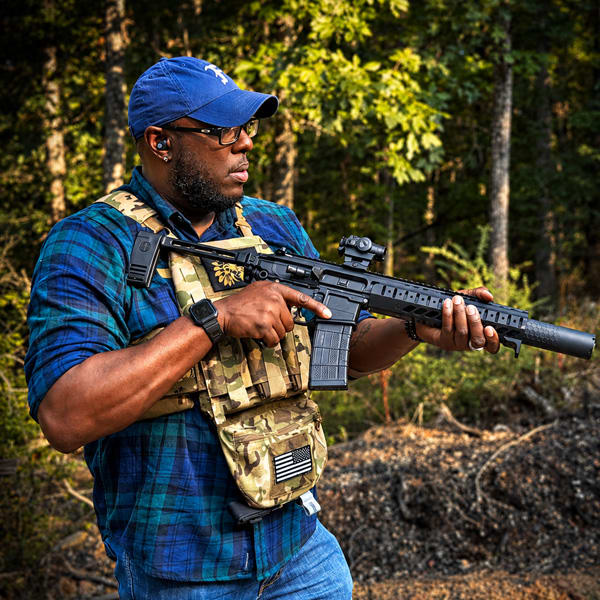
The video opens with Clint at Take Aim Training and Range explaining that he’ll be shooting everything with suppressors, or silencers, throughout the day. He argues that these devices should be removed from the NFA and treated more like simple mufflers for firearms rather than firearms themselves. He emphasizes that they reduce noise, protect hearing, and make shooting more considerate for others at the range or in the field, such as when hunting near other hunters. Even though he still wears hearing protection due to prior exposure to loud noise, he stresses that suppression makes shooting noticeably more comfortable and polite. To start the comparisons, he runs a short Mk18-style rifle in 5.56 with a SureFire SOCOM can, then transitions to a CZ Scorpion in 9mm fitted with a .45-caliber suppressor. After a few slow shots to get a feel for the sound, he flips the Franklin Armory binary trigger on the Scorpion and dumps the rest of the magazine, noting how enjoyable it is to shoot. He points out that both 5.56 and 9mm are supersonic in this setup, so even with the suppressor, viewers can still hear the sharp crack from the bullets passing through the sound barrier, illustrating the limits of suppression with high-velocity ammunition.
300 Blackout: Supersonic vs Subsonic Performance
The focus shifts to 300 Blackout as an example of a cartridge designed from the ground up to work well in compact, suppressed platforms. Clint brings out a Nemo Battle Light with an approximately 8-inch barrel and a Yankee Hill suppressor that tucks slightly under the handguard, a look he says he really likes. He loads 125-grain supersonic 300 Blackout first, explaining that these rounds will still produce a sonic crack even though the suppressor will cut down the muzzle blast. Firing a string of shots, he comments that it sounds good and is clearly more comfortable than an unsuppressed rifle, but the high-speed rounds still generate that distinct snap in the distance. He then introduces heavier, slower 220-grain subsonic 300 Blackout, explaining that these rounds stay below the speed of sound. With the subsonic loads, the character of the sound changes dramatically: the primary noises become the action cycling and the bullet hitting the berm or steel, while the muzzle report is greatly reduced. Clint notes that from behind the gun, the setup feels very quiet and effectively hearing safe, especially when combined with his Walker Silencer Bluetooth hearing protection. This segment sets up 300 Blackout as a standout option for suppressed use and leads into a comparison with another naturally slow, heavy round: .45 ACP.
.45 ACP Suppressed and Gemtech Can Setup
To provide a baseline, Clint first demonstrates an unsuppressed .45 ACP pistol so viewers can hear the full-volume report. He then moves back to the CZ Scorpion and removes the .45-caliber suppressor, pointing out the different barrel thread pitches and how accessories mounted on M-LOK slots can make it tricky to spin a can off without scraping it. He introduces a Gemtech .45 suppressor that uses a monolithic monocore design, explaining that the internal chambers are engineered to slow and cool propellant gases, which significantly reduces the audible report. He shows the dedicated .45 ACP piston, spring, and end cap, then swaps pistons so the can can be mounted on a CMMG Banshee in .45 ACP. Once everything is assembled, he fires the Banshee with subsonic .45 ACP ammunition. The resulting sound is described as impressively quiet, with the action noise and target impact standing out more than the muzzle blast. Clint highlights that .45 ACP is a strong choice for suppression because many common loads are already subsonic, and when paired with a quality .45 can, the combination is extremely pleasant to shoot.
Subsonic 300 Blackout, Safety Argument, and Testing Plans
Later in the video, Clint returns to the heavy 220-grain subsonic 300 Blackout loads to reinforce his earlier points. Shooting through the suppressed Nemo Battle Light again, he notes that from the shooter’s perspective the dominant sounds are the mechanical cycling of the bolt and the thump of the bullet hitting the target, with only a muted report at the muzzle because the rounds never cross the sound barrier. He uses this performance to reiterate his view that suppressors are essentially metal mufflers that reduce noise and recoil, making firearms more manageable and less disruptive to people nearby. He criticizes the current legal treatment of suppressors as firearms under the NFA, calling it misguided and counterproductive to hearing safety. Clint also mentions that they attempted to capture sound levels with an inexpensive decibel meter but found the readings unreliable, and he acknowledges that camera microphones and basic tools do a poor job of conveying how quiet these setups actually are. He outlines plans for future range sessions using higher-end sound equipment to provide more rigorous, side-by-side decibel comparisons across different calibers, barrel lengths, and suppressor models so viewers can better understand real-world performance.
Suppressing the Barrett .50 BMG and Favorite Calibers
In the final segment, Clint escalates the discussion by talking about suppressing a Barrett M107 chambered in .50 BMG. He highlights the rifle’s built-in QD interface for Barrett-branded suppressors and notes that SureFire also produces compatible cans, referencing the SureFire SOCOM 556 used earlier on the Mk18 as part of their broader lineup. He emphasizes the sheer power of .50 BMG, describing a 660-grain projectile traveling at over 3,000 feet per second, and explains that even a massive rifle like this benefits from a suppressor to tame blast, concussion, and felt recoil. The video also promotes a giveaway of a semi-auto Barrett M107 equipped with an EOTech Vudu 3.5–18x optic, done in collaboration with Alex Zedra, and Clint encourages whoever wins to consider adding a suppressor to complete the setup. He invites viewers to comment with their favorite calibers to shoot suppressed, singling out 300 Blackout as one of his top picks because it was purpose-built for suppressed use and excels with subsonic loads. The video closes by directing viewers to enter the giveaway at classicfirearms.com and wrapping up with a brief sign-off and well-wishes from the range.



















 Loading...