The video opens by introducing Jim Foreman, a retired Navy SEAL who now works with Ferro Concepts, Zenith Firearms, and Active Crisis Consulting. The host frames the discussion around a realistic SHTF or martial law scenario, asking what Jim would actually run if things truly went bad. Jim explains that his priority is a loadout that covers the most bases rather than niche, specialized gear. He immediately focuses on the primary long gun, emphasizing the need for a platform that can handle close engagements while still being effective at distance. Jim chooses a 5.56 rifle with roughly a 14–14.5 inch barrel, describing it as a sweet spot for accuracy, maneuverability, and ballistic performance. He contrasts this with 7.62x39 AK platforms, noting that while AKs are rugged, they generally struggle with accuracy at longer ranges compared to a well-set-up AR-15. The segment sets the tone: practical, experience-driven decisions aimed at surviving and fighting effectively in a prolonged emergency.
Jim dives deeper into why a 5.56 AR-15 is his primary SHTF rifle in the United States and other NATO countries. He highlights that 5.56 ammunition is widely available domestically, making resupply more realistic than with more exotic calibers. On the rifle, he prefers a variable optic in the 2.5–10x class; his example is a 3.5–18x scope, which gives him the ability to identify and engage targets at extended distances. To handle close-quarters work, he pairs the magnified optic with a red dot, allowing rapid engagements out to around 100 yards without needing to dial magnification. Jim adds a bipod for stability on longer shots and a foregrip for better weapon control. He stresses the importance of a visible white light for target identification, deliberately omitting an IR laser because most civilians do not own night vision. He notes that outside the U.S.—in Eastern Europe, parts of Europe, or South America—7.62x39 might be the smarter choice simply due to regional ammo availability.
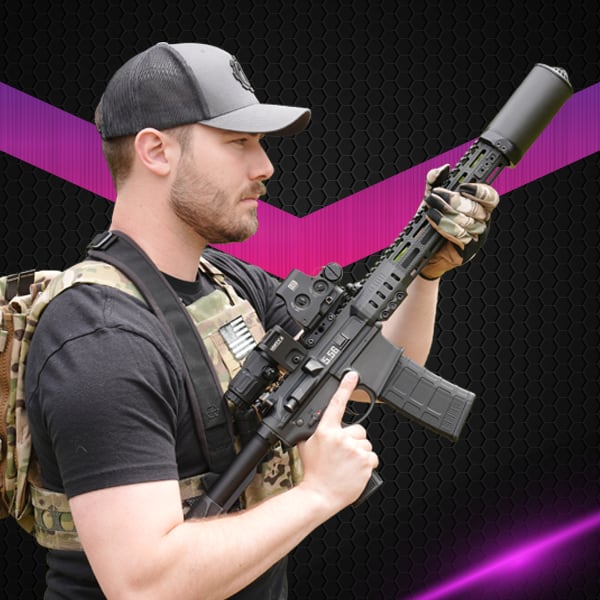
The conversation shifts to accessories that make the rifle more effective and survivable in a crisis. Jim strongly favors running a suppressor, such as a SureFire RC2, to reduce sound signature and make it harder for opponents to pinpoint the shooter’s location. He reiterates the importance of a visible white light and explains his preference for activation methods. Positive-click pressure pads or tailcap switches are preferred over overly sensitive pads that can cause accidental light discharges, which could give away a position. For a right-handed shooter, he likes the light mounted on the right side of the rifle. Handguard choices are examined: M-LOK, KeyMod, and full Picatinny quad rails. Jim leans toward Picatinny or metal M-LOK, warning that polymer M-LOK or polymer stocks can fail under stress, citing a bipod mount that broke on a polymer stock. Sling selection centers on the Ferro Concepts Slingster two-point sling, chosen for its metal hardware and quick adjustability. He explains optimal front and rear attachment points, especially placing the rear near the castle nut to improve weapon mobility and make it easier to put on or remove the rifle when wearing body armor.
Jim demonstrates how sling adjustment affects rifle handling. Loosening the sling increases mobility, makes it easier to get the rifle on and off over body armor, and facilitates switching shoulders when shooting around cover. Attention then turns to the buttstock, specifically a B5 stock with an internal battery compartment. Jim likes storing spare batteries and small tools, such as Allen keys, directly on the weapon so that critical items are always with the rifle rather than relying on body-worn storage that might be separated in a rush. He describes the AR-15 as a highly versatile SHTF platform, capable of close-quarters work with the red dot while still allowing accurate engagements out to roughly 500 yards when combined with the magnified optic, bipod, and suppressor. The modularity of the setup is emphasized: the bipod can be quickly removed to lighten the rifle, and the SureFire suppressor can be taken off if the shooter wants more noise or needs a shorter overall length. This modular approach lets the same rifle adapt to different missions and environments. The segment transitions toward pairing this primary rifle with a Glock pistol as a simple, reliable sidearm.
The focus moves to the handgun that complements the rifle in Jim’s SHTF loadout. He chooses a Glock as the primary sidearm because it is simple, durable, and runs reliably straight out of the box. A full-size Glock 17 is highlighted as a strong choice. Jim favors iron sights as the baseline, especially because less-experienced family members, including children he has trained, are already familiar with irons. The host shows his own Glock 17 configured with a SureFire X300 weapon light, an Aimpoint Acro red dot, and a Dead Air Mojave 9 suppressor in its short configuration with a booster. In a real SHTF situation, this pistol would typically be carried unsuppressed for practicality, but the suppressor can be attached when needed for sound reduction. They discuss the tradeoffs of red dots versus irons: red dots are faster and can improve accuracy, but they depend on batteries and rugged construction. Some pistol optics have failed under the relatively snappy recoil of 9mm handguns. To hedge against this, the Glock is equipped with very tall backup iron sights that remain usable even if the red dot breaks or loses power.
The SureFire X300 pistol light is demonstrated in detail. The host explains the difference between momentary and constant-on activation, emphasizing deliberate, positive controls that reduce the chance of accidental light discharges. Momentary activation allows quick target identification without broadcasting position for long periods, while constant-on can be used when sustained illumination is necessary. Aside from the light and possibly an optic, the Glock would remain largely stock in a true SHTF scenario to preserve reliability. The discussion then shifts to ammunition and magazine strategy. On the rifle, Jim recommends an extended first magazine, such as a 40-rounder or even taped-together magazines, because the first mag is most likely to be used in an initial engagement. However, he cautions against overly heavy options like 100-round drums that add bulk and weight. A typical plate carrier setup might carry three standard rifle magazines, with additional ammo and food stored in a go bag or backpack. Medical gear is highlighted as essential: a med kit should live on the belt as second-line gear, with additional medical supplies possibly mounted on the backpack or plate carrier. The segment closes by introducing the Ferro Concepts FCPC plate carrier, chosen for its modularity and ability to accept different shoulder pads, while noting that many plate carriers can work if configured intelligently.
The FCPC plate carrier is examined in depth. Jim points out its modular design, including interchangeable shoulder pads for comfort and load distribution. The front of the carrier uses a Velcro and G-hook pouch system, allowing different placards or pouches to be swapped quickly. The rear features MOLLE-compatible sections for attaching pouches, and side zippers that accept zip-on backpacks or panels. One-inch extensions allow the user to run a water bladder and an additional pack while keeping the overall profile relatively low. Body armor selection is addressed next. Jim recommends level III or III+ plates and highlights TAC 11, noting that Justin at TAC 11 has developed very light, approximately 2.2-pound level III+ plates that still carry strong ballistic ratings. Multiple weight and rating options exist, but lighter plates reduce fatigue and increase mobility. Jim outlines an over-belt system using a Velcro inner belt and a quickly donned outer belt. The outer belt carries a holster, med pouch, and pistol and rifle magazine pouches, and can be run independently of the plate carrier. Helmet use is discussed from a civilian perspective: ballistic helmets and night vision are valuable, especially since night vision must be mounted to something, but Jim is not focused on wearing a helmet constantly due to bulk and comfort. He frames it as a useful but not mandatory piece of gear.
Communication planning is highlighted as a critical but often overlooked part of SHTF preparedness. Jim and the host explain that in a serious crisis, cell phones and normal networks may not function, so at least short-range radios, such as walkie-talkie–type units, become essential for coordinating with a team, family, or community. Without radios, groups must rely on prearranged plans, rally points, and old-school methods, which are slower and risk miscommunication. The host then recaps Jim Foreman’s overall SHTF loadout. The primary rifle is an ADM weapon system AR-15 configured similarly to the one previously shown, with a variable optic, red dot, bipod, white light, and the option to run a SureFire suppressor. The sidearm is a Glock handgun, again mirroring the earlier example with the possibility of adding a suppressor and weapon light. Jim reiterates that his approach is minimalist: he wants gear that works, is maintainable, and covers the widest range of likely problems rather than chasing every possible niche scenario.
The closing segment focuses on philosophy and practicality for viewers building their own setups. Jim emphasizes starting simple, noting that a Glock is an accessible, relatively inexpensive, and extremely capable foundation for a defensive loadout. From there, shooters can add a reliable rifle and gradually build out supporting gear like a plate carrier, belt, and communications. The host acknowledges that the specific equipment shown in the video—high-end optics, mounts, lights, and suppressors—may not look budget-friendly. However, he stresses that similar capability can be achieved at various price points. For example, a solid AR-15 with an LPVO, a basic red dot, a functional white light, and a suppressor or muzzle device can be assembled for significantly less than top-tier brands, potentially under $2,000 if buyers shop carefully. The key is prioritizing reliability, ammo availability, and training over flashy accessories. The video ends with a reminder to be prepared, along with mentions of Jim’s training and consulting work for those who want deeper instruction on building and running a realistic SHTF loadout.





















 Loading...