The video opens with Steyr unveiling a modern AUG pistol magazine adapter that accepts Glock magazines, reviving an idea first developed for police in the 1980s. The presenters explain that Glock pistol mags are globally ubiquitous, making them a practical choice for agencies and shooters who already issue or own Glock sidearms. They highlight that 10-round Glock magazines are available for jurisdictions with capacity restrictions, and reference dedicated training magazines sold as part of a police training kit on Steyr Arms International’s website. The discussion notes that full-auto AUG variants benefit from a specific stock with a modified internal “roof” to optimize ejection with 9mm, while semi-auto AUGs can run the system with standard stocks. Controls on the 9mm AUG mirror the classic AUG layout: a left-side charging handle, rear bolt release, and a three-position crossbolt safety on select-fire models, with semi-only configurations for civilians. The quick-change barrel system is mentioned, with a front button enabling easy barrel swaps, underscoring the platform’s modularity.
The focus shifts to how users convert an existing AUG into a 9mm Glock magazine-fed configuration. Steyr’s 9mm conversion kit includes a dedicated 9mm barrel, a matching 9mm bolt, Glock-compatible magazines, and the pistol magazine adapter that locks into the AUG’s magwell. The presenters clarify that the newest 9mm AUGs are not backward compatible with the older steel magazine adapters originally designed for earlier 9mm variants, so buyers must use the current system. They emphasize that full-auto 9mm AUGs employ a proprietary stock with a distinctive internal “roof” geometry to improve reliability and control in automatic fire. This specialized stock is standard on new semi-auto 9mm factory guns but is not required or bundled with the standalone conversion kits. Semi-auto owners can still enjoy the 9mm setup using their existing stocks, while agencies running select-fire guns benefit from the enhanced stock design optimized for sustained 9mm operation.
Steyr outlines different 9mm AUG offerings for law enforcement and civilian customers. Law enforcement agencies can purchase only the pistol magazine adapter, allowing officers to feed the AUG with their existing service Glock magazines and streamline logistics. Civilian buyers, by contrast, can opt for complete 9mm AUG rifles that ship with 10-round magazines to comply with restrictive markets, and they can also buy the Glock magazine adapter separately. The conversation then transitions to Steyr-branded cold hammer forged AR-15, M4, and M16 barrels offered to the OEM market. These barrels are available in 5.56 NATO with options for chrome-lined or non-chrome-lined bores and various twist rates to suit different ammunition and performance requirements. The presenters stress that there are no exotic proprietary features beyond Steyr’s renowned hammer forging process and use of quality materials, positioning these barrels as high-end components for other firearm manufacturers and vendors rather than direct retail products.
The discussion dives deeper into Steyr’s in-house barrel manufacturing capabilities. Steyr uses European steel and cold hammer forging to produce durable, accurate barrels, with chrome lining offered as an option depending on customer specifications and intended use. The presenters explain that this particular barrel program is aimed squarely at OEM clients—vendors and firearm manufacturers who want to integrate Steyr-quality barrels into their own platforms. Rather than targeting the U.S. civilian aftermarket directly, Steyr positions these barrels as a behind-the-scenes product that enhances other companies’ rifles and carbines. This OEM focus allows Steyr to leverage decades of barrel-making expertise, including precise control over chamber dimensions, rifling profiles, and surface treatments. The segment underscores that while end users may not always see the Steyr name on the outside of their rifles, many will benefit from Steyr’s barrel technology through partner brands and contract builds.
Attention returns to the AUG platform’s broader history and evolution. Steyr recounts how development of the AUG began in the late 1960s, culminating in its adoption as the StG 77 by the Austrian military. Over time, the AUG family expanded beyond its original 5.56 NATO chambering into additional calibers to meet diverse operational needs. A 9x19mm variant was introduced using a magwell adapter for steel magazines, offering a compact, subgun-like configuration while retaining the AUG’s bullpup ergonomics and manual of arms. Steyr also developed 300 Blackout AUG configurations, supported by conversion kits that allow users to change calibers by swapping key components rather than buying entirely new rifles. This multi-caliber approach reflects Steyr’s emphasis on modularity and lifecycle adaptability, enabling militaries, police forces, and civilian shooters to tailor the AUG to roles ranging from close-quarters work to suppressed operations and intermediate-distance engagements.
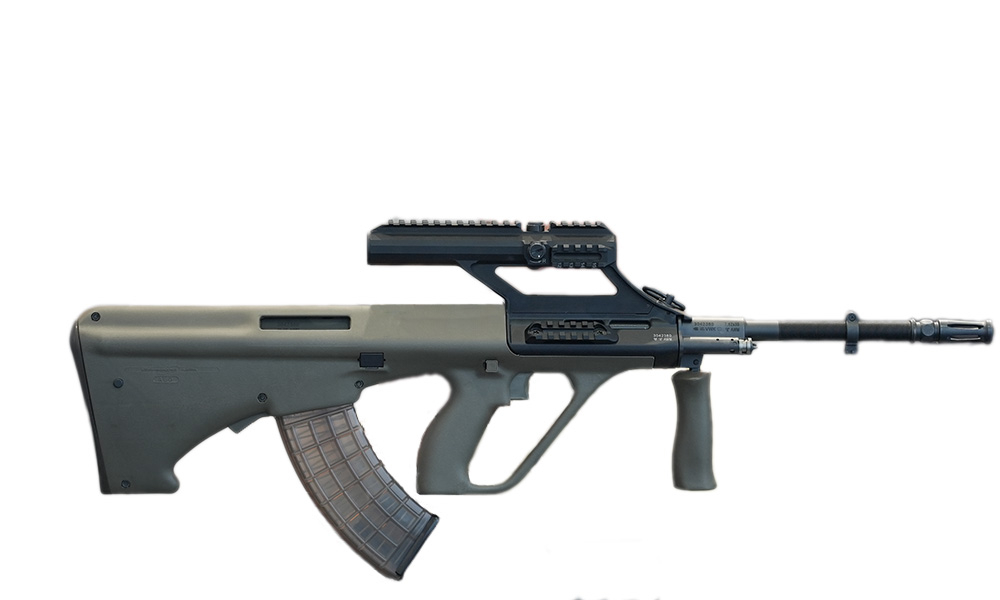
Steyr introduces a new AUG chambered in 7.62x39, aimed primarily at military and law enforcement customers. The presenters note that while 5.56 NATO dominates the U.S. market, 7.62x39 remains extremely popular among AK enthusiasts and in many former Eastern Bloc and other countries with large existing stocks of that ammunition. The 7.62x39 AUG is pitched as combining the precision, smooth handling, and ergonomics of the AUG with the rugged, hard-hitting character associated with AK-pattern rifles. It retains the familiar AUG manual of arms, including the adjustable gas system, while adapting internal components to the different cartridge. Caliber changes to 7.62x39 require a dedicated barrel, a specific bolt, and unique magazines designed for the cartridge’s taper and geometry. Steyr plans to offer conversion kits so existing AUG users can adopt 7.62x39 without purchasing a completely new rifle, extending the platform’s versatility.
The conversation highlights the distinctive magazines developed for the 7.62x39 AUG. Steyr’s classic translucent, waffle-pattern AUG magazines are reimagined in a curved form to suit the 7.62x39 cartridge, leading the presenters to jokingly dub them “banana waffle” magazines. These 30-round mags maintain the recognizable AUG aesthetic while providing the curvature needed for reliable feeding of the tapered 7.62x39 rounds. The rifle configuration discussed uses a standard 20-inch barrel, balancing velocity, accuracy, and handling. Steyr clarifies that the 7.62x39 AUG is a brand-new offering with no formal contracts signed yet, positioning it as an emerging option for agencies and militaries evaluating alternatives to traditional AK platforms. In contrast, the .300 Blackout AUG already enjoys active cooperation with European police forces, indicating that Steyr’s multi-caliber strategy is gaining traction in specialized law-enforcement roles, particularly where suppressed and close-quarters performance is prioritized.
The final segment focuses on the 300 Blackout AUG and Steyr’s broader caliber philosophy. To ensure reliable cycling with subsonic 300 Blackout ammunition, Steyr engineered a significantly larger, more robust gas operating system than that used on standard 5.56 or 7.62x39 AUGs. This “beefy” gas system is designed to handle the wide pressure range of 300 Blackout, especially in suppressed configurations favored by European police units currently cooperating with Steyr. The presenters address purist concerns that chambering the traditionally 5.56 AUG in 7.62x39 or 300 Blackout is “heresy,” countering that offering 7.62x39, 300 Blackout, 9mm, and other options simply broadens the platform’s appeal. They emphasize there is no “AUG church,” only a diverse community of AUG fans who prefer different calibers for different missions. The video closes with lighthearted banter about pricing, encouraging viewers to explore Steyr’s expanding AUG lineup for themselves.





















 Loading...