The video focuses on the US Palm CAT4 rifle, a semi-auto AR-15 pattern gun with a pistol variant also available. The stated MSRP is about $1,300, with the design goal of offering features typically found on rifles closer to $2,000. Basic dimensions are outlined: overall length is approximately 33.5 inches collapsed and 36.8 inches extended, with a height of 7.3 inches and width of 2.7 inches. The rifle uses a 16-inch barrel and weighs about 7 pounds unloaded and 7.8 pounds loaded, making it relatively light out of the box. The twist rate is 1:7, and the barrel is threaded 1/2x28. Initial shooting involved roughly 70 rounds through both the rifle and pistol versions during daytime, with no visible flash or fireball observed at the muzzle in those conditions.
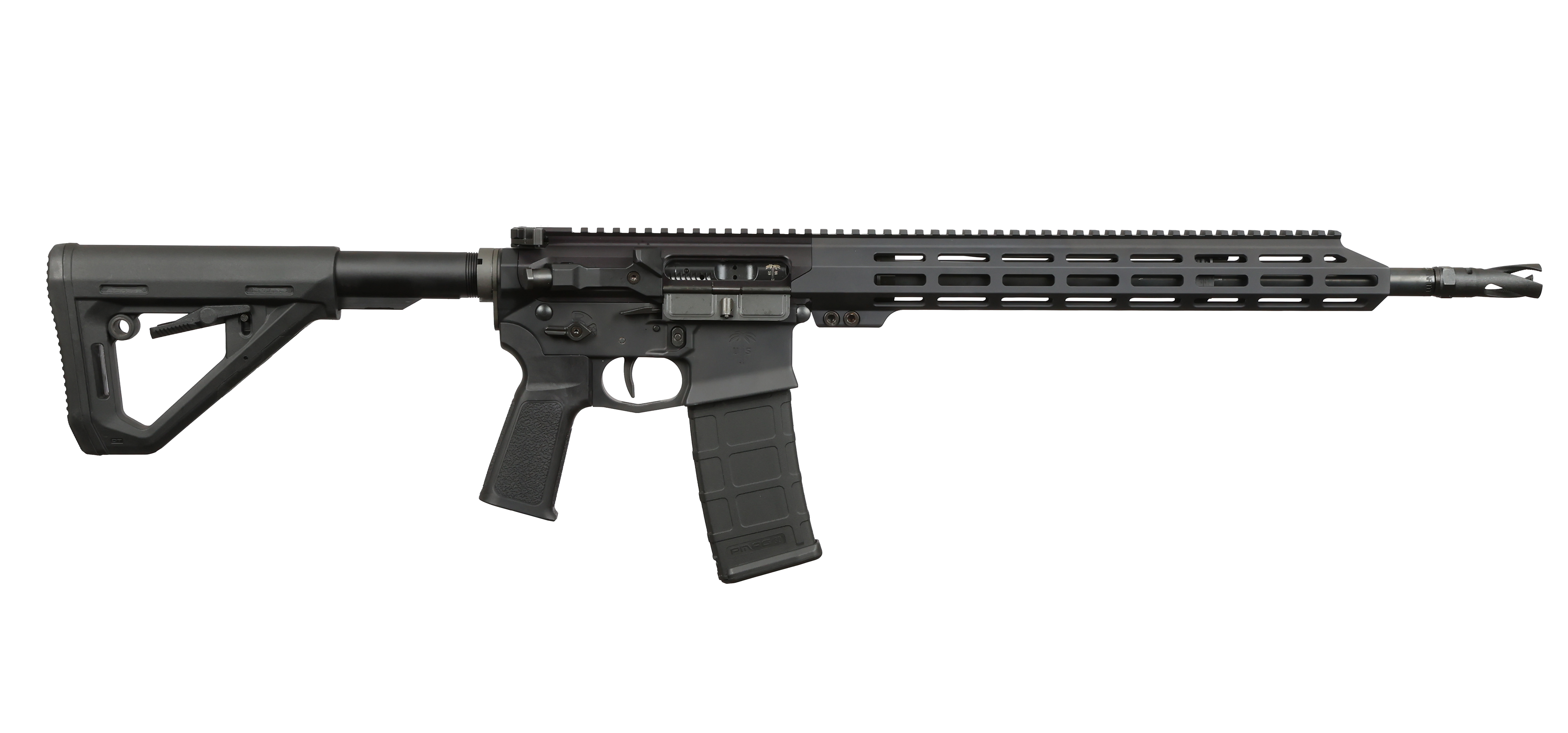
The CAT4 features a full M-LOK handguard with slots all the way around, allowing accessory mounting at multiple positions. The front of the handguard has an angled, shovel-like cut that gives it a distinctive appearance. A full-length Picatinny rail runs along the top for optics and sights. The rifle uses 7075-T6 aluminum for the handguard, upper receiver, and lower receiver. The muzzle device, associated with the Hurricane name, is claimed by the manufacturer to significantly mitigate flash, and its appearance suggests a swirling, hurricane-like design. During limited daytime firing, no noticeable flash was seen, though more testing is planned. Overall, the external build presents as a lightweight rifle with extensive mounting options and a unique front-end profile.
US Palm uses what it calls a Monolock system to mate the upper receiver and handguard. Tabs are machined into both the handguard and receiver, interlocking along the top and flattening along the bottom to create a tight interface. The manufacturer claims this delivers a monolithic-like lockup that exceeds a typical free-float AR-15 setup. The host notes that, in hand, the system feels very solid, though the rifle is brand new and not yet stress-tested for flex. The handguard is further secured with a two-screw lockup at the bottom and a single receiver screw on the opposite side, which pinches the assembly together. These elements are presented as part of the rifle’s attempt to approach the rigidity of true monolithic uppers while remaining within a more accessible price range.
The rifle uses a cold hammer forged 4150 chrome-moly steel barrel, which is expected to support good accuracy and durability. The trigger is a Hiperfire EDT Designated Marksman single-stage unit. Its shoe shape is described as a hybrid between a traditional curved trigger and a flatter style, with a slight curve in the middle and a flatter front face. The pull is characterized as light with a crisp break and a very tactile reset. The lower receiver is fully ambidextrous, featuring a prominent bolt release paddle on one side that is easy to engage yet shaped to reduce the chance of snagging on gear. There are magazine releases on both sides of the lower, and a bolt catch on the opposite side functions as expected. The castle nut is staked, which is noted as a positive detail sometimes omitted on rifles in this price category.
Several features typically associated with higher-end rifles are highlighted. A screw on the upper indicates a replaceable cam path insert, a high-wear component that can be swapped as it erodes over time, similar to what is seen on platforms like the SIG MCX. The pin that interfaces with the charging handle latch is also replaceable. The charging handle itself is extended and includes a small ridge intended to help with gas management, though its effectiveness has not yet been tested. The safety selector is a 45-degree, fully ambidextrous unit with a tactile feel. It is somewhat stiff out of the box but is expected to smooth out with lubrication and use. The selector uses a simple bar shape with an arrow indicating safe or fire, emphasizing function over elaborate styling while still feeling precise.
The grip on the CAT4 is described as somewhat square in profile. It is not overly thick or thin, but its front-to-back dimension feels a bit narrow while remaining comfortable overall. The stock is a Magpul dual-tension design, referred to as a Magpul DT stock, similar in concept to the CTR. It locks firmly into position with minimal wobble without needing an additional friction lock, and its slight angle is intended to help in varied shooting positions. QD sling attachment points are present at the rear of the stock. The handguard itself lacks built-in QD sling sockets, which is attributed to a trend of placing QD mounts on Picatinny sections to keep slings from interfering with magazine changes at the magwell. Aside from that omission, the furniture is presented as functional and well-suited to the rifle’s intended role.
The rifle incorporates several user-serviceable wear components. In addition to the cam path insert and charging handle interface pin, there are polymer parts around the ejection port and forward assist that can be replaced as they wear. A single screw allows removal of that assembly, making it possible to refresh high-wear areas without purchasing an entire new upper receiver. This modular approach suggests the rifle is intended for high round counts, with the expectation that users can maintain reliability by replacing specific parts over time. The fact that most components are designed and produced by the same company is presented as a way to ensure compatibility and consistent performance. The overall concept is a rifle that can be run extensively while keeping long-term maintenance costs lower than replacing major assemblies.
The presenter concludes that the US Palm CAT4 rifle makes a strong first impression for an MSRP in the $1,200 to $1,300 range. The combination of a cold hammer forged barrel, full ambidextrous controls, the Monolock handguard system, replaceable wear parts, and the Hiperfire EDT Designated Marksman trigger positions it as a feature-rich option. It is noted that if a rifle with this feature set had appeared about five years earlier, it likely would have drawn significant attention. However, the current assessment is based on initial handling and limited live fire, with more extensive testing and training courses planned to evaluate long-term performance, flash mitigation claims, and durability. Viewers with experience using US Palm rifles are invited to share feedback, which will help build a broader picture of how the CAT4 performs over time.





















 Loading...