The video opens with a brief joke about the Barrett M107A1 before shifting focus to the Barrett REC7 DI AR-15. The hosts introduce the rifle as a 16-inch direct-impingement platform from Barrett Firearms and set the expectation that they will walk through technical specifications and then verify them. They emphasize that this model is intended as a duty-style or general-purpose AR-15 rather than a .50 caliber system. The plan is to cover materials, barrel features, gas system, and then move into measured weight, length, and trigger performance using a scale, tape measure, and trigger gauge.
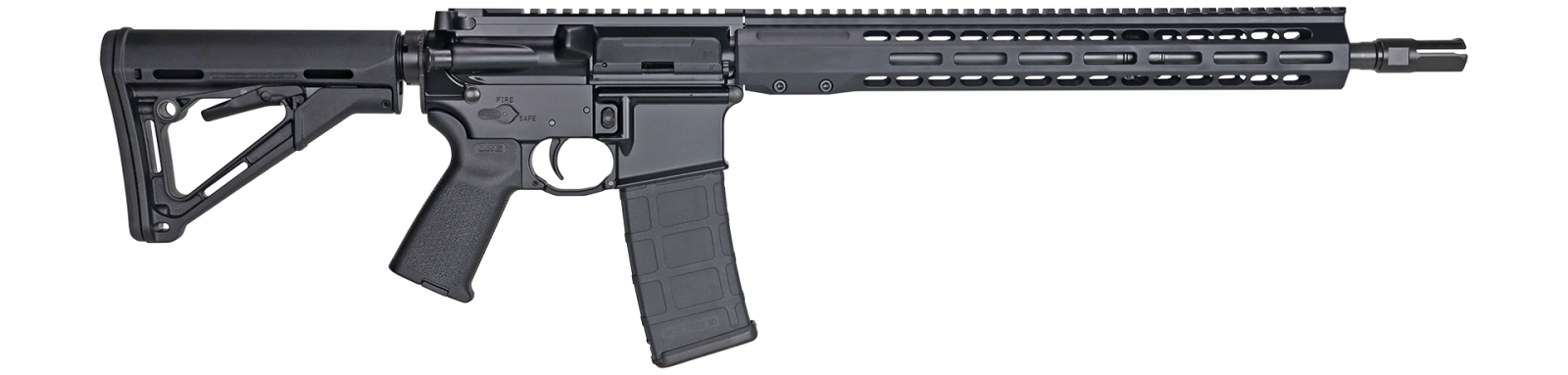
The REC7 DI is described as having both upper and lower receivers forged from 7075-T6 aluminum. Other aluminum components receive a hard chrome coating. The rifle uses a cold hammer forged, chrome-lined barrel, which the hosts note is intended to increase barrel life and durability with only a minor trade-off in potential accuracy. They frame this as a typical chrome-lining debate but characterize this rifle as a duty-oriented option where longevity is prioritized. The barrel is 16 inches with a 1:7 twist. A mid-length gas system is highlighted as a key feature, allowing the rifle to run reliably both suppressed and unsuppressed while remaining a relatively soft shooter.
The rifle comes equipped with Magpul furniture, including a CTR stock and a Magpul grip, identified as an SLS-style grip. An ambidextrous safety selector is included, which the hosts consider an important feature on modern AR-15s, even if ambidextrous bolt controls are not always necessary. They reiterate that the barrel is 16 inches and that the overall length is specified at 33 inches with a weight of 6.6 pounds. At the muzzle, the rifle uses Barrett’s proprietary three-prong flash hider. The hosts prefer a flash hider over a muzzle brake on a 5.56 NATO rifle, noting that 5.56 is manageable without a brake and that a flash hider avoids excessive blast to nearby shooters. They mention the characteristic ring of the three-prong device, which diminishes as carbon builds up with use.
The hosts then verify Barrett’s published specifications. Using a scale, they weigh the rifle with a magazine at approximately 6.85 pounds. With the magazine removed, the rifle comes in at about 6.55 pounds, slightly lighter than the listed 6.6 pounds. They next measure overall length. With the stock collapsed, the rifle measures exactly 33 inches from muzzle to butt, matching the manufacturer’s claim. Fully extended, the stock adds roughly three to four inches, bringing the length to about 36.25 inches. They also note an approximate overall height of around 7.5 to 7.75 inches. The conclusion is that Barrett’s published dimensions are accurate or slightly conservative on weight.
Attention shifts to the trigger, which is identified as a single-stage unit. Before testing, the hosts confirm that the rifle is unloaded and safe. They estimate the pull weight in the 5.5 to 6.5 pound range but acknowledge that they are not expert at guessing. Using a trigger gauge, the first measured pull registers 3.81 pounds. A second pull comes in at 2.15 pounds, which prompts them to take a third reading. The third pull measures 3.31 pounds. Based on these results, they characterize the trigger as averaging roughly 3 to 3.5 pounds, which they find notably light and impressive for a 16-inch direct-impingement duty-style AR-15.
After handling the rifle further, they point out a polymer dust cover featuring the Barrett logo, contrasting it with the standard metal covers found on many mil-spec AR-15s. They appreciate these small design touches as evidence of extra attention to detail. The handguard is secured with two bolts and also dovetailed into the upper receiver, resulting in a very solid, flex-free interface between upper, lower, and handguard. They describe the REC7 DI as a solid 16-inch direct-impingement offering from Barrett, suitable as a do-all or duty-style AR-15 in the mid- to higher-tier segment. Pricing is noted as a bit over the $1,500 range but still below some competitors like Daniel Defense. The video closes by inviting viewers to share their experiences with the Barrett REC7 and ends with brief sign-off remarks.





















 Loading...