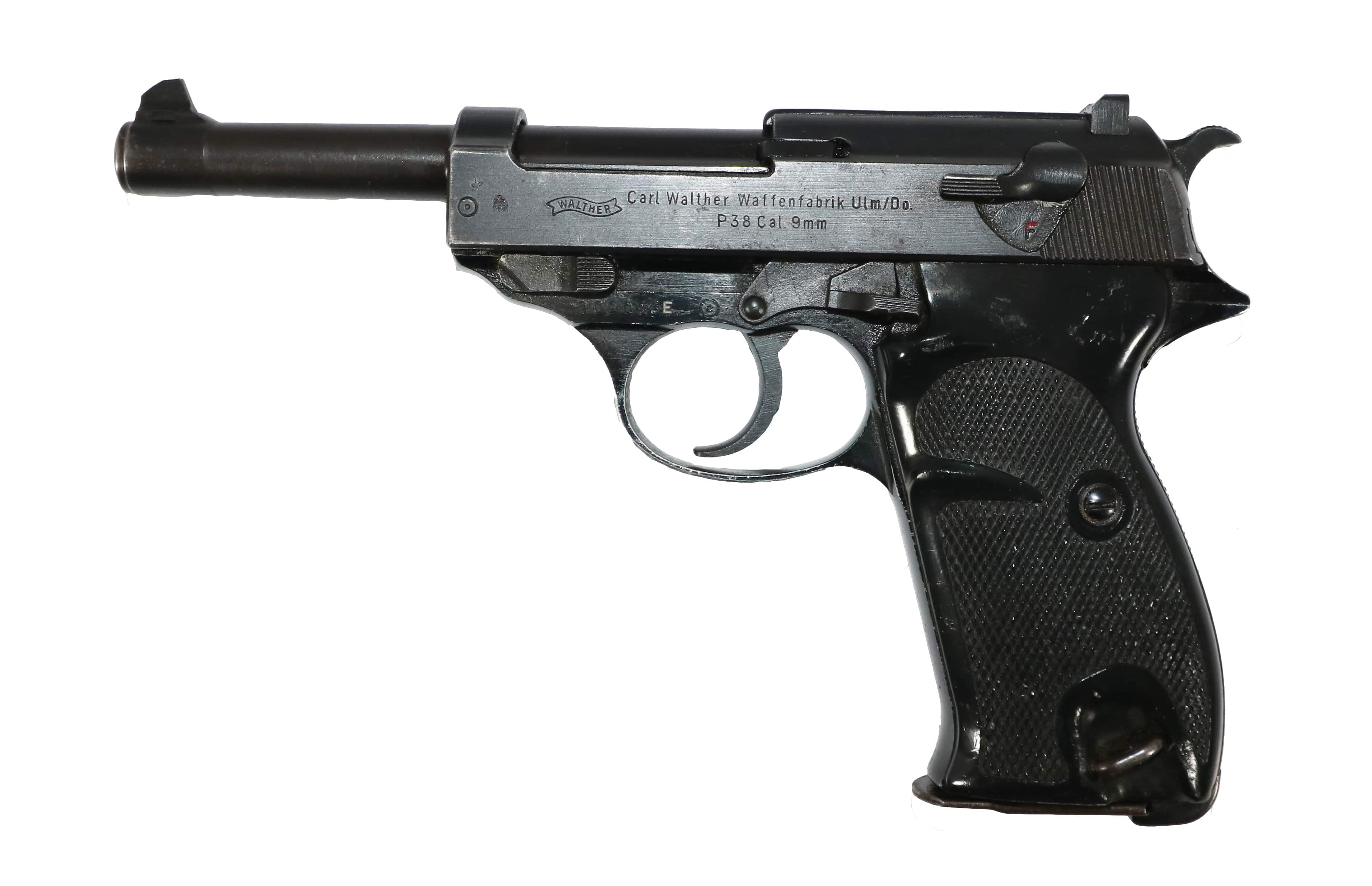
The discussion opens with the Walther P38 as a reference point for how semi-automatic pistols have evolved. The focus is on tracing development from some of the earliest successful semi-auto handguns to what would be considered modern designs. The video does not attempt to cover cutting-edge technology, but instead uses representative pistols to illustrate major design steps. A contemporary Beretta 92 is presented as an example of a modern handgun, contrasted against much earlier designs to show how mechanisms, ergonomics, and features have changed over more than a century of semi-automatic pistol history.
One of the first successful semi-automatic pistols highlighted is the Borchardt C93, designed in 1893. It used a toggle-lock mechanism derived from Hiram Maxim’s machine gun design, resulting in a distinctive profile with a “snail back” and a steep, perpendicular grip angle that appears awkward by modern standards. The Borchardt C93 was chambered in 7.65x25 Borchardt and attracted both civilian interest and military evaluation as forces considered moving from revolvers like the Webley and Nagant to semi-automatic sidearms. Early cartridges such as the Borchardt and later the Mauser and Tokarev 7.62x25 are noted as bottlenecked pistol rounds, a configuration that was common at the time but is relatively rare in modern handguns.
The Luger pistol is presented as a development of the Borchardt concept, retaining the toggle-lock action but in a more refined form. Developed in 1898, it was first adopted by Switzerland in 1900, including in 7.65x21, also known as .30 Luger. The German Navy adopted it in 1904, followed by the German Army in 1908, with Germany using it in 9x19mm Parabellum. The toggle system uses a knee joint that stays locked with the barrel briefly under recoil before a cam surface in the frame lifts the joint, allowing the toggle to break upward and the slide to cycle. This provides a locked-breech action suitable for higher-pressure cartridges, unlike simple blowback designs that would require impractically heavy slides. Despite its effectiveness, the Luger is described as expensive and complex to manufacture due to the number of precisely machined interacting surfaces.
The German military sought a more economical replacement for the Luger and eventually adopted the Walther P38. The P38 became the primary German service sidearm in World War II, although Lugers and even older pistols like the Mauser C96 remained in concurrent use while production ramped up. The P38 introduced features that align closely with modern service pistols. It uses a falling-block locking system inside the frame, providing a locked-breech action in 9x19mm. The pistol has a double-action/single-action trigger, allowing the hammer to be lowered and the first shot fired with a longer double-action pull, followed by lighter single-action shots. Some variants incorporate a safety that also functions as a decocker, lowering the hammer on a chambered round without firing. Magazine capacity is limited by a single-stack design, reflecting the era before reliable double-stack service pistol magazines became standard.
Production of wartime P38 pistols ran from about 1939 to roughly 1943. After World War II, manufacture resumed around 1957 with updated postwar models designated as the P1. A key change was the adoption of an aluminum frame instead of the original steel frame, reducing weight while retaining the same basic operating system. The examples discussed on the table are 1960s-era P1 pistols, representative of this postwar production. The design remained in service with the German military for decades, with the P1 serving as a standard issue sidearm until it was replaced by the HK USP9 around 1993. This long service life illustrates how a pistol design originating in the 1930s continued to meet military requirements well into the late 20th century.
The comparison then shifts to the relationship between the Walther P38 and the Beretta 92 as examples of older and modern 9mm service pistols. With the P38 slide locked back, square notches in the frame for the internal falling block are visible. Similar locking recesses can be seen in the Beretta 92 frame through its open-top slide. Both pistols use a wedge or block under the barrel that locks the barrel and slide together for a short distance of rearward travel under recoil. Once the block drops out of engagement, the slide continues rearward to complete the cycle. Both are chambered in 9mm and use a double-action/single-action trigger system with decocker or safety/decocker controls, showing clear mechanical continuity despite the decades between their designs.
Modern pistols like the Beretta 92 add features that were not present on earlier designs such as the P38. The Beretta shown includes an accessory rail for mounting lights, a threaded barrel for use with suppressors, and slide cuts that can accept optics mounting solutions, depending on configuration. Control options vary, with versions offering decocker-only or safety/decocker setups. The most significant functional difference is the use of a double-stack magazine, providing substantially higher capacity than the single-stack P38 and P1 magazines. These changes highlight how user needs and accessory compatibility have driven design evolution, even though the core locked-breech, recoil-operated mechanism and DA/SA trigger concept remain closely related to the earlier Walther system.
The segment concludes by emphasizing how far semi-automatic pistols have progressed from complex early designs like the Borchardt and Luger to more streamlined service pistols such as the Walther P38 and Beretta 92. Early pistols often appear overengineered by modern standards, but they established the principles that later designs refined. To illustrate practical differences, the plan is to take a Luger, a P38, and a Beretta 92 to the range. Shooting them side by side will show how each functions in the hands of a shooter, how their ergonomics compare, and how design changes over time affect handling and performance while still using broadly similar calibers and operating systems.





















 Loading...