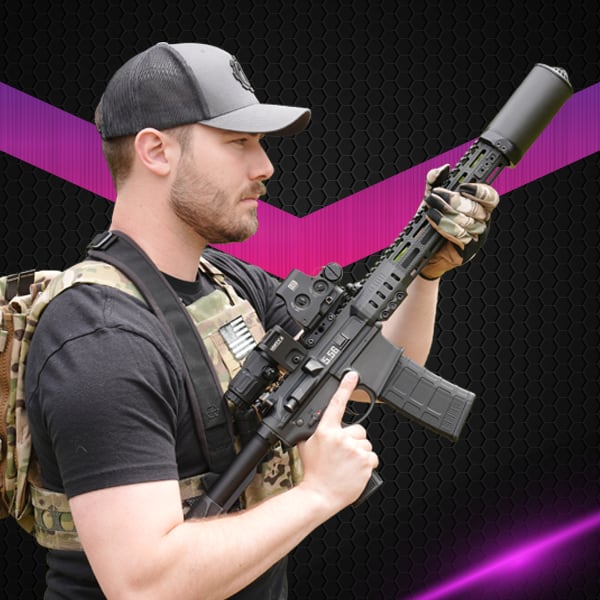
The video opens with Clint from Classic Firearms visiting Q in New Hampshire to unpack why the Honey Badger SD SBR exists and how it compares to legacy integrally suppressed platforms. The conversation immediately frames the Honey Badger SD as a modern answer to the MP5 SD’s role in close-quarters battle and signature reduction. They explain that integrally suppressed guns, whether 9mm or 300 Blackout, run significantly dirtier than non-SD guns because fouling and gas travel back up the bore into the action, demanding cleaning three to five times more often. The hosts then examine the compromises of cutting down 5.56 barrels on platforms like the Mk18, shortened M4s, and HK416s, where velocity and effective range are sacrificed for compactness. Kevin details the MP5 SD’s vented barrel with roughly 32–34 ports that bleed gas to keep 115–124 grain 9mm subsonic, which dramatically reduces performance. This performance loss and CQB requirement set the stage for developing a cartridge optimized for short barrels and suppression.
The discussion turns to the specific SOCOM special warfare requirement that led to 300 Blackout. Units wanted AK-like 7.62x39 performance from a short-barreled AR platform, with both effective supersonic capability and heavy subsonic bullets for signature reduction. Severe case taper on 7.62x39 caused feeding and capacity issues in the AR magwell and weakened bolts, so engineers moved to a 5.56-based case necked to .308. They had to design .308 projectiles with the right ogive to feed reliably in standard M4 magazines while functioning as both super and subsonic loads in a single gun. This allowed one platform to cover CQB and distance roles. The hosts contrast the MP5 SD’s heavily reduced 9mm, with limited effective range, against the Honey Badger SD’s ability to ring steel at 350 yards. With 300 Blackout, the Honey Badger SD becomes both an offensive CQB weapon and a defensive gun at distance, while retaining familiar AR ergonomics and significantly lighter weight than roller-delayed 9mm subguns.
Attention shifts to direct comparison between the Honey Badger SD and the MP5 SD, as well as short 5.56 carbines. The Honey Badger SD is presented as a newer, more capable design that outperforms the older German HK platform in weight, accuracy, and versatility. Unlike the MP5 SD, which is locked into 9mm subsonic performance, the Honey Badger SD runs both subsonic and supersonic 300 Blackout effectively. They compare a 10.3-inch 5.56 Mk18-style setup to a suppressed 300 Blackout Honey Badger, noting that 5.56 loses much of its intended terminal performance from very short barrels, while 300 Blackout is purpose-built to remain effective in those lengths. The AR/M4/M16 platform’s modularity is highlighted: users can swap only the barrel to move between 5.56 and 300 Blackout, keeping the same bolt, magazines, controls, and muscle memory. The MP5’s roller-delayed system is criticized as heavier, less reliable, and less accurate, with a non-swappable, inferior trigger, whereas the Honey Badger accepts standard AR triggers, giving users better ergonomics and customization.
The video then covers Sonoran Desert Institute’s distance education programs briefly before diving back into the Honey Badger SD’s role in the Low Visibility Assault Weapon (LVAW) program. The Honey Badger SD uses a dedicated, 1.5-inch diameter titanium silencer tucked under a compact handguard, engineered to meet strict size, weight, and accuracy requirements for low-visibility operations. Design decisions include omitting a forward assist and eventually deleting the dust cover after torture testing revealed the dust cover spring could break and induce malfunctions. These parts add complexity and liability for scenarios most civilian owners will never encounter. The rifle features a free-floating handguard with full top rail and M-LOK slots, a stainless match barrel with a fast 1:5 twist optimized for 300 Blackout, a Radian charging handle and selectors, and a compact Magpul grip inspired by the MP5. A shortened recoil system enhances concealability. The team explains why they did not choose a piston system, arguing that pistons are not inherently more reliable or cleaner with silencers, since most fouling enters through the bore, and SOCOM focused on performance results rather than dictating gas system type.
Next, the Honey Badger is compared directly to the SIG MCX, which competed in the same military space. Testing showed the MCX piston gun was quieter and more accurate, largely due to a longer barrel and newer silencer technology, but it was also heavier and, according to Q’s data, four times less reliable than the Honey Badger. SOCOM’s evaluation emphasized actual performance metrics rather than whether a gun used piston or direct impingement. In the final down-select, the Honey Badger and a SIG gun remained, with SIG likely chosen because Remington, Q’s then-parent, was collapsing and long-term support was a concern. The segment also touches on the Honey Badger’s cultural footprint, including its appearance in Call of Duty through technical consulting with Infinity Ward and the use of Q’s firearm audio in films like Saving Private Ryan and Band of Brothers. They then explain the Honey Badger’s adjustable gas block, factory-set to run both subsonic and supersonic .300 Blackout from quality manufacturers such as Hornady, Black Hills, SIG, and Federal, while allowing users to fine-tune for dedicated subsonic use without adding weight to the gas system.
The focus moves to the Honey Badger SD SBR’s adjustable gas block and the engineering around it. Q designed an adjustable block that weighs no more than a fixed unit, yet allows precise tuning for subsonic or supersonic ammunition so the rifle cycles reliably and locks open on the last round. An M-LOK slot is intentionally positioned to give direct Allen wrench access to the gas block, eliminating the need to remove the handguard for adjustments. Q’s philosophy extends to hardware: they design and manufacture proprietary screws with specific heads and thread pitches to optimize clamping force on new handguard systems instead of using generic fasteners. This attention to detail yields Honey Badger rifles that are roughly a pound to a pound and a half lighter than comparable setups. Their Cuser and QERT handguards come in at about half the weight of many competitors while offering less deflection and better return to zero. These gains come at higher component costs, such as $5 custom screws, but are justified as real, measurable performance improvements rather than cosmetic upgrades.
The conversation broadens to Q’s overall product development approach. The company embraces long testing cycles for products like the Boom Box, QERT handguard, and a new trigger, preferring to release items only when they are fully refined rather than rushing to market. Design goals include making guns 20–25% lighter than competitors while increasing stiffness, reducing deflection, and improving return-to-zero, ensuring that weight savings do not compromise performance. As a founder-owned company, Q contrasts itself with public or private equity–owned firms driven by quarterly targets. Engineers are paid fairly, not pressured by artificial deadlines, and are encouraged to innovate details such as non-marring, snug-fitting upper and lower receivers. The owner emphasizes a mission to support tier one military units, with capabilities developed for hunting terrorists directly translating to self-defense, law enforcement, municipal protection, home defense, and hunting, including African game. This alignment between elite military needs and civilian applications shapes every design decision and testing protocol.
Q’s culture is further illustrated through its people and daily operations. Engineers personally handle magazine loading, live-fire testing, high-speed video capture, and data recording, rather than delegating to a separate test department. This hands-on approach ensures that those who design the products also directly validate performance claims. The team’s passion is evident in their willingness to stay after hours, attend dinners, and educate visitors without seeing it as a burden, treating the company as their own. Engineers often choose to invest in expensive new machines and capabilities instead of pushing for personal raises, understanding that better equipment shortens R&D cycles and improves products. Leadership sacrifices personal pay to fund these investments. The segment underscores that firearms like the Honey Badger and Boom Box are built for serious, sustained use, not just occasional range trips. The visible pride and ownership among staff reinforce the message that Q’s guns are engineered for demanding end users who rely on them professionally and in high-stakes environments.
Returning to the Honey Badger SD, the hosts explain why it is far more than a flashy “Gucci range toy.” Engineering choices start with a lightweight aluminum barrel nut that reduces weight and heat at the chamber, paired with a stainless steel match barrel in 300 Blackout designed to maintain accuracy over high round counts. The muzzle uses a tapered interface for secure, repeatable direct-thread suppressor alignment. An adjustable gas block with a jam nut lets users optimize reliability with both super and subsonic ammunition without over-gassing the system. Internally, a two-piece bolt carrier is tuned for ideal bolt balance, and the rifle features a three-pound, drop-safe trigger with an extremely short reset that still meets NATO and U.S. safety standards. A shortened recoil system is engineered to mimic the recoil impulse of a standard AR with a full-length receiver extension, preserving familiar feel in a compact package. Extensive high-round-count testing validates these design decisions. Every part on the gun is custom, explaining the higher cost and underscoring its purpose-built nature.
The video then moves to the range for a practical demonstration of 300 Blackout’s capability through the Honey Badger and Honey Badger SD. The shooters attempt hits at 350 yards using subsonic ammunition and red dot optics with no magnification, a demanding test for both shooter and platform. They estimate a roughly six-foot holdover above the berm to compensate for the heavy, slow-moving bullets. Through trial and adjustment, they work out elevation and slight wind holds, commenting on the noticeable projectile travel time before hearing the steel gong ring. The exercise highlights how well-tuned subsonic 300 Blackout can still deliver consistent hits at extended distances when paired with a properly engineered integrally suppressed SBR. Observers note the satisfaction of hearing impacts after the delay, reinforcing earlier claims that the Honey Badger SD is not limited to close-quarters roles but can credibly engage targets at several hundred yards, even with quiet, subsonic loads designed for maximum signature reduction.
After demonstrating the Honey Badger at distance, the focus shifts to an 8.6 Blackout gas gun nicknamed the Boom Box, described as the Honey Badger’s big brother. Shooters remark on how the Boom Box feels at the muzzle, noting surprisingly low recoil that is comparable to, or only slightly more than, the Honey Badger despite firing much larger projectiles. They are impressed by its controllability and overall performance. The cartridge showcased is a 300-grain Sierra MatchKing, a .338 projectile seated in a shortened 6.5 Creedmoor-based case. The Boom Box is built on an SR-25/AR-10 style platform with modularity that allows barrel swaps to calibers like 6 Creedmoor, 6.5 Creedmoor, and .308 while keeping overall weight around five pounds, even in a 16-inch DMR-style configuration. The short-chop 8.6 suppressor is noted for being relatively quiet, with shooters comfortably firing at the muzzle without additional ear protection, underscoring the effectiveness of the integrally tuned system.
The hosts dive deeper into 8.6/86 Blackout ballistics and design rationale. They claim that subsonic rounds from an 8-inch 8.6 barrel deliver more energy at 600 yards than a .45 ACP 1911 at point blank, and more energy at 1,000 yards than a .308 Winchester, highlighting the round’s heavy-bullet, high-rotation wounding capability. Skepticism about 8.6/86 Blackout is addressed by comparing it to 375 Raptor. While 375 Raptor can suffer feeding issues in SR-25 magazines due to bullet ogive and internal mag rib interaction, 8.6 uses a .338 bullet in a necked 7.62x51/.308 case to avoid magazine modification and ensure consistent feeding. This cartridge was developed by the same team behind 300 Blackout, leveraging lessons learned about magazine geometry and projectile design. With both subsonic and supersonic loads, 8.6/86 Blackout is positioned as capable of taking any animal in the world, making it suitable for hunting the largest game while also offering tactical and defensive applications in a compact, suppressed gas-gun platform.





















 Loading...