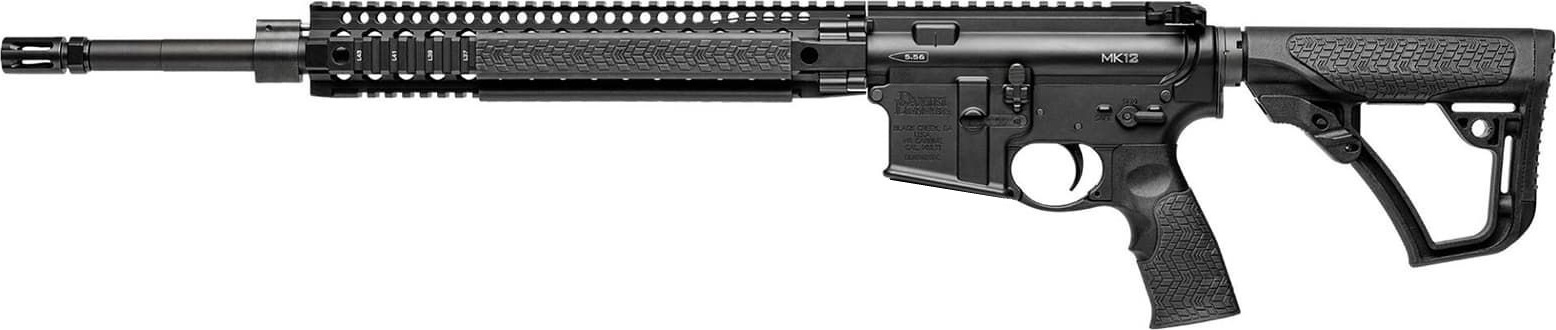
The video opens with a brief note about properly tightening the suppressor on a Mk12 to avoid gas leaking from the muzzle area. The hosts then introduce the Daniel Defense Mk12 and frame it within the history of the Mk12 program during the Global War on Terror. They describe the Mk12 as one of the most recognizable platforms of that era, used in both clandestine and conventional combat environments for short- and long-range engagements. The rifle shown has seen range use, including being fired from the back of a truck. The discussion emphasizes the Mk12’s reputation as a capable and proven platform with an 18-inch barrel configured for precision work.
Attention shifts to the Allen Engineering suppressor, described as the same style used during military service from roughly the early 2000s through about a decade of GWOT use. The hosts note how quiet the AEM5 is on this setup and how well the rifle shoots with it attached. They highlight Daniel Defense’s gas-busting charging handle, which reduces gas blowback to the shooter’s face, especially important on a direct-impingement gun. The Mk12 uses an 18-inch barrel with an intermediate gas system rather than a standard rifle-length system, giving dwell times that work well both suppressed and unsuppressed. This configuration is credited with making the rifle a reliable, accurate “tack driver” while remaining relatively light.
The hosts describe the rifle as an SPR-style build intended for longer-range engagements while still being maneuverable. They note that, compared with carrying a 7.62 NATO platform like the M110 or a .308 rifle, this Mk12 configuration is lighter and faster, and allows the user to carry more ammunition. These traits make it well suited to the environments in which special operations units often work. They mention that many special operations personnel, including SEAL team members, have used Mk12 variants, and that numerous reference photos exist online showing different Mk12 mods such as Mod 1, Mod H, and Mod 2. The rifle’s role as a practical, fielded precision 5.56 platform is emphasized over heavier alternatives.
The optic on this Mk12 is a Leupold Mark 5HD 2-10x scope with a PR1 MOA reticle. The hosts comment that the reticle is MOA-based rather than mil-based and briefly joke about preferring a mil reticle such as a scaled-down Tremor 3. The scope is mounted in Mark 5 rings that provide additional height for comfortable eye relief. Up front, the rifle is equipped with a Harris bipod and a small angled foregrip, giving the shooter options for both supported precision fire and more mobile shooting. This combination of glass, mount height, and front-end accessories is presented as a practical setup for running the rifle from prone or a supported position as well as for moving and shooting.
The hosts handle the rifle with and without the suppressor attached, noting how light and well balanced it feels for an 18-inch Mk12. They emphasize that the rifle remains manageable even with the AEM5 installed, and feels even lighter and more agile when the suppressor is removed. The suppressor interfaces with an Ops Inc-style collar system that is partially shrouded by the handguard. The collar allows the suppressor to slide over and then thread onto the barrel, replicating the original Mk12 mounting method. They point out that this setup is about as clone-correct as possible for this type of build. A reminder is given to fully tighten the suppressor to prevent gas escaping around the mount during firing.
In closing, the hosts review additional details on the rifle. It features a quad rail with soft rail covers to improve comfort and heat management, a Harris bipod, and a polymer magazine, in this case a Daniel Defense-branded magazine. The trigger is identified as a Geissele unit, and the rifle includes an ambidextrous fire selector, a Daniel Defense pistol grip, and the Daniel Defense charging handle previously mentioned. A Magpul STR stock provides extra stability and a solid lockup on the shoulder. They reiterate that the locking collar and Allen Engineering suppressor are key clone-correct elements that were unavailable to the public for a long time. Daniel Defense’s Mk12 is described as a civilian-available interpretation of the historic platform, giving shooters access to a configuration closely tied to its operational roots.





















 Loading...