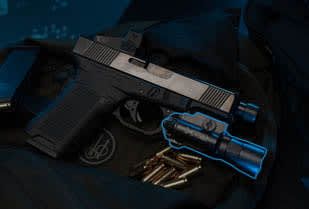
The video opens with an explanation of a dedicated outdoor, pitch-black test of weapon-mounted lights for both rifles and pistols. All testing is done with no moonlight or ambient illumination so performance comes entirely from the lights. Instead of focusing on technical specs like lumens, lux, and candela, the hosts translate those into practical categories: spill, flood, and throw. Two test setups are used. At 25 yards, a 15-yard-wide array of three targets evaluates spill and flood across the field of view, plus usable throw. A second setup at roughly 100 yards checks not just basic target identification but also fine detail, such as whether a drawn pistol or a rifle on the target can be seen. The SureFire X300 Ultra is used as an early benchmark. At 25 yards it scores around 3 for throw, 4 for spill, and 3 for flood, offering a balanced, general-purpose beam. However, at distances beyond 100 meters, its target detail drops to about 1, illustrating how environmental factors and distance quickly expose limitations.
The testing methodology is clarified further, using a 0–5 scale to rate throw, spill, flood, target identification, and target detail. The SureFire X300 Ultra is characterized as a mid-pack performer: around a 3 for close-range target detail, but falling to roughly a 1 at over 100 meters. Its approximate $340 price is highlighted to frame cost versus capability. Attention then shifts to the SureFire X300 Turbo. This model delivers a very tight, pointed beam with a throw score of 5, minimal spill around 2, and a flood rating near 3. At distances beyond 100 meters, the Turbo earns a 5 for target identification but only about a 2 for fine detail, emphasizing its specialization in long-range PID rather than nuanced discrimination. The segment wraps up the SureFire pistol lineup by stressing mission-based selection: the Turbo is favored for extended-range identification, while the X300 Ultra is recommended as a more generalized, closer-range pistol light within the SureFire ecosystem.
The focus moves to Streamlight pistol options, starting with the TLR-1 HL. This light shows a strong but somewhat wide throw, scoring about 3.5, with moderate spill around 3 and very visible flood at 25 meters. It works well for illuminating a broad area at typical handgun distances. However, at longer ranges its performance drops off, with target identification at roughly 1.5 and target detail around 1, making it serviceable but not ideal for long-range pistol use. Next, the Streamlight TLR-7 Sub X is evaluated. This compact light is heavily biased toward close work, with almost no throw (rated about 1), strong spill, and a very high flood score of 5. Up close, it excels at lighting everything in front of the shooter, but at distance it scores only 1 for target ID and 0 for target detail, struggling even on white, reflective targets. These results underscore that both Streamlight models are best suited to near-field defensive contexts rather than extended-range pistol engagements.
The video transitions from pistol to rifle-mounted lights, beginning with the SureFire Vampire (V model). This light is noted for its compatibility within the SureFire ecosystem and the option to purchase just the head for around $200 or a complete light for roughly $459. Despite a modest 250-lumen rating, the platform performs well in the outdoor tests. The hosts then evaluate a 250-lumen short-body weapon light head mounted on an existing body, illustrating how head swaps can change performance. Surprisingly, this compact setup delivers a throw score of about 3.5, spill at 3, and flood at 3.5. At 100 yards, it earns a 4 for target identification but only a 2 for fine target detail, meaning the shooter can tell a person is present but may struggle to discern exactly what is in the subject’s hands. This segment highlights that lumen count alone does not dictate real-world effectiveness, especially when beam shape and candela are optimized.
Attention shifts to the SureFire M600 Dual Fuel, a rifle light that can run on either two CR123A batteries or a single 18650 cell. A related M300 Dual Fuel variant uses one CR123A or one 18350, offering a more compact option. At close range, the M600 Dual Fuel scores about 3 for throw, 3 for spill, and 3 for flood, providing a balanced beam that clearly illuminates multiple targets across a roughly 180-degree field at 15 yards. However, at 100 meters its performance is less impressive, with target identification rated around 2 and target detail at 1, making threat discrimination challenging despite the light’s size and cost. The hosts note that these tests were conducted in very cold conditions, which can affect batteries and output. The segment then briefly introduces the SureFire M600 DFT Turbo, setting the stage for a more throw-focused option designed to overcome some of the long-range limitations seen with the standard Dual Fuel configuration.
The SureFire M600 DFT Turbo is evaluated as a dedicated long-range rifle light. It produces an extremely tight, high-throw beam with minimal spill and limited flood, prioritizing distance over peripheral awareness. In testing, this configuration enables clear target identification and recognition of fine details at 100 meters, making it ideal for users who need focused illumination on distant threats. The trade-off is reduced situational awareness off the centerline. The segment then turns to the Inforce WML Gen 3, a budget-friendly, single-cell 450-lumen option. This light offers moderate throw, strong flood, and relatively weak spill. At close range, the broad flood helps light up nearby areas effectively, but at longer distances the beam tends to wash out, reducing contrast and detail. The Inforce’s performance reinforces the pattern that lower-cost lights often struggle at extended ranges, though they can still serve adequately for home-defense distances and general-purpose use.
The SIG Foxtrot MSR is introduced as a notable exception to the usual budget-light compromises. Priced around $160, it includes the light head, body, mount, and a tape switch that uses a Safariland-style plug compatible with the broader SureFire/Unity/modbutton ecosystem. In close-range testing, the Foxtrot MSR earns mid-range scores of about 3 for throw and 3 for spill, with a stronger flood rating of 4 that provides generous illumination around the target. At roughly 100 meters, it achieves around 3.5 for target identification and 3 for target detail, with its high flood slightly hindering distant clarity but still delivering consistent, impressive performance for the cost. The discussion then shifts to the Modlite family, focusing on the PLHv2. A complete PLHv2 kit runs about $300–309 and is characterized by strong throw (around 4), lower spill (2), and solid flood (3). At 100 meters, it scores about 4 for target ID and 3.5 for detail, aided by its very crisp, white light output.
The Modlite PLHv2 impressions are briefly summarized with an overall score around 3.5, emphasizing its clean, white beam and balanced performance. The Modlite OKW is then examined as a more throw-focused sibling. Similarly priced but slightly more expensive than the PLHv2, the OKW earns a 5 for throw, with limited spill and flood both around 2. At 100 meters, it delivers outstanding results: target identification rated 5 and target detail at 4, making it one of the top long-range performers. The video then turns to Cloud Defensive’s REIN 3.0. This light is described as very focused and throw-oriented, with short-range throw around 4, minimal spill at 1, and flood at 3. At distance, it is a powerhouse, matching Modlite-level performance with target ID at 5 and detail at 4. The REIN 3.0 has a warmer hue compared to Modlite’s cooler white, and features an integrated tailcap housing plus included accessories around a $350 price point, though its two-size screw mounting system is noted as a minor ergonomic quirk.
Cloud Defensive’s lights are compared directly to Modlite, with emphasis on the Cloud’s warmer color temperature and exceptional durability. Anecdotes include a Cloud light surviving being run over and even shot with 12-gauge, underscoring its ruggedness and value given the included accessories. The MALOV series is then introduced as a modular option, allowing users to configure head, body, and a DS00-style tailcap or switch. A base MALOV setup is around $215. Performance-wise, it scores about 4 for short-distance throw, 3 for spill, and 2 for flood. At distance, it earns roughly 3.5 for target identification and 2.5 for target detail, placing it as a solid mid-tier performer. The Streamlight ProTac 2, an older ProTac series model around $150, is also evaluated. It comes as-is without extensive accessories. In testing, it scores about 3 for throw, 2.5 for spill, and a very strong close-range flood of 4 that starts at the shooter’s feet and expands outward. At longer ranges, it is less impressive, with target ID around 2.5 and detail at 2, requiring more effort to interpret what is happening downrange.
The discussion zooms out to frame the Streamlight ProTac series and similar lights within a broader price-to-performance context. The hosts note that ProTac performance generally aligns with its mid-range price: adequate for many users but clearly outclassed by premium options at long distances. They stress that environment plays a major role in light selection. For example, in snowy conditions, a wide, high-flood beam can reflect heavily off the ground and surrounding surfaces, potentially blinding the user or obscuring detail. Conversely, in dense foliage or humid Southern environments, throw and candela become more important to punch through atmospheric haze and vegetation. Viewers are encouraged to think about their typical surroundings—urban, rural, wooded, or open fields—when weighing spill, flood, and throw. This context sets up the final recommendations by showing that the “best” light is not universal, but depends on mission, budget, and operating environment.
The hosts name their value champions and overall favorites based on the outdoor testing. For pistols, the Streamlight TLR-1 HL is selected as the best bang-for-buck option, offering solid close-range performance at a relatively affordable price despite its limited long-range capability. For rifles, the SIG Foxtrot MSR is crowned the bang-for-buck winner, praised for its strong performance, included mount and tape switch, and roughly $160 price tag. When considering overall top performers, the SureFire X300 Ultra and X300 Turbo share the crown for pistols, with the choice depending on user needs: the Ultra for general-purpose use and the Turbo for extended-range identification. On the rifle side, the SIG Foxtrot MSR is again highlighted as the best overall light, though its fixed tailcap design locks users into the SureFire/Unity/modbutton ecosystem. That limitation is partially offset by built-in constant-on functionality and the practical performance demonstrated in the night testing.
The closing segment spotlights three standout weapon-mounted lights for long-distance rifle use: the Cloud Defensive REIN, the Modlite OKW, and the SureFire DFT. All three are described as top-tier performers that delivered excellent target identification and detail at 100 meters and beyond, making them prime candidates for users prioritizing long-range capability. Viewers are invited to comment with any lights that may have been missed and to suggest additional models for future testing, reinforcing that the comparison is extensive but not exhaustive. The hosts preview an upcoming indoor-focused test, noting that flood, spill, and candela can behave very differently inside structures, where reflection, confined spaces, and white walls change how beams perform. This future content aims to complement the outdoor results with a more home-defense and CQB-oriented perspective. The video ends with appreciation for viewers and customers, along with a brief sign-off acknowledging the support that makes such in-depth testing possible.










 Loading...