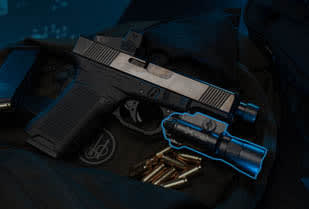
The video opens by framing a direct comparison between a roughly $1,000 2011-style pistol and an $8,000–$10,000 high-end 2011 modeled after the Atlas/Arabus Sand Viper. The hosts reference the Sand Viper’s pop-culture status from movies like John Wick and The Accountant 2, positioning it as the aspirational, “bougie” 2011 benchmark. The budget gun is identified as a MAC 19 double-stack 1911 manufactured by Tisas, with a note that a newer version exists but was not available for testing. They describe the Tisas/MAC as a solid, good-feeling pistol right out of the box, setting expectations that it is not a toy or gimmick despite its price. The stage is set to see whether the premium 2011’s smoother recoil, advanced porting, and competition-grade trigger can realistically justify a price gap of around $6,000 or more for most shooters.
The hosts begin live fire with the Tisas/MAC 2011, getting a baseline for recoil, trigger feel, and general shootability. They quickly move to the Sand Viper-style 2011 and immediately notice a significant difference in how the gun behaves under recoil. The high-end pistol feels much smoother, with less perceived kick and a notably crisper, competition-style trigger that breaks very cleanly. They attribute much of the recoil advantage to the compensator and porting layout, which uses multiple upward ports and slots to keep the muzzle flatter. Even though the premium gun is heavier, it feels less snappy and more controlled. However, the shooters already begin questioning whether this performance improvement alone can justify a roughly $6,000 price difference when the Tisas still feels competent and controllable on the range.
Attention turns to the technical differences in port and compensator design between various 2011-style pistols. The hosts explain why they prefer multi-slot porting, similar to what is seen on the P211, because it tends to produce a smoother, less abrupt recoil impulse. They contrast this with other port layouts that can feel sharper or more vertical in their movement. Trigger quality becomes another major talking point. The more expensive, competition-coated 2011, akin to the Sand Viper, is praised for having an exceptionally clean, light trigger that feels purpose-built for speed shooting. In contrast, the Tisas 2011’s trigger is acknowledged as not being in the same league, yet still impressively good for a pistol at its price point. This leads to a recurring theme: the performance gap exists, but the $6,000–$7,000 cost difference is difficult to rationalize for many shooters.
The shooters start running structured drills, including Mozambique and Bill Drill style exercises, to stress-test both the Tisas and the Sand Viper under speed and pressure. With the Sand Viper, they note extremely light trigger pulls and very tight groups, especially when pushing cadence. The gun’s compensator and porting help keep the muzzle flat, allowing fast follow-up shots and quick transitions between body and head shots. When they switch back to the Tisas, it continues to perform better than expected, holding its own in terms of accuracy and control despite a less refined trigger and simpler porting. The Atlas Arabus is introduced as another high-end benchmark, described as possibly the nicest 2011 on the market at around $9,000. This sets up a three-way context: a budget Tisas, a pop-culture Sand Viper, and an ultra-premium Arabus/Erebus-level 2011.
The discussion broadens to the 2011 market, where many pistols live in the $5,000–$10,000 range. Against that backdrop, the Tisas is framed as a true budget outlier that still competes in function. Timed drills are run and A-zone hits are called out, showing that the Tisas can deliver practical accuracy. Reliability is examined when a Mec-Gar magazine causes a failure to eject, following earlier issues with an Airsoft-style magazine. The hosts note that the gun may be intermittently hiccuping, but they also recognize that magazine choice and ammo can influence performance. Recoil characteristics are highlighted: the compensator keeps the gun extremely flat, so flat that shooters initially start hitting low because they are used to Glock-style muzzle rise and dot tracking. They adjust their grip and visual tracking to accommodate the different recoil pattern before preparing to run a Mozambique drill with the Sand Viper using 115-grain 9mm ammunition.
With 115-grain 9mm ammunition, the hosts focus on multiple live-fire strings using the Sand Viper. The trigger is described as almost binary, with essentially no take-up or prep, demanding careful discipline to avoid unintended doubles while still shooting fast. They work through Mozambique-style drills, emphasizing the challenge of consistently picking up the red dot during rapid transitions from body to head. A specific recoil-driven technique from training classes is referenced, where the shooter uses the gun’s movement to time the shift from torso to head shots. Comparisons to the Tisas continue: the Sand Viper feels smoother, softer, and more refined, but the Tisas still clearly competes in both performance and reliability. One of the shooters even considers purchasing a Tisas based on how well it runs. This segment closes by setting up the build drill, defined as six rounds into the A-zone at seven yards as fast as possible, to be run with the Tisas, Sand Viper, and later the Arabus/Erebus.
The build drill becomes the central test, designed to expose differences in recoil control, trigger management, and consistency. The hosts explain the standard: six rounds, seven yards, all into the A-zone as quickly as the shooter can manage. They begin with the Tisas 2011, observing how the dot tracks and how the compensator helps keep the muzzle from climbing excessively. Shot placement is examined closely, with comments on whether rounds stack vertically or spread horizontally. Switching to the Sand Viper, they note how its extremely light trigger and tuned comp allow for very fast splits and tight clusters, but also demand more discipline to avoid outrunning the dot. The plan is to repeat the drill with the Atlas Arabus/Erebus as well, using the same distance and round count to keep the comparison fair. Throughout, they emphasize that shooter skill plays a major role, not just the hardware.
Multiple build drill strings are run back-to-back, and the hosts analyze the resulting groups in detail. They point out instances where several shots land in essentially the same hole, demonstrating how both the Tisas and Sand Viper can deliver impressive precision when the shooter does their part. Round counting becomes a minor challenge as they push speed, occasionally losing track of whether six shots have been fired. Differences in recoil impulse and dot movement are highlighted: one gun tends to produce more vertical stringing, while the other yields tighter, more horizontal clusters. A notable moment occurs when the Sand Viper’s ultra-light trigger and slide behavior make it feel almost like the gun is out of battery, suggesting a near-malfunction that never fully materializes. By the end of this segment, the consensus is that both pistols perform extremely well, and the question remains whether the Sand Viper’s marginal gains justify a $6,000 premium for most users.
The conversation shifts explicitly to value. The hosts debate whether a Staccato-style Sand Viper truly earns its roughly $6,000 price premium over a capable budget 2011 like the Tisas. To deepen the comparison, they bring in another high-end option: the Atlas Erebus V3, priced in the $8,000–$10,000 range. The goal is to see how the Erebus stacks up against the Sand Viper in terms of recoil, trigger feel, and overall shootability. They acknowledge the Sand Viper’s strong aesthetic appeal and movie-driven desirability but question whether that alone should drive purchasing decisions. The Erebus is positioned as a more competition-tuned, performance-first pistol, potentially offering an even softer shooting experience. This sets the stage for live-fire testing of the Erebus with the same 115-grain ammunition, knowing that tuning and ammo choice may significantly affect reliability and feel.
Live fire with the Atlas Erebus V3 reveals a different set of trade-offs. While shooting 115-grain 9mm, the hosts encounter multiple malfunctions, including failures to eject and the slide not cycling fully to the rear. They attribute these issues to a combination of light ammunition, competition-oriented tuning, and possibly less-than-ideal grip firmness, joking about limp-wristing. Despite the reliability hiccups, the Erebus impresses in terms of feel. It is described as slightly smoother and softer-shooting than the Sand Viper, largely due to its additional weight and refined setup. The grip texturing earns praise for providing excellent control without relying on a traditional grip safety paddle, which some shooters dislike. They even joke about the gun behaving like a “single-shot” when it malfunctions. If money were no object, several comments suggest the Erebus might be the preferred choice, even though the Tisas remains a standout for value.
Returning to the Tisas 2011, the hosts emphasize how surprisingly well it performs relative to its price. In some strings, groups from the Tisas are as tight or even tighter than those from the higher-end 2011s, reinforcing that spending more does not automatically buy skill. They discuss how the 2011 platform demands different recoil management compared to a Glock, particularly in how the red dot tracks and returns to target. Shooters accustomed to Glock-style flip must adapt to the flatter, more linear recoil of a compensated 2011. The Tisas is framed as a bridge between familiar duty pistols and expensive, high-end 2011s, allowing shooters to experience the platform without going into debt. It offers a realistic way to learn dot tracking, grip, and trigger control on a double-stack 1911-style frame before deciding whether a $5,000–$10,000 upgrade is truly necessary.
In the closing moments, the hosts reinforce the idea that the Tisas 2011 makes the 2011 platform more accessible to a wider audience. Shooters can experiment with compensated, double-stack 1911 ergonomics and dot behavior without committing to a Sand Viper or Atlas-level investment. They reiterate that heavier, more expensive pistols do not substitute for fundamentals like grip, stance, and trigger control. To illustrate recoil sensitivity, they film humorous outtakes where exaggeratedly tight or awkward wrist positions induce malfunctions, prompting over-the-top reactions on the range. These clips underline how shooter input can make even high-end guns stumble. The video ends on a light note, but the core message remains clear: a well-made budget 2011 like the Tisas can deliver serious performance and serve as a smart entry point before chasing ultra-premium 2011s for marginal gains.












 Loading...