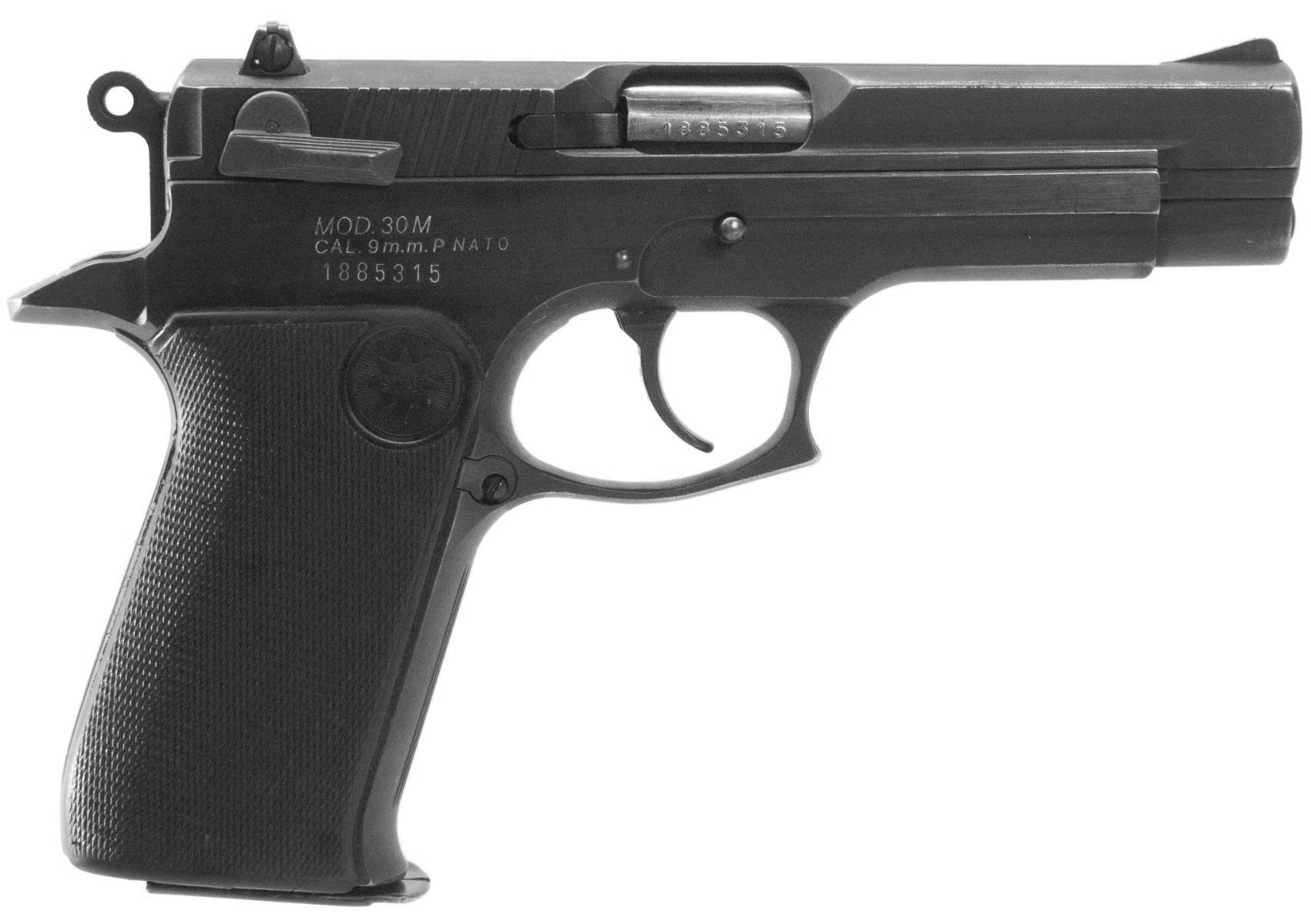
The video opens with Brandon and Matt introducing the Star Model 30M, a surplus 9mm “Wonder Nine” pistol. They explain that the 30M is a variant of the Star Model 30, which itself evolved from the earlier Star Model 28. Unlike Star’s older 1911-style pistols such as the Model B and BM, the 30M is a double-stack, all-metal service handgun with a 15-round magazine. It uses a traditional double-action/single-action system, allowing the first shot to be fired double-action with subsequent shots in single-action. Safety features include a magazine safety and a mechanism that retracts the firing pin for added drop safety. The hosts estimate the pistol’s weight at around 3 pounds and the barrel length at roughly 4.25 inches. They describe the sight setup as a molded front sight paired with a replaceable rear notch, sometimes featuring different paint configurations. Production dates are outlined: the Model 28 from the early 1970s, the Model 30 around 1981, and the Model 30M produced approximately from 1983 to 1994.
The discussion shifts to how the Star Model 30M developed from the Model 28 and 30. The Model 28, which competed in the 1977 U.S. Air Force trials but lost to the Beretta 92, was the foundation. The later Model 30 and 30M refined that design with a less bulky slide and a slightly lighter front end. A small notch was added near the rear of the slide to improve purchase on the otherwise minimal rear serrations, while ambidextrous safeties were retained. The hosts note evolving grip materials and textures: early Model 28s used straight plastic, while later guns adopted more rubberized plastic, with variations such as fully checkered grips or horizontally serrated backstraps. Surplus examples may show mixed parts due to interchangeability. Mechanically, the 30M is a recoil-operated, locking-breech, linkless Browning-style pistol similar to the Browning High Power. It combines this with CZ75-style internal slide rails, where the slide rides inside the frame rails rather than outside like a 1911, influencing handling and feel.
The hosts highlight the Star 30M’s slide and frame interface, emphasizing that the slide runs inside the frame rails in a CZ75-like fashion, contrasting it with the external rail arrangement of a 1911. They then cover the pistol’s service role, noting its use by the Spanish Navy and Army, as well as police forces in Spain and Peru. Particular attention is given to frame markings, including the “GC” stamp indicating issue to the Guardia Civil, and two-digit numbers that likely denote year of manufacture. To give real-world data, they weigh two Star 30M pistols with empty magazines. One comes in at about 2.35 pounds, with the other slightly heavier, illustrating manufacturing variation similar to odd weight differences they have seen in other pistol models. Measurements show an overall length of about 8 inches, a height around 5.5 inches, and an approximate barrel length of 4.25 inches, with the caveat that a proper barrel measurement should be taken using a rod to the breech face.
Attention turns to the Star Model 30M’s trigger performance, measured with a pull gauge. In single-action, the pistol consistently breaks around 3.3 to 3.6 pounds, which is relatively light for a duty-style handgun. The double-action pull measures approximately 9.3 to 9.4 pounds. While not especially light, the double-action stroke is described as smooth, likely due to wear-in from prior service use. The trigger has a bit of smooth take-up, followed by a defined wall and a crisp break in both modes, contributing to good shootability. The slide is noted to cycle very smoothly, again reflecting extensive but even wear. The presenters then explain surplus grading terminology for these pistols. The examples shown are graded as “good” condition, meaning they are fully functional and mechanically sound, may show notable cosmetic wear, but generally lack pitting. Any replacement parts should be correct for the model, preserving proper function and configuration despite their surplus status.
The final portion focuses on what buyers can expect from surplus Star 30M pistols. The example shown exhibits visible finish wear but no rust, illustrating typical cosmetic aging without structural damage. Replacement parts, such as grips, may vary, with some guns wearing earlier Model 28-style plastic grips and others featuring later rubberized panels, yet all should remain correct for the platform. Despite its age, the Star 30M is presented as a fully functional, practical 9mm self-defense pistol with a 15-round capacity. Its substantial size and weight, however, make it less ideal for everyday concealed carry compared to more modern, lighter designs. The hosts emphasize the historical appeal of owning a pistol that may have served with the Spanish Army, Navy, or police forces, giving it dual value as both a capable shooter and an interesting collectible. The video closes by inviting viewers to leave reviews and comments about their experiences with Star pistols, including the 28, 30, 31, and 30M, before heading out to shoot the guns.





















 Loading...