

















 Nations that must fight for survival often have a robust arms industry, and Israel is no exception. Israel Weapons Industries (IWI) has a storied past when it comes to producing firearms for the Israel Defense Forces (IDF) and foreign customers. Since the 1930s, IWI is responsible for crafting some of the most combat-proven guns in the world. The History of IWI Israel had a burgeoning small arms industry since before WWII. At that time, the nation that would become Israel was called the Mandate of Palestine and was controlled by the United Kingdom. In 1933, Israel Military Industries (IMI) originated to produce firearms so that Jewish residents could arm themselves against aggressors. This ability to build guns would be crucial for the future Jewish nation to preserve itself in the Middle East, and IMI became the state-owned arsenal. After WWII, IMI obtained tooling and equipment from America to produce more advanced firearms. During the Cold War period of Israel's history, IMI produced some of its most noteworthy guns, such as the Uzi submachine gun and Galil rifle discussed below. In addition to small arms (rifles, pistols, submachine guns, etc.) IMI produced larger military systems like bombs and missiles. In 2005, the Israeli government decided to spin off IMI's small arms division by creating Israel Weapons Industries (IWI)
. IWI became a private business responsible for making small arms for the IDF and other military customers. SK Group, a South Korean holding company, is the current owner of IWI. While the two companies are separate, IWI represents the modern incarnation of IMI for firearms on both the American and world commercial market. Notable Products Uzi Submachine Gun One of the first successful products made by IWI was the Uzi 9mm
submachine gun. The Uzi went on to become one of the most widely used submachine guns of the post-WWII era. Submachine guns are fully automatic and fire pistol-caliber cartridges. Developed in the late 1940s by Uziel Gal, a soldier in the IDF, the Uzi provided the IDF with the compact firepower of a modern submachine gun. By the mid-1950s, the IDF fielded Uzis in high numbers for various types of personnel, from secondary reservists to front line soldiers. The Uzi was both modern and traditional by submachine gun standards at the time. It featured a highly effective blowback operation that was typical in its contemporaries. Blowback firearms do not have a locked bolt (the part that cycles ammunition). Instead, they use a heavy bolt and stiff recoil spring to slow the opening of the bolt after firing. Lightweight sheet steel stampings lowered weight and saved money in the manufacturing process without sacrificing durability. Lastly, a novel telescoping bolt made the Uzi compact. Most blowback-operated submachine guns rely on a long bolt to make blowback operation effective. In the Uzi, most of the weight of the bolt wrapped around and sat in front of the barrel. The telescoping bolt of the Uzi made it smaller than other submachine guns at that time. In addition to serving with the IDF, countless nations and security forces adopted the Uzi. It went on to become a cultural icon for how submachine guns looked. After nearly 50 years of service, the IDF retired its Uzis in the early 2000s. However, the Uzi set the standard for modern submachine guns and is still in operation around the world. 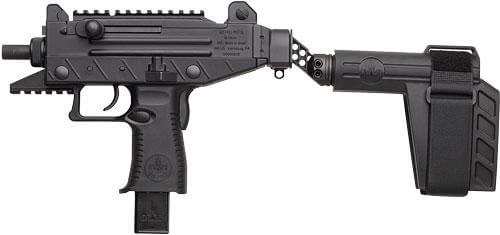
The IWI Uzi Pro is a modern semi-automatic 9mm pistol version of the classic Uzi submachine gun.
Galil Rifle Like many western nations in the 1950s, the IDF fielded a version of the Fabrique Nationale FAL 7.62 NATO
rifle as its standard service rifle. The FAL was an excellent rifle; but it required stringent cleaning in the dusty desert environment that the IDF found itself fighting in. During that time, Israel fought Arab nation coalitions armed with Soviet firearms, among them the AK47
. The AK47 chugged right through dust and sand, providing unrivaled reliability to the soldiers equipped with them. After being on the receiving end of AK47s, the IDF decided to pattern their next rifle after that firearm. As the 1970s rolled around, Israel looked to replace its aging FALs. IMI studied captured AK47s and the Finnish RK62 (a rifle based on the AK47) to design a new 5.56 NATO
service rifle. IMI christened this rifle the Galil. The Galil achieved impressive reliability due to its AK47 style long-stroke gas piston operating system. On top of offering incredible reliability, the Galil was compact and handy for all soldiers with its side-folding buttstock. The Galil was the official service rifle of the IDF starting in the early 1970s. However, in the mid-1970s, Israel began receiving military aid from the US, which included M16 rifles. These M16s
were both lighter and cheaper than Galils, so the IDF moved Galils to more secondary roles. Although the IDF did not fully utilize the Galil, other nations showed great interest in them. IMI sold Galils to many foreign nations' militaries, and allowed licensed production of Galils in other countries. Around 2008, IWI designed a modernized Galil called the Galil Ace with improved polymer parts. The Galil Ace achieved both military and commercial success, proudly carrying on the tradition of the classic Galil rifle. 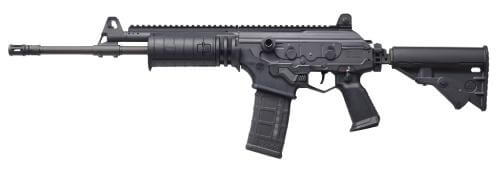
The modern 5.56 NATO Galil Ace rifle.
Tavor Rifle To remain up to date in small arms implementation, IMI again sought to replace the service rifle of the IDF in the mid-1990s. While the Galil and M16 served well in military service, IMI thought they could design a more compact rifle that increased durability more than currently issued rifles. After the IDF's experience fighting in the 1982 Israel-Lebanon War, they discovered a real need for firearms designed for close-quarters fighting. Their standard-issue rifles had long barrels that got in the way fighting in the narrow confines of cities. IMI decided on a bullpup rifle design that made extensive use of polymer to cut weight and increase durability. Bullpup rifles feature a pistol grip in front of the action (the mechanism that feeds ammunition), and the action itself is at the very rear of the receiver (the firearm frame). Rifles with a bullpup
configuration maintain a short overall length with a long barrel, which aids in performance. Like the Galil that came before it, designers incorporated a long-stroke gas piston system to promote high reliability. This modern bullpup rifle became the 5.56 NATO Tavor. Around 2006, the IDF adopted the bullpup Tavor rifle made by the privatized IWI
. Being a compact bullpup, the Tavor was ideal for all soldiers regardless of their mission. The IDF still issues the Tavor in various models. In addition to fully automatic Tavors, IWI also produces semi-automatic versions, which are quite popular on the US commercial market. The Tavor is the latest in a line of IWI/IMI rifles made tough for desert fighting. 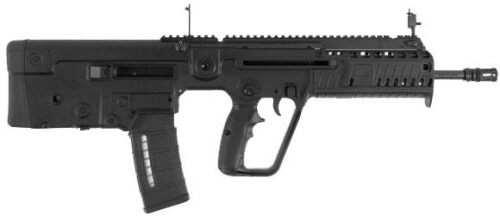
The Tavor X95 is the latest semi-automatic 5.56 NATO Tavor available on the commercial market.
Conclusion Compared to its neighbors, Israel is a tiny country. But despite its small size and short history, Israel's small arms industry has made a considerable impact on the world of firearms. Whether manufactured under the historic IMI brand, or the current IWI label, these firearms stand the test of time. Shop our line of IMI and IWI long guns
and handguns
.
Brand Spotlight: IWI
Israel Weapons Industries (IWI) has a storied past when it comes to producing firearms for the Israel Defense Forces (IDF) and foreign customers.
Posted on Nov 08, 2019 in
General
By Pete Steele



 Loading...