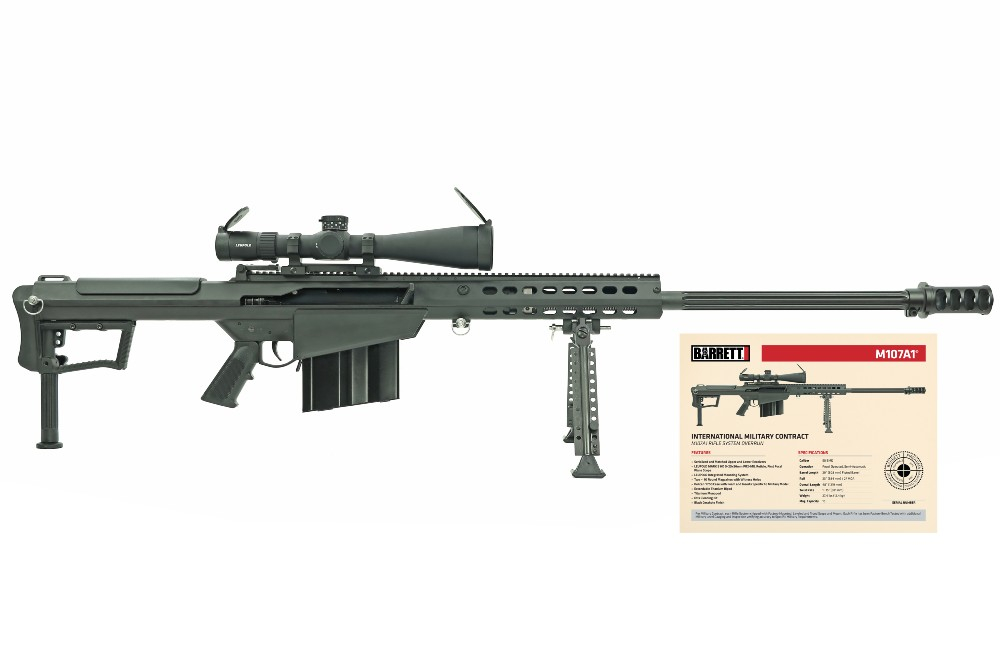
The hosts introduce a Barrett M107A1 .50 BMG rifle built as an international military contract deployment package. It features a 29-inch barrel with a large compensator and ships with two 10-round magazines that have witness holes on the back. The rifle is topped with a Leupold Mark 5HD 5-25x56 scope, mounted and leveled at the factory using Barrett’s own mounting system. This configuration was originally intended for an overseas military contract but became available due to export license delays. The discussion sets up a closer look at the rifle’s technical details, how it is configured for field use, and what is included in this specific contract-style package.
The rifle is chambered in .50 BMG and uses a long recoil action. Under recoil, the barrel reciprocates rearward, the bolt continues back, and then the barrel returns forward, an arrangement the hosts describe as an interesting design. The barrel has a 1:5 twist rate, which they note is uncommon in their experience. They then outline Barrett’s origin story: Ronnie Barrett was a photographer with no prior firearm design background who saw a .50 BMG Browning machine gun on a river boat and realized there was no shoulder-fired rifle for that cartridge. He worked with a cut-and-die shop to build parts and produced a prototype of the Barrett M82 within about four months. That design was later adopted by the CIA, the Marine Corps, and then more broadly by the military, eventually evolving into the M107 series seen here.
This M107A1 is equipped with a titanium extendable bipod at the front and a titanium monopod at the rear to help establish a stable, level shooting position. The rifle weighs about 28 to 29 pounds, which the hosts describe as heavy to carry but beneficial for managing recoil. They explain that, despite the size of the .50 BMG cartridge, the perceived recoil is comparable to a 12-gauge shotgun. Several shooters, including one of the hosts and a Navy SEAL featured in a short clip, have fired the rifle standing. They describe an offhand technique where the shooter starts with the rifle high on the shoulder and lowers it onto target as the weight settles, using the recoil to help balance the rifle. When fired in quick succession, the rifle tends to “float” in the shoulder, moving rhythmically rather than sharply.
At the muzzle, the rifle uses a large four-chamber muzzle brake that significantly reduces recoil and redirects blast. The brake is taller than it is wide because it incorporates locking flanges designed to interface with a dedicated suppressor for the M107. The hosts note that this suppressor-ready feature is built into the brake via those locking lugs. Behind the brake, the barrel is fluted, which they consider appropriate given the rifle’s intended use for deliberate, lower-volume fire rather than high round counts. Along the top, a full-length Picatinny rail carries the Leupold Mark 5HD scope. The rifle also includes backup sights: a rear sight mounted at the back of the rail that flips up under spring tension, and a corresponding front sight that would be used if the scope were removed.
Moving to the receiver area, the rifle uses a paddle-style magazine release similar to an AK pattern, and the magazines rock into place, engaging a front tab before locking. The trigger guard is fully metal and integrated into the lower receiver. The hosts verify the rifle is clear before demonstrating the trigger. They describe it as having a two-stage feel with a smooth initial take-up followed by a distinct break, and they remark on the loud mechanical sound when the hammer falls. The grip and safety are AR-style, scaled up for the larger platform. Using a trigger pull gauge, they record two measurements of approximately 5 pounds 13.7 ounces and 5 pounds 14.6 ounces, concluding that the trigger is consistently just under 6 pounds. They consider this appropriate for deliberate, precision-oriented shooting with a heavy .50 BMG rifle.
At the rear of the rifle, there is an adjustable cheek rest to help the shooter achieve a proper sight line behind the Leupold Mark 5HD optic. A rear sling swivel is mounted near the buttstock, complementing a sling mount on the side of the forward rail. The titanium monopod at the back can be extended or retracted to fine-tune elevation when shooting from a stationary position, though the hosts note it might be omitted for more mobile use. They point out that both the upper and lower receivers are serialized and factory-matched, which they consider unusual since most rifles only serialize the lower or primary receiver component. The package also includes a certificate of authenticity documenting its status as an international military contract configuration.
The rifle ships in a Pelican 1750 hard case, which the hosts highlight as a significant part of the package. Inside, the rifle is stored with the upper and lower separated, rather than fully broken down into small parts. The foam is cut to fit the rifle components, magazines, and accessories. Dedicated slots hold the two 10-round magazines, and there is space for the scope’s sunshade. An Otis cleaning kit is included, along with a care package for the Leupold scope containing a lens pen and cleaning materials, plus the user manual. The case is configured so the upper can remain assembled with the scope mounted, allowing transport without disturbing the optic or risking a change in zero. The hosts emphasize that the case and included accessories provide a complete, deployment-style setup for the Barrett M107A1 .50 BMG rifle.





















 Loading...