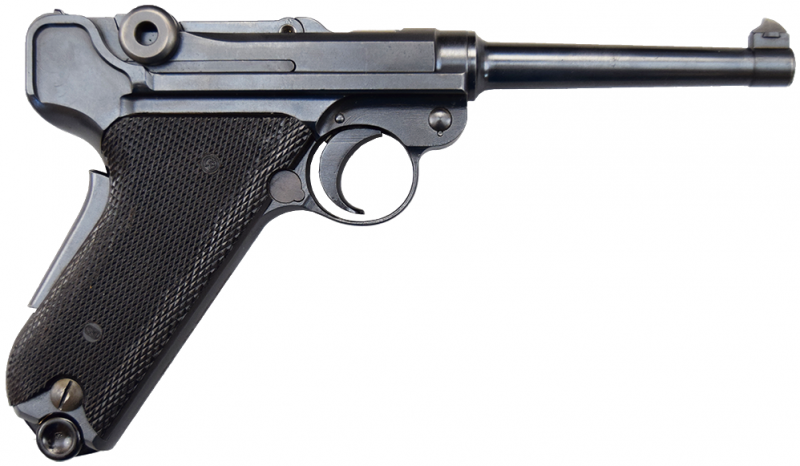
The video opens with Kai on the range, introducing a pair of Swiss 1929 Lugers chambered in 7.65 Luger. These pistols are closely related to the Swiss Luger Model 1906 24/29 pattern, featuring a 4.75-inch barrel and classic Luger toggle-lock action. Kai brings them out before any studio discussion to form unbiased shooting impressions. He notes their robust construction and the distinctive Swiss quality evident in the machining and fit. As he prepares to fire, he points out details like the compact magazine well and the loaded chamber indicator, which provides a quick visual and tactile confirmation that a round is chambered. The focus is on getting a feel for the pistols in real use, setting the stage for later commentary on how these Swiss Lugers compare to expectations and to other service pistols of their era.
On the firing line, Kai begins with deliberate slow fire, then transitions into more rapid strings to evaluate how the Swiss 1929 Lugers behave under different paces. He comments on the pistols’ excellent balance, noting that the weight distribution and grip angle make them point naturally on target. Despite the all-steel construction and substantial slide and toggle assembly, recoil in the 7.65 Luger caliber is described as light and very controllable. The heavy upper assembly seems to soak up recoil impulse, allowing quick sight recovery between shots. Kai highlights how the trigger and ergonomics contribute to accurate, comfortable shooting, and he pays attention to how the pistols track during rapid fire. These live-fire impressions begin to shift his opinion of the Luger platform from a historical curiosity to a surprisingly practical and refined service sidearm.
Attention turns to the magazines used in the Swiss 1929 Lugers, which are closely associated with the Swiss Luger Model 1906 24/29 pattern. Kai demonstrates how the side notch and follower design make these single-stack magazines unusually easy to load by hand. The cutout allows the shooter to pull down the follower and stack 7.65 Luger cartridges with minimal effort, a welcome feature for extended range sessions. He notes the snug fit of the magazines in the relatively small magazine well, yet they insert and drop free smoothly. During both slow and rapid fire, the pistols cycle reliably, feeding and ejecting without malfunctions. This reliability, combined with the user-friendly magazine design, reinforces the impression that Swiss engineers refined the Luger into a robust, soldier-friendly sidearm. The segment underscores that these are not just collectible curios but well-thought-out service pistols capable of dependable performance.
After the range session, the video shifts back to the studio, where Kai and Matt discuss the experience with the Swiss 1929 Lugers. Kai admits that actually shooting the pistols has changed his opinion of the Luger design. Previously seen mainly as an iconic but perhaps finicky collector’s piece, the Swiss examples impressed him with their balance, light recoil, and consistent function. Matt uses this as a springboard to explain that these are Swiss 1906/29 Lugers, a refined evolution of the early Swiss adoption. The studio setting allows them to handle the pistols more closely, pointing out the loaded chamber indicator, the compact magazine well, and the overall robust construction. Kai’s newfound appreciation highlights how hands-on use can overturn assumptions about historical firearms, especially when dealing with high-quality Swiss production intended for real military service rather than just parade ground appeal.
Matt provides a concise historical overview of the Swiss 1906/29 Luger, tying the range footage to its broader context. Switzerland first adopted the Luger design in the early 1900s, initially relying on production from DWM in Germany. Over time, Swiss authorities transitioned to domestic manufacture at Waffenfabrik Bern, resulting in the 1906/29 variant. This model, represented by the 7.65 caliber pistols seen on the range, reflects Swiss priorities for precision, durability, and consistent service performance. Matt notes that these Lugers remained in Swiss military service up through around 1970, a fact that surprises Kai and underscores how long the design stayed relevant. The extended service life suggests that the Swiss 1906/29 was not merely a stopgap but a trusted sidearm for generations of soldiers. This historical context deepens the viewer’s understanding of why the pistols feel so refined and reliable in the shooting segments.
As the video moves toward its conclusion, the host emphasizes that actually shooting firearms like the Swiss 1906/29 Luger is entirely optional and left to each viewer’s discretion. The segment underscores personal responsibility and comfort level when deciding whether to fire collectible or historical pistols. The speaker repeatedly references something called a “seef contest,” suggesting that viewers who are unfamiliar with the term should search for it online to better understand the context. This brief mention hints at an external topic or event related to firearms or marksmanship without going into detail. The tone remains conversational and respectful, bridging the technical and historical content of the earlier segments with a reminder that participation in shooting activities is a personal choice, not an obligation, even for owners of capable and historically significant sidearms.
The closing portion of the video focuses on appreciation and a warm sign-off. The host thanks viewers for tuning in and expresses genuine hope that they enjoyed learning about the Swiss 1906/29 Luger and seeing it in action. There is explicit acknowledgment of the audience’s and customers’ business, reflecting a commercial or retail context connected to firearms like the Swiss Luger Model 1906 24/29 pistol. The speaker offers a religious blessing, repeatedly saying “God bless,” as a sincere farewell. The outro also emphasizes that this is not the end of the journey, with repeated assurances that the creators will see viewers on the next video. This promise of future content ties together the range impressions, historical overview, and viewer-focused messaging, inviting the audience to return for more in-depth looks at other firearms and related topics.





















 Loading...