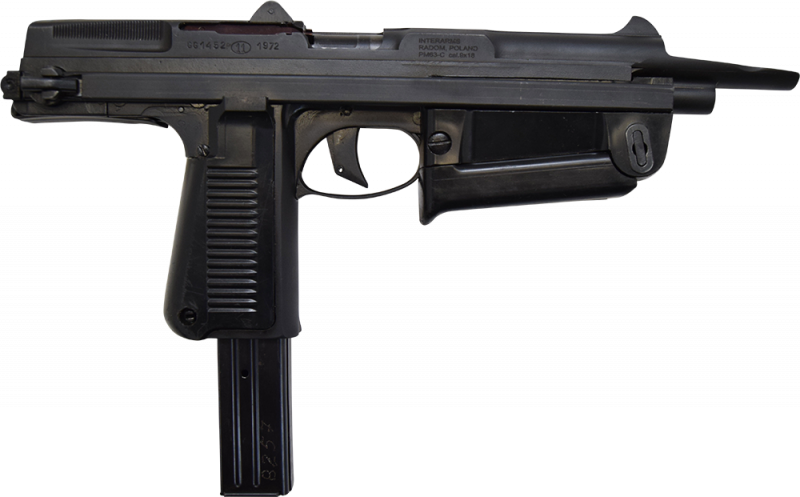
The video opens with playful back-and-forth about optics and long-range shooting before the hosts reveal the star of the episode: the Polish PM-63C RAK. They joke about its compact size, the 9x18 chambering, and how it looks like something out of a sci-fi movie. Clint introduces the PM-63 as the “Commando handheld automatic pistol” and notes that the original design was a compact, open-bolt gun capable of continuous fire, while the examples on the table are semi-auto 9x18 Makarov versions imported by Pioneer Arms from Radom, Poland. They point out the distinctive slide extension at the front, explaining that it was designed so the shooter can hook the slide on a solid surface to rack it one-handed, a clever feature for troops who might be injured or otherwise unable to use both hands. The pistols are sold as packages that include a 25-round magazine and a 15-round magazine, with the hosts jokingly calling the shorter mag the concealed carry option. After some banter, they move to the range, where they engage a large puddle and a man-sized steel target at roughly 70–75 yards, commenting on how surprisingly soft the recoil feels and how practical the accuracy is with the simple notch-and-post iron sights. Because these are sold as pistols rather than short-barreled rifles, the integrated stock is welded in place, which changes how the gun is shouldered and handled compared to the original configuration.
Attention turns to the PM-63’s unique stock and front grip arrangement. The hosts explain that, on the original PM-63, the metal stock would deploy to provide a third point of contact, and the front grip would act as a true vertical foregrip, dramatically improving controllability during rapid fire. To comply with U.S. regulations and keep the PM-63C classified as a pistol, the stock on these imports is welded in the closed position and the vertical grip is pinned so it functions as an angled foregrip instead. They describe how, in its original form, the PM-63 filled a role similar to compact personal defense weapons, with the stock and foregrip making it very controllable and fun to shoot. Even in semi-auto, they emphasize how enjoyable the PM-63C is on the range, with the 25-round and 15-round magazines offering different handling characteristics and balance. The discussion highlights how these modifications preserve much of the original feel and ergonomics while staying within modern legal constraints for civilian ownership.
The hosts walk through the PM-63C’s controls and shooting characteristics in detail. The pistol uses a heel-style magazine release, typical of older European designs, which they demonstrate while swapping between 25-round and 15-round magazines. They show how the slide can be locked to the rear and then released using a combination of the magazine and the safety lever. When the safety is switched to fire, the slide can automatically go forward, chambering a round, while the safety in the safe position completely freezes the trigger. They comment that the trigger pull on this semi-auto conversion is very soft but somewhat long, a byproduct of adapting a design originally intended for open-bolt operation. Despite its age and narrow, simple sights, the pistol proves reliable and impressively accurate, with the shooters repeatedly ringing steel at 70–80 yards. They note how flat and controllable the 9x18 recoil feels, even during rapid strings, and demonstrate both traditional one-handed pistol shooting and a two-handed grip using the pinned front support. The hosts are clearly impressed that such an old-school design can still perform so well at extended distances.
As the shooting continues, the conversation shifts toward the PM-63C’s historical and surplus appeal. The hosts emphasize that Classic Firearms has deep roots in the surplus market and that bringing in uncommon, historically significant firearms like the Polish PM-63C RAK is a major part of that identity. They highlight how rare it is to get hands-on time with a design that traces back to Cold War-era Polish service, especially in a configuration that still closely resembles the original compact automatic pistol. This leads into a broader discussion of dream surplus guns they would love to see available, such as the STG44 and the Thompson, and how cool it would be to have more classic designs on the civilian market. They lament how regulations like the NFA, the Hughes Amendment, and the 1968 Gun Control Act limit the import and civilian ownership of many classic automatic firearms. Viewers are encouraged to comment with their own experiences or opinions on the PM-63, to share what surplus guns they would like to see, and to keep an eye on Classic Firearms’ ongoing contests and surplus offerings.
Near the end of the video, the hosts direct viewers to cfcontest.com and tease an upcoming giveaway by referencing an “HK slap” and using the code word “MP5,” hinting strongly at an MP5-style firearm prize. They segue into humorous sign-off banter, repeatedly joking about tipping waitresses and being kind to waitstaff. The focus then returns to the range for a final demonstration of the PM-63C’s capabilities. One host attempts one-handed shots at over 100 yards using only the iron sights, underscoring how easy the old-school pistol is to shoot accurately at extended distances. He notes that he could not replicate this performance with a modern Echelon pistol and contrasts today’s long-range outdoor shooting with his previous experience firing the PM-63 at an indoor 25-yard range. The closing moments reinforce how the PM-63C RAK combines quirky Cold War engineering, surplus charm, and surprisingly modern-feeling performance in a rare semi-auto package that Classic Firearms is excited to offer.





















 Loading...