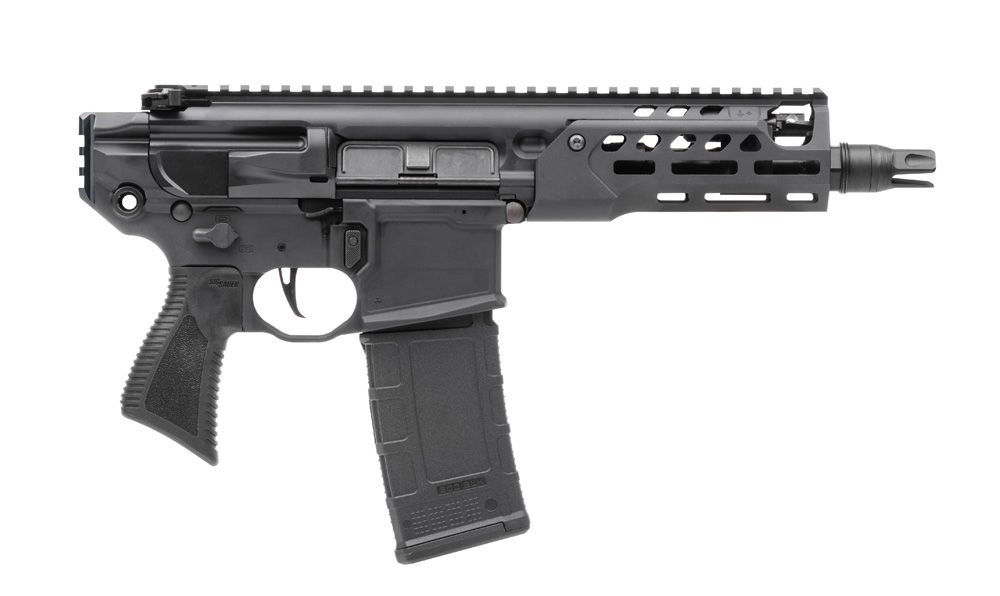
The video opens with the hosts introducing Jason’s compact Sig MCX TacOPS .300 Blackout build and deciding to break down every component of the configuration. The foundation is a Sig MCX with a TacOPS upper and a 6.75-inch .300 BLK barrel featuring a fast 1:5 twist, optimized for both subsonic and supersonic loads in a very short package. They describe the gun as compact yet hefty, emphasizing that the weight contributes to controllability rather than making it unwieldy. Up front, the rifle wears a Dead Air Sandman K suppressor fitted with an E-Brake, tucked so closely under the SD handguard that it barely clears the rail. This tight fit underscores the build’s emphasis on overall length reduction for close-quarters work while still maintaining full-time suppression and reliable function with .300 Blackout ammunition.
The hosts focus on the front-end accessories that make this Sig MCX TacOPS a purpose-built CQB and night vision gun. A Modlite weapon light is chosen for its high-output performance, initially producing a tight beam with about a 3-foot hotspot. With the setup’s diffuser and configuration, that beam can be opened up to roughly a 15–20-foot spread, effectively filling an entire room with usable light, which the speaker considers a major advantage indoors. Mounted alongside is an ATPIAL-C, the civilian PEQ-15, providing both a red visible laser and IR laser capability. A Villain Weapon Systems IR illuminator diffuser is added to the ATPIAL-C, transforming its normally tight IR spot into a broad, adjustable IR flood. Jason notes that this rifle is primarily run under night vision, and the diffuser allows the IR illuminator to go from a narrow 3-foot spot to a 15–20-foot wash, giving full-room IR coverage for rapid target identification and engagement in confined spaces.
Attention shifts to how the rifle is controlled and managed during hard use. The light is set up with a DS00 tailcap for momentary activation, while a Unity Hot Button controls the PEQ and a ModButton runs the Modlite OKW, giving intuitive, separate activation for white light and IR. Cables are routed simply but effectively to avoid snags. To deal with heat and grip, the handguard wears RailScales Dragon Skin panels and a small hand stop, helping the shooter index the support hand and maintain control during rapid strings. For aiming, the rifle uses SIG flip-up sights mounted on a Wilcox riser with a flip-side mount, raising the irons to a height suitable for passive aiming under night vision and serving as a backup if electronic optics fail. The HRF Concepts RCM Magwell adds a flared opening that speeds reloads under nods, and the Rainier Arms Avalanche charging handle is highlighted as the preferred option over the Radian, offering a large, easy-to-grab profile without feeling obtrusive. The hosts also note that this .300 BLK setup can quickly transition between subsonic and supersonic loads for effective engagement out to roughly 300 yards.
The discussion moves into night vision equipment and how it drives the rifle’s configuration. The hosts showcase BNVD 1431 Mark binocular night vision goggles with white phosphor tubes from Night Solutions, comparing white versus green phosphor for different environments, such as urban versus rural settings. Under night vision with infinity focus, fine motor skills and depth perception degrade, making enlarged controls critical. The build’s oversized paddle releases, ambidextrous controls, and flared magwell are emphasized as essential for reliable reloads and manipulations when the shooter’s vision and dexterity are compromised. They mention Matt Bach’s lens cover, which allows near/far focus adjustments to help with tasks like reading or working in confined spaces, but stress that gear alone is not a solution. Instead, they emphasize repetition and dry-fire practice to build muscle memory, especially when transitioning from a familiar platform like a short Mark 18-style 5.56 to this different .300 BLK MCX setup. Consistency in control layout and repeated reps are presented as the key to performing under stress with night vision.
The hosts reinforce the importance of keeping rifle setups consistent so that manipulations become automatic, particularly for a dedicated CQB and night vision system. They then move to live fire, testing the Sig MCX TacOPS with Hornady Black 208-grain subsonic .300 Blackout ammunition. On the range, they highlight the extremely soft recoil impulse, describing the gun as very flat-shooting. They demonstrate the minimal difference in sound after the initial first-round pop, noting that subsequent shots remain impressively quiet through the Sandman K suppressor and E-Brake combination. The rifle’s weight and balance are discussed in detail: while the setup initially feels chunky, the condensed overall length and forward weight from the suppressor make it balance nicely when shouldered, especially compared to a longer 14.5-inch rifle. They observe very little muzzle flash and minimal gas blowback to the shooter’s face, attributing this to the suppressor, subsonic ammo, E-Brake, and Sig’s factory gas tuning, all working together to create a controllable, low-signature CQB platform optimized for night vision use.
The conversation turns to real-world applications and ballistic performance. The hosts explain that this compact .300 Blackout CQB build would have been ideal for law enforcement team use, especially in tight hallways, vehicles, and urban environments, and argue it is generally better suited to typical day-to-day law enforcement work than a 16-inch 5.56 rifle. They highlight .300 BLK’s versatility, expressing confidence in engaging targets out to about 300 yards using 110- or 124-grain supersonic loads at an estimated 2400–2600 feet per second. They contrast this with 5.56, which loses significant velocity and terminal effectiveness when fired from very short barrels, having been originally designed around a 20-inch barrel. The Sig MCX’s short-stroke piston operating system is discussed, with the note that a similar direct impingement setup would mainly be gassier and dirtier but still functionally acceptable. This particular gun primarily runs subsonic ammunition and is cleaned roughly every 1,000 rounds, reflecting a practical maintenance schedule for a suppressed, high-use CQB rifle.
In the closing segment, the hosts invite viewers who visit Takeame Training and Range to ask politely if they want to shoot the featured guns, reminding them to bring their own ammunition. They mention that visitors occasionally get the chance to shoot more exotic firearms, including a .50 cal, depending on what is on hand. The video then promotes their CF Contest site at cfcontest.com/win, also accessible through Classic Firearms, where viewers can find various gun-related giveaways and featured items. They clarify that Jason is unlikely to part with this specific Sig MCX TacOPS build despite its popularity. Finally, they explain that this nighttime CQB configuration is part of a broader series, teasing upcoming videos on intermediate and distance-oriented builds, including the often-requested Mark 18. Viewers are encouraged to comment with their thoughts and suggestions for future content, as the hosts thank them for following along with the build breakdown and range demonstration.




















 Loading...