The discussion opens with an overview of why the Sig Spear exists and how it ties into the U.S. Army’s Next Generation Squad Weapon (NGSW) program. The hosts explain that 5.56 NATO has shown limitations at longer distances, particularly against modern body armor and intermediate barriers. They note that earlier conflicts often involved opponents without armor, while current and future adversaries are more likely to use Level III or Level IV plates. This shift in threat profile drove the search for a more capable cartridge and platform. Sig Sauer, along with other manufacturers, submitted designs to meet these requirements, leading to the development of the MCX Spear as a heavier, battle-rifle or DMR-style weapon intended to deliver better performance at extended ranges.
The hosts then compare the emerging 6.8mm cartridge, also known as .277 Fury, to the traditional .308 Winchester/7.62 NATO. They show a .277 Fury round with a white tip alongside a standard 6.8 cartridge and a .308, pointing out the visual differences in case design. The .277 Fury uses a hybrid case with a steel base and brass upper portion to handle very high chamber pressures. They mention that .277 Fury can reach roughly 3,100 to 3,300 feet per second, depending on barrel length, which is significantly faster than typical .308 velocities around 2,400 to 2,600 feet per second. The steel base is highlighted as important for safely containing these higher pressures compared to an all-brass case.
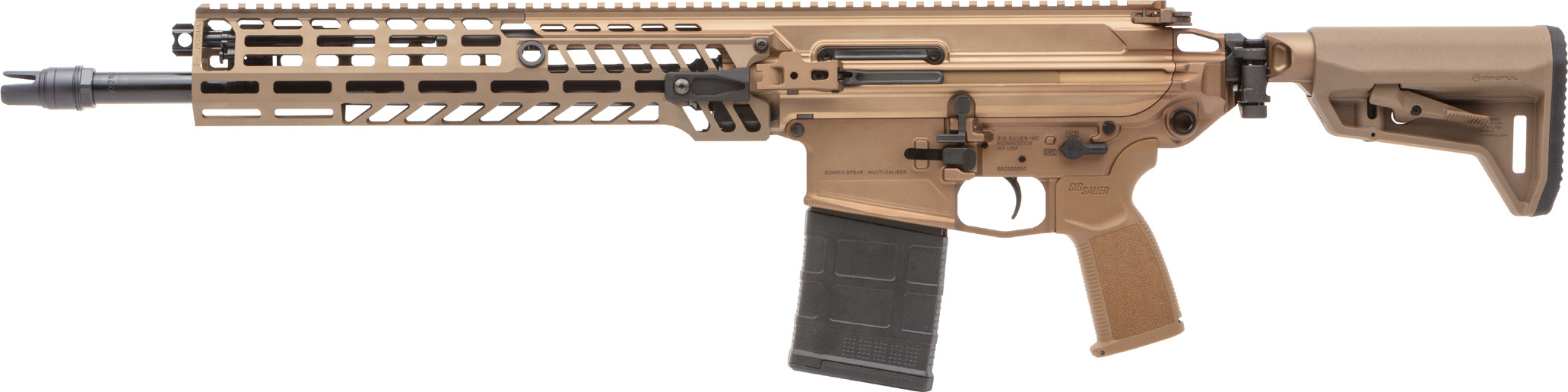
After outlining the military-focused 6.8mm concept, the conversation shifts to the civilian-oriented Sig MCX Spear chambered in .308. The hosts emphasize that this .308 version is essentially the same platform as the 6.8/.277 Fury Spear but configured for 7.62 NATO. They argue that .308 is one of the most widely used rifle calibers in the world, making it more affordable and easier to source for non-military users. The cartridge is described as well proven in both military and civilian roles, with strong energy and effectiveness at distance. For large properties or general-purpose use, they see the .308 Spear as a practical choice that still delivers substantial capability without the specialized ammunition requirements of .277 Fury.
The video then covers the MCX Spear’s controls and ergonomics. The rifle is described as fully ambidextrous, with mirrored controls on both sides. This includes the safety selector, magazine release, bolt release, and bolt catch, allowing operation from either shoulder. A notable feature is the side charging handle on the Spear, which the hosts call out as a significant change from traditional rear-charging AR-style rifles. The stock on this particular rifle is collapsible, adding adjustability for different shooters and shooting positions. Overall, the control layout and charging system are presented as modern and user-friendly, supporting both right- and left-handed operation without modification.
Attention turns to the accessories mounted on the rifle. On top, the hosts have installed an EOTech G33 magnifier paired with a Sig Sauer Romeo 8T optic. The Romeo 8T is fitted with a glare-reducing front device to help prevent reflections from giving away the shooter’s position. Up front, the rifle wears a BCM vertical foregrip for improved control and a Magpul bipod for stability when shooting from supported positions. A Magpul MS3 sling is attached, and the hosts stress the importance of having a sling, even prioritizing it over a weapon light in some setups. These accessories are presented as a practical configuration for making the most of the Spear’s capabilities.
The hosts describe changes made to the rifle’s muzzle device and explain the operating system. The original Sig three-prong flash hider has been replaced with a SureFire compensator, which they expect to provide improved recoil control. They note that the MCX Spear uses a short-stroke piston system and features an adjustable gas block with clearly marked settings for normal and suppressed use. The gas selector is labeled, making it straightforward to switch between modes when attaching a suppressor. For magazines, the rifle originally came with a PMAG, but they have fitted a translucent Lancer magazine, partly for aesthetics. The combination of piston operation, adjustable gas, and quality magazines is presented as central to the rifle’s reliability and adaptability.
In the closing segment, the hosts mention that the featured Sig MCX Spear in .308 will be given away to a viewer at no cost. They decide on a code word for the giveaway entry: “NATO,” referencing the rifle’s 7.62 NATO chambering. Viewers are encouraged to submit entries using that code word. There is also a brief nod to the channel’s “Bust Your Build” series, where viewers can email their rifle builds for critique. The video ends with a reminder to share thoughts on the MCX Spear in the comments and a sign-off wishing viewers well until the next installment.





















 Loading...