The video focuses on the Smith & Wesson FPC, a foldable 9mm pistol-caliber carbine. It arrives with a dedicated bag and three magazines: two 23‑round magazines and one 17‑round magazine. The carbine uses a blowback action and has a 16.25 inch barrel. Overall length is listed at about 30.4 inches, with a width of roughly 2.5 inches and a height of about 8 inches, depending on the magazine used. The unloaded weight is specified at about 80.42 ounces. The host plans to verify these specifications, including folded and unfolded length, overall weight, and trigger pull, and then walk through the carbine from muzzle to stock to highlight its main design features.
At the front, the FPC has a threaded barrel with 1/2x28 thread pitch and a thread protector installed. A long Picatinny rail runs along the top, extending from the receiver forward and providing roughly 14 inches of mounting space for optics, lights, or lasers. The handguard includes M‑LOK slots on the bottom and sides for additional accessories. The central feature is the folding hinge or knuckle. A large button on the side releases the front half of the carbine, allowing it to fold upward and over, in a manner reminiscent of the KelTec Sub2000. When folded, the Picatinny rail remains facing up, so optics can stay mounted. Folded length is around the same as the barrel, roughly 16 to 16.3 inches, making the carbine compact and easy to stow in a backpack.
The FPC uses a crossbolt safety located just in front of the trigger guard. The trigger assembly includes a trigger shoe similar to other Smith & Wesson pistols, requiring the shoe to be depressed before the main trigger can move. There is noticeable take‑up to a firm wall, followed by a clean break that feels in the roughly 4 to 5 pound range. The reset is short and distinct, allowing quick follow‑up shots with minimal trigger movement. The lower receiver and handguard are polymer, including the trigger guard. The grip features aggressive but manageable texturing that provides a secure hold, even with sweaty hands. The magazine release shares this texture, is not overly raised, and is designed to avoid accidental activation when the carbine is set down on a surface.
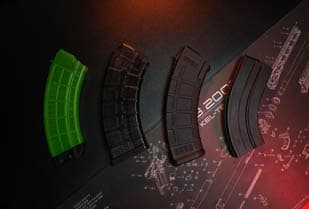
The carbine ships with two 23‑round magazines and one 17‑round magazine. Each 23‑round magazine includes a collar that allows it to sit flush in the magwell and provides additional pinky support. The collars are interchangeable, so a collar can be moved to the 17‑round magazine to reduce the amount it protrudes from the grip. The charging handle sits at the rear and has a distinctive shape that the host compares to a stingray. It is pulled straight back to charge the carbine. This component also interfaces with the folding system: when the bolt is locked to the rear, the front section cannot be locked into its folded position and remains free‑floating. Once the bolt is released forward, the front half can lock securely into place for use or storage.
The rear portion of the FPC includes a metal buffer tube area that houses the blowback system, while the stock itself is polymer. The stock is relatively large, making it easy to seat firmly in the shoulder. Integrated into the stock is a magazine caddy that holds two spare magazines. These magazines insert upside down into the stock. A lever on the bottom releases the magazine on the left side, and a corresponding control releases the magazine on the right side. The stock also includes a QD sling mount at the rear for attaching a sling, along with a butt pad to improve comfort and stability when shouldered. This arrangement allows the shooter to keep additional magazines on the carbine without separate pouches.
The host uses a trigger pull gauge to verify the FPC’s trigger weight. After removing the magazine and confirming the carbine is clear, several measurements are taken. The first reading shows approximately 3.99 pounds. A second pull measures about 4.46 pounds. A third test comes in around 3.84 pounds. These results place the trigger in the roughly 3.8 to 4.5 pound range, aligning with the earlier estimate of a light, crisp trigger. The measurements confirm that the FPC’s trigger is relatively light for a pistol‑caliber carbine, with a consistent break and a short, tactile reset that supports fast, controlled shooting.
A measuring tape is used to confirm the FPC’s overall dimensions. With the carbine unfolded, the length is shown to be about 30.4 inches, matching the listed specification. Height measurements vary depending on where they are taken and which magazine is installed. Measuring from the bottom of the grip to the top of the receiver yields roughly 6.5 inches. With a magazine inserted and measuring from the magazine base to the top of the knuckle area, the height approaches the stated 8 inches. When folded, the carbine’s length is checked again. Measuring from the rear to the muzzle, the folded length is right around 16 inches, essentially the same as the barrel length, confirming its compact folded profile.
The FPC is placed on a scale to verify its weight. With all magazines removed, the carbine weighs almost exactly 5 pounds, which aligns closely with the earlier ounce specification. When the three empty magazines are added to the carbine, the total weight increases by roughly three‑quarters of a pound. The host notes that once the magazines are loaded with 9mm ammunition, the overall weight will move to a bit over 6 pounds. These checks confirm that the FPC remains relatively light even when configured with multiple magazines, while still offering a full‑length 16.25 inch barrel and a folding design for compact transport.













 Loading...