The video opens with a lighthearted Christmas skit where one of the hosts wishes Santa would bring a Sig Spear in 6.8 instead of .308. Santa appears, joking that the rifle is not for the host because of past misbehavior. The hosts introduce themselves, including a Santa-themed guest, and transition from the comedy bit into the main topic. They explain that the focus is the Sig Sauer MCX Spear associated with the NGSW program, emphasizing that this is the true 6.8x51 configuration rather than the civilian .308 version. The tone shifts from playful banter to a more technical discussion of the rifle and its development.
The discussion moves to the origins of the NGSW program. Around 2019, the U.S. military sought a new caliber and platform, questioning the capabilities of 5.56 NATO from the M4 for extended ranges and defeating modern body armor and intermediate barriers. The hosts note that 5.56 remains a relevant and effective NATO cartridge, but the requirement was for greater effective distance and improved barrier performance. Sig Sauer ultimately secured the contract with what became the XM7, now designated the M7, chambered in 6.8x51. The hosts emphasize that the rifle on the table is the actual 6.8x51 military configuration, not the earlier .308 civilian MCX Spear.
The hosts compare 6.8x51 to both .308 and 5.56. They describe 5.56 as a fast, small cartridge and note that typical .308 velocities from a 16-inch barrel are around 2,600 feet per second. In contrast, the 6.8x51, also referred to as 277 Fury, is described as flying faster than 5.56 and significantly faster than .308, with velocities in the roughly 3,000 to 3,100 feet per second range from a 16-inch barrel. To handle the required pressures, Sig Sauer uses a hybrid case design with a steel base and brass upper portion, since a full brass case would not tolerate the higher pressures. Based on available testing data, the hosts state that 6.8x51 substantially outperforms .308, which contributed to Sig securing the NGSW contract.
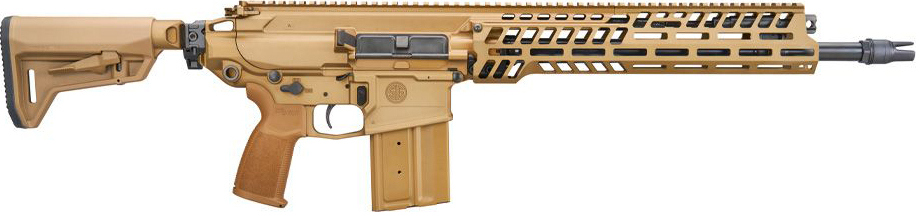
Attention shifts to the specific features of the M7 configuration. The rifle uses a 16-inch barrel and is chambered in 277 Fury, or 6.8x51. The hosts explain that this version incorporates several refinements that evolved from the XM7 into the current M7, including upgraded controls designed to prevent users from injuring their hands during operation. They describe this rifle as a direct one-to-one comparison with what is currently being fielded, highlighting that it is effectively a clone-correct setup. The controls and layout reflect the military configuration rather than an earlier or commercial variant, and the hosts stress that this is the same pattern being issued to personnel in uniform.
The hosts identify the optic as a Sig Sauer Tango 6T, referred to as the Tango 60 in the conversation, noting that this is the military version. The reticle is matched to the barrel and platform, mirroring the configuration used on fielded M7 rifles. They point out the Sig muzzle device at the front, which is compatible with Sig suppressors, while also allowing users to remove it and install other muzzle devices or suppressors if desired. The rifle uses a short-stroke piston system and features M-LOK attachment points on the handguard. The upper receiver extends forward to provide ample rail space for thermal devices, lasers, or other accessories, accommodating typical modern military accessory setups.
The rifle includes both a traditional rear charging handle and a side charging handle. The hosts recall that on earlier civilian .308 MCX Spear models, the side charging handle was sharp enough to cut the shooter’s hand if it was positioned too far forward when releasing the bolt. On this M7 configuration, Sig Sauer added a polymer overmold to the handle to prevent it from gouging the user, addressing that issue. The hosts also highlight the ambidextrous fire controls, including selector levers, magazine releases, and bolt catch and release controls on both sides of the rifle. These features are presented as part of the refinements that distinguish the M7 from earlier versions.
The hosts show the folding stock and note that different cheek pieces or stocks can be installed according to user preference. They reiterate that the rifle and optic combination is expensive and that this setup is effectively clone-correct to what is being fielded, down to the optic and reticle configuration. The conversation returns briefly to the Santa skit, with jokes about the rifle not being a present for the misbehaving host and the possibility of receiving only a shirt instead. They introduce a code word, “CLAUS,” and close by thanking viewers, expressing appreciation for their business, and offering a holiday-themed sign-off while mentioning Classic Firearms by name.





















 Loading...