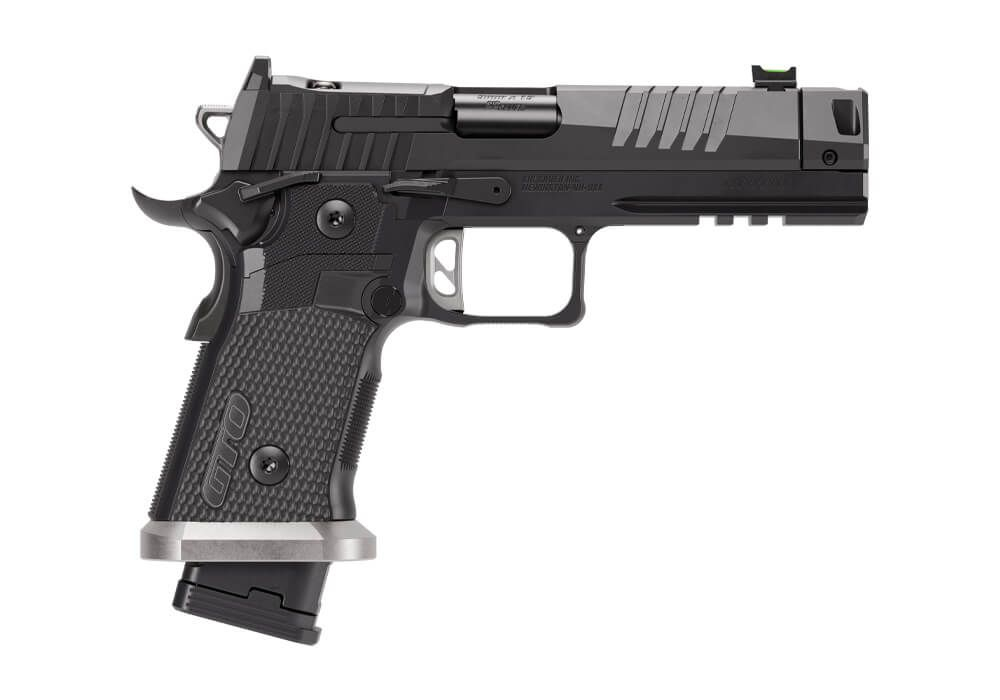
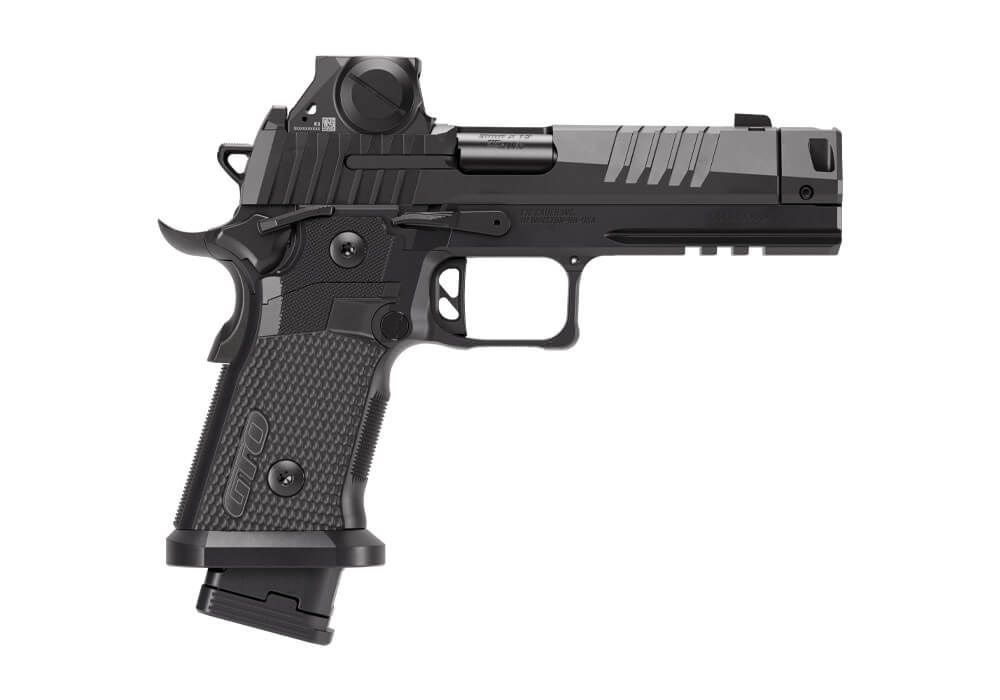
The discussion opens at Sig Sauer Academy in Epping, New Hampshire, with an overview of the new Sig P211 GTO. It is described as Sig’s entry into the high-capacity 1911, often referred to as a 2011-style platform. The team notes that many 2011 pistols on the market would not pass Sig’s internal durability and reliability standards, so the P211 GTO was developed to meet those higher test requirements. The goal was to deliver a high-cap 1911 with the features shooters typically upgrade to, but in a configuration that is attainable and does not require extensive aftermarket modification right out of the box.
The P211 GTO uses a steel frame with an alloy grip attached to it, rather than a polymer grip module. It includes removable grip panels, allowing customization, and Sig has already coordinated with accessory makers for replacement panels and holsters. A key design choice was to run the pistol on Sig P320 magazines, which are described as the company’s most tested magazines, avoiding common 2011 magazine-related reliability issues. The pistol features a fully ambidextrous slide catch lever engineered so the right-side control reliably locks the slide back and releases it for left-handed shooters. Ambidextrous safeties are also present, and the gun includes a 1913 accessory rail for lights or other attachments.
Instead of a traditional threaded compensator, the P211 GTO uses a unique, non-threaded compensator system intended to avoid loosening and carbon buildup issues. The barrel end is shaped so the compensator inserts, rotates into position, and is secured by a flat pin retained with a spring and set screw. Sig reports that this setup stayed tight through tens of thousands of rounds. The compensator is 3D-printed to achieve internal gas paths that could not be easily machined. Gas is directed not only upward but also into a chamber where it is delayed and then vented out the sides, flattening the recoil impulse. The presenters describe the recoil as very soft, balanced, and “linear,” and state that it recoils less than comparable compensated 1911 or 2011 pistols they have used.
The slide on the P211 GTO is optic ready and accepts multiple popular footprints. It is stated to support Sig optics, Glock-style patterns, the Romeo and Romeo1Pro footprints, DeltaPoint Pro, and RMR footprints on the same platform. The slide has been reshaped with top serrations for those who prefer racking over the top, while traditional rear serrations remain for more conventional manipulation. Ambidextrous thumb safeties are designed to be equally usable from either side. Because the pistol uses P320 magazines, it can also accept the AXG magazine release, which can be reversed to accommodate left-handed shooters, contributing to a fully ambidextrous control layout. For competitors in USPSA Limited Optics, Sig plans to offer a barrel block that replaces the compensator via the same pin and rotation system, allowing a non-compensated configuration suitable for that division.
The pistol ships with three magazines: two standard 21-round P320 magazines and one magazine with a redesigned base pad that increases capacity to 23 rounds. This extended magazine is engineered to fit within the USPSA box while still locking the slide to the rear without changes to followers or springs. The presenters mention that 24-round configurations are possible when experimenting with magazines, highlighting the capacity advantage over typical 17- or 18-round setups. Attention then shifts to the trigger, which is targeted at a consistent 3–4 pound pull with a strong reset, produced on a production line rather than by custom gunsmithing. The trigger is compared favorably to high-end 2011 triggers, including those on pistols like the Sand Viper and custom STI-based 2011s, with the claim that similar performance previously required expensive custom work.
The safety system includes a grip safety and thumb safety, but Sig also addresses drop safety beyond traditional 1911 designs. The company tests to higher drop standards and more orientations, including muzzle-down impacts on concrete. Traditional Series 70-style 1911 and many 2011 pistols are acknowledged as not being fully drop safe in muzzle-down impacts without additional firing pin safeties. Conventional Series 80 parts can negatively affect trigger feel because the trigger must lift extra components. Sig states that it redesigned the Series 80-style system with a different geometry and fulcrum to maintain drop safety without degrading the trigger pull. The P211 GTO is subjected to the same environmental and durability validation as other Sig pistols, with a specified mean rounds between stoppages requirement. According to their internal benchmarking, the P211 GTO exceeded Sig’s minimum standard and performed roughly three times better than competing 2011-style pistols tested alongside it.





















 Loading...