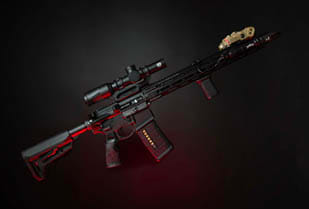
The video opens with Eliza introducing Willie, a former Navy SEAL with a decade on teams who now works as a shooting and tactics consultant. The stated goal is to show how to set up AR-15s for different roles, contrasting close-quarters battle configurations with recce or light sniper-style builds. Willie starts by walking through his recce rifle. It is built on a Geissele platform with a Magpul stock and a GBRS sling, configured as a precision-focused 5.56 gun. Up front, he runs a Resilient suppressor, chosen because it is budget-friendly and comes with a free tax stamp. Illumination is handled by a Malcoff weapon light with a simple push-button tailcap. For aiming, he uses a Holosun LS321 laser and an Arken Optics 1-8 LPVO mounted on a Badger Ordnance riser to clear the laser. A 45-degree offset red dot provides rapid close-range capability while keeping his profile lower than a top-mounted dot when shooting around cover, and he notes this rifle can reliably hit silhouettes at 600 yards with quality Hornady .223 ammunition.
After the recce overview, the focus shifts to Eliza’s more CQB-oriented AR-15. Her rifle leans heavily on Griffin Armament components, including a Dual-Lok 5 AM suppressor that keeps the gun compact while taming blast indoors. She runs a SIG Romeo 4T red dot for fast target acquisition at short distances and pairs it with a SIG Romeo Foxtrot MSR light for white-light work. A Wilder Tactical sling and SBA5 brace round out the compact, maneuverable package. The discussion then turns to how accessory placement affects performance in tight spaces. They emphasize keeping the rifle’s sides as clean as possible to avoid snagging on door jambs and obstacles. For a CQB gun, that means mounting the laser on the top rail and pushing a pistol-style light to the bottom, leaving the left and right sides slick. Eliza mentions plans to move her optic to an angled mount similar to Willie’s approach, both to free up rail space and to maintain a cleaner, more snag-resistant profile when working around structures.
The hosts begin assembling a dedicated CQB rifle, starting with a 10-inch Daniel Defense upper chosen for its compact length and maneuverability in hallways and small rooms. They explicitly reject LPVOs for this role, explaining that magnification and eye box constraints slow down target acquisition at room distances. Instead, they select an Aimpoint T2 red dot, mounting it on a riser to align better with night vision devices and provide a more heads-up shooting posture. The existing stock is swapped for a Magpul stock to improve ergonomics and shoulder weld on the SBR. A laser is added specifically for night work under NODs, reinforcing that this build is optimized for low-light CQB. On the handguard, they install a Magpul hand stop or angled foregrip to aid in barricade shooting, weapon retention, and consistent indexing of the support hand. For retention, they choose a single-point sling, noting that for this sling type a bungee design is preferred because it allows the rifle to move with the shooter while still staying tight to the body.
The conversation deepens around sling selection for a CQB rifle. They highlight that a bungee single-point sling excels in tight interiors because it keeps the gun close to the torso yet stretches enough to shoulder quickly, transition shoulders, or work around doorways without feeling constrained. Moving to illumination, they opt for a streamlined setup using a Streamlight TLR-1 series pistol light mounted in a way that minimizes bulk and snag points. The light is positioned so the shooter can activate it naturally while maintaining a firm grip, and its compact profile helps the rifle slip past door frames. For muzzle devices, they add a SureFire RC4 suppressor, praising its low back pressure and strong flash mitigation, which are critical when firing indoors or in low light with teammates nearby. This configuration—short barrel, single-point bungee sling, compact TLR-1, and RC4 can—is described as clean, ergonomic, and highly maneuverable, embodying what they want from a purpose-built CQB SBR.
Attention shifts from the CQB build back to a recce-style rifle intended for mid-range precision. They start with optic selection, choosing an ACOG for its rugged fixed magnification and illuminated reticle. The host notes that taping over the fiber optic strip can reduce reticle brightness in bright conditions, preventing bloom and preserving a finer aiming point. On the handguard, they add a Magpul AFG hand stop to provide a consistent, low-profile index point that works well when shooting from supported or prone positions. The buttstock is swapped for a thinner, lighter option to reduce overall weight and improve comfort during long periods of carry. They also change out the pistol grip, preferring options from Magpul or Driven Arms Co. that offer better ergonomics and angle for prone and supported shooting. For illumination, a Malov light is mounted on the left side via M-LOK, positioned to support both target identification and precision shots without adding unnecessary bulk or snag risk.
The recce setup is refined further with attention to stability, weight, and ballistic consistency. A Malov weapon light is secured to the M-LOK rail, and a metal bipod is added to provide a solid front support for prone and supported positions, critical for stretching the rifle to 500–600 yards. They replace a large, heavy Devol A2-style optic with a lighter Holosun to cut weight, recognizing that a recce rifle may be carried for long distances before being fired. Sling choice is revisited, with a two-point sling recommended not just for comfortable carry but as an active shooting aid. By tensioning the sling, the shooter can gain extra stability in kneeling, seated, or standing supported positions. For muzzle devices, they again favor a larger SureFire RC4 suppressor on this rifle, prioritizing maximum sound and flash reduction over compactness. The hosts stress the importance of a dope card, even on a 500–600 yard gun, to track how temperature, altitude, barometric pressure, and density altitude affect point of impact, ensuring first-round hits when conditions change.
On the range with the recce rifle, the focus turns to body position and shot execution. The instructor explains natural point of aim, having the shooter adjust their lower body—hips and legs—until the reticle naturally settles on target without muscular effort. The arms form a U-shaped cradle that pulls the buttstock firmly into the shoulder, creating a stable platform. Trigger control is emphasized with a “bang-click” rhythm: press smoothly to break the shot, then hold the trigger to the rear momentarily before resetting, avoiding slapping or jerking. Consistent body position and follow-through help manage recoil so the reticle returns directly to the target instead of jumping off. This allows faster shot-to-shot recovery and better observation of impacts or misses. The coaching ties back to the recce role, where accurate, repeatable hits at distance matter more than raw speed, and where proper fundamentals let the shooter fully exploit the rifle’s optics, bipod, sling support, and ballistic data.
The final portion returns to the CQB rifle for live-fire evaluation and troubleshooting. They encounter an issue trying to mount the SureFire RC4 suppressor on a Mk18-style upper because the muzzle device or flash hider is dirty, illustrating how carbon buildup can prevent quick attachment. This leads to a discussion of running rifles unsuppressed indoors; in a team context, the extra blast and noise can be used deliberately to create chaos and overwhelm adversaries. On the range, they run the CQB setup and quickly discover the optic is not properly zeroed, requiring a significant hold to the left to get hits. Despite the zero issue, they assess the front-end configuration. The sides of the rifle remain clean, validating the earlier emphasis on avoiding snag points. The light is placed so it can be activated with a knuckle while maintaining a solid grip, and the foregrip and hand stop arrangement, though somewhat bulky, is praised for being functional and controllable. The video closes by reinforcing how gear choices, mounting positions, and realistic testing shape effective CQB and recce AR-15 setups.











 Loading...