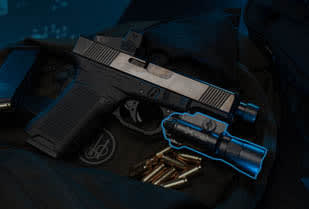
The video opens with a mixed-ammo reliability check of the H&K VP9CC, loading 127-grain, 147-grain, and steel case 9mm to see if the pistol truly “runs anything.” Despite H&K’s reputation, an early malfunction appears, immediately raising questions about steel case performance. The host then situates the VP9CC in the concealed carry landscape, noting its micro/subcompact 9mm role alongside pistols like the Glock Gen 6 19, Springfield Hellcat, several .380s, and especially the SIG P365 Lux, which is closest in size. Key specs are outlined: roughly 6 inches overall length, 4.41-inch height with a flush magazine, 3.13-inch barrel, and 10+1 or 12+1 capacity options. Controls include a paddle-style magazine release, light front and rear slide serrations, and a rear striker indicator. A standout feature is the optics plate, cut about 40% lower than typical, providing roughly 25% more co-witness capability compared to common micro-compacts like a KOA-cut Glock 43X. The segment closes by referencing H&K’s five-year German durability testing from -76°F to 176°F and setting up initial accuracy and feel testing on paper and cardboard.
The shooter moves to paper targets to evaluate the VP9CC’s real-world accuracy and handling. Initial strings show all A-zone hits, indicating solid mechanical accuracy despite the pistol’s small size. The slide is described as stiff, which may affect some shooters when racking under stress. Recoil is slightly jumpier than preferred for a micro-compact 9mm, but still manageable. Double-tap drills are used to judge sight tracking and muzzle return, revealing that the sights come back on target predictably. The trigger earns strong praise, with a clean break, a distinct wall, and a positive, tactile reset that supports faster follow-up shots. These characteristics help offset the inherent snappiness of the small frame. The segment establishes the VP9CC as accurate and controllable for its class, while hinting that ergonomics and recoil management will be key differentiators once it is compared directly to other popular concealed carry pistols.
The VP9CC is then shot back-to-back with the Shadow Systems CR920 and Taurus GX4 to highlight differences in recoil impulse and point of impact. The VP9CC is preferred over both, with the CR920 tending to impact low and the GX4 feeling harsher and more abrupt in recoil. The H&K’s smoother impulse and superior trigger make it easier to keep rounds centered. A comparison with the standard SIG P365 follows, where the P365 is described as substantially jumpier. The VP9CC’s slightly wider grip aids muzzle control and helps tame recoil, though the reviewer notes a key ergonomic critique: the frame lacks an indentation or relief cut for the support-hand thumb, limiting the ability to lock in a high, aggressive grip. This detail becomes important when shooting quickly. The segment transitions toward the Glock 43X, setting up a look at how the VP9CC stacks against one of the most popular slim carry pistols and how grip length and pinky support influence control and consistency.
Attention shifts to the Glock 43X, with the caveat that the comparison is imperfect because some pistols wear lights or optics while others are bare. The 43X feels smoother than in past experiences, and its longer grip is highlighted as a major advantage over the VP9CC, where the pinky finger barely hangs on with the flush magazine. This extra grip length improves control and comfort, though some shots drift left, likely due to ergonomics and wrist input rather than mechanical inaccuracy. The shooter emphasizes how extended magazines on subcompacts can meaningfully involve the pinky and tighten groups. The 43X’s trigger and overall shooting experience are described as consistent and pleasant, with tighter groups than expected from a small gun. The Glock 19 Gen 6 is then introduced as the concealed carry benchmark, representing the balance point between capacity, shootability, and concealment. This leads into a broader discussion of how micro-compacts are inherently snappier and why shooters must weigh concealability against the ability to shoot quickly and accurately under pressure.
The comparison shifts to a similarly sized .380 pistol referred to as the Lux, contrasted directly with the 9mm VP9CC. The Lux stands out for its noticeably softer recoil and almost no visible muzzle movement, making it extremely easy to control and attractive for shooters sensitive to recoil or prioritizing comfort. However, this comes with the tradeoff of stepping down from 9mm to .380 ACP. The Lux is optics-ready, with an MSRP around $1,000, and roughly $1,400 when paired with a Vortex Defender CCW optic, placing it in a similar price bracket to the VP9CC. The host then frames the VP9CC and other micro-compacts against personal carry choices like the SIG X-Macro, Glock 19, SIG P365 XL, Bodyguard 2.0, FN Reflex, PX9 Carry, and the snappier Hellcat Pro. The Glock 19 is still described as offering the best overall blend of capacity and shooting experience, underscoring that ultra-small guns like the VP9CC and Lux are primarily for users who must prioritize deep concealment over maximum shootability.
Building on H&K’s claims of rigorous German testing, the video sets up a focused reliability evaluation for the VP9CC using a deliberately mixed magazine. The shooter loads 127-grain, 147-grain, and 115-grain steel case 9mm into the same magazine to see how the pistol handles rapid transitions between different bullet weights and case materials. This test is framed as a real-world check of whether the VP9CC can truly run “anything,” including budget steel case ammunition that some shooters rely on for practice. The upcoming string is intended to stress the extraction and ejection system, as well as the recoil spring tuning, by mixing heavier subsonic-style loads with lighter, harder-to-extract steel case rounds. The segment reinforces that, on paper, the VP9CC has passed extensive environmental and durability trials, but the goal here is to verify performance with common, varied range ammo in a practical concealed carry context.
During the mixed-ammo test, the VP9CC encounters a failure to extract with a 115-grain steel case round, leaving the case stuck in the chamber and requiring effort to clear. A rerun with additional steel case confirms a pattern: despite marketing that it should run anything, this particular pistol clearly dislikes 115-grain steel case ammunition. In contrast, a Glock Gen 6 19 reportedly runs five rounds of the same steel case load without issue, highlighting a difference in ammo tolerance. When switched to 147-grain subsonic ammunition, the VP9CC functions properly, suggesting the reliability problem is specific to that steel case load rather than a broad mechanical defect. The closing impressions position the VP9CC as a strong option for shooters who prioritize micro/subcompact 9mm concealability and appreciate its excellent trigger, low optics cut, and controllable recoil. However, viewers are cautioned to avoid steel case ammo in this platform, to expect an adjustment period with the paddle-style magazine release, and to carefully balance concealability, capacity, and shooting comfort when choosing a carry gun.












 Loading...