The video opens by challenging the cliché that war never changes, contrasting ancient Roman legionary combat with modern battlefields dominated by continuous fire from a single platform. The host argues that once one position could maintain a high volume of fire on advancing troops, massed charges across open ground became far more dangerous and often suicidal. This sets up the central question: which specific gun most changed war? The narrative then moves back to the origins of firearms, highlighting 13th‑century Chinese hand cannons as the first true gunpowder projectile weapons. These crude tubes, ignited by a lit match, established the basic concept of propelling a projectile with explosive force. Although inaccurate and awkward, they marked a decisive break from bows and melee weapons. The segment frames everything that follows as an evolutionary path from these simple hand cannons toward weapons capable of sustained, self-loading fire that would reshape tactics, formations, and casualty rates on an industrial scale.
The discussion turns to the arquebus, the first widely used shoulder‑fired firearm. By adding a wooden stock and matchlock mechanism, soldiers could brace the gun against the shoulder, use both hands, and actually aim, rather than simply pointing a hand cannon. This shift from unaimed to aimed gunfire was a major step in battlefield effectiveness. Over the following centuries, ignition systems evolved from matchlock to wheel lock, flintlock, and eventually percussion caps. Despite these mechanical refinements, all remained single‑shot muzzleloaders: the soldier still had to ram powder and ball down the barrel for every shot. The host emphasizes that, tactically, wars did not fundamentally change during this long period. Armies still relied on massed formations, volley fire, and close‑range engagements because rate of fire and effective range were limited. The true revolution would require new propellants, new ammunition, and a way to combine accuracy with practical loading speed.
In the 19th century, firearms technology accelerated dramatically. New propellants such as guncotton in the 1840s and later smokeless powders promised higher velocities and cleaner burning. At the same time, ammunition evolved from fragile paper cartridges to robust metallic cartridges that combined projectile, propellant, and primer in a single, self‑contained unit. A key breakthrough was the Minié (often pronounced Manet) ball, a conical bullet with a hollow base that expanded into the rifling when fired. This design allowed relatively easy loading like a smoothbore musket, yet fully engaged rifling for spin‑stabilized accuracy. By the 1850s and 1860s, major armies were issuing rifled muskets such as the Pattern 1853 Enfield and the 1861 Springfield. Ordinary infantry now had far greater effective range and precision than with earlier smoothbores, setting the stage for devastating long‑range fire in mid‑19th‑century conflicts.
The video explains how the combination of rifled muskets and Minié balls made traditional block formations increasingly suicidal, as seen in the Crimean War and the American Civil War, where troops were cut down at ranges previously unimaginable. Attention then shifts to early repeating rifles, particularly the Spencer and Henry rifles introduced around 1860. Using rimfire metallic cartridges and tubular magazines, these lever‑action designs allowed multiple shots before reloading. About 50,000 Spencer rifles saw U.S. military service, while only a few thousand Henry rifles were acquired, often privately, yet both proved the tactical and psychological value of repeaters and inspired later Winchester designs. The narrative then moves to France’s pioneering development of smokeless powder, Poudre B, and the Lebel rifle. France also fielded the first military spitzer (pointed) bullets, whose superior aerodynamics and higher ballistic coefficient produced flatter trajectories and extended effective range, reshaping expectations for individual rifle performance.
With higher‑velocity cartridges and smokeless powder, rifles could shoot flatter and farther, encouraging emphasis on individual marksmanship over rigid volley fire. The story then pivots to sustained‑fire weapons. The 1862 Gatling gun, with multiple rotating barrels hand‑cranked by an operator, is presented as an early machine gun capable of high rates of fire. It saw use in the American Civil War and later colonial campaigns, dramatically increasing firepower but still relying on manual operation. The decisive leap came with Hiram Maxim’s 1884 Maxim machine gun, the first self‑acting, water‑cooled design of its type. Using recoil energy to cycle the action, it could fire continuously as long as ammunition and cooling water were supplied. Rapidly adopted by major powers, the Maxim dominated World War I trench warfare and persisted into World War II. Its design lineage continues in weapons like the PM1910, still seen in the modern Ukrainian‑Russian conflict, underscoring its enduring impact.
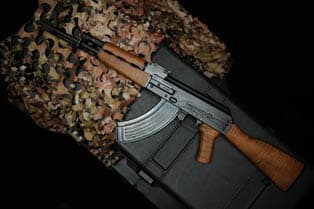
The host argues that, aside from the original invention of firearms, the Maxim machine gun is the single gun that most changed war, because it proved a weapon could load and fire itself continuously, multiplying the destructive power of defensive positions in an era still built around cavalry and single‑shot rifles. The focus then shifts to the conceptual birth of the assault rifle with Germany’s STG44. This weapon introduced the idea of an intermediate cartridge and select‑fire capability, allowing semi‑automatic fire for distance and rapid fire for close‑quarters combat, better matching real engagement ranges than full‑power rifle cartridges. For practical impact, the AK‑47 is highlighted as the most produced military firearm in history, surpassing Mauser bolt‑action rifles and influencing conflicts worldwide. Its earlier widespread adoption compared to the American M16 amplified its global footprint. The segment recaps transformative weapons—early handguns, arquebus, rifled musket, Gatling, Maxim, STG44, and AK‑47—as milestones in changing how soldiers fight.
In closing, the video explains why the analysis centers on rifles and machine guns rather than pistols. Wars are fundamentally fought with long guns, which determine infantry range, firepower, and tactics. While acknowledging influential revolver innovations—such as Smith & Wesson’s bored‑through cylinder enabling metallic cartridges, and iconic service revolvers like the Colt Army and various Smith & Wesson models—the host argues their strategic impact is minor compared to rifle development. The conclusion is reiterated: the Maxim machine gun stands as the single most transformative firearm because of its role in driving military doctrine, industrial‑scale killing, and population losses in the 20th century. The video ends by inviting viewers to comment on firearms they believe were overlooked, share whether they agree with the ranking and the focus on the Maxim, and suggest future topics for historical firearms and warfare analysis.












 Loading...