The video opens with SIG Electro-Optics explaining how the new XRAY5, also referred to as the X35, pairs with a phone app to learn a pistol’s recoil signature in just five rounds. Once calibrated, the optic tracks round count automatically and lets shooters switch between ammunition types, such as 115-grain range loads and 147-grain defensive ammo, without re-zeroing. John from SIG introduces the XRAY5 as a ground-up design that replaces a traditional single emitter with a 225-pixel LED matrix. Instead of moving the emitter or lens, the system electronically selects different pixels to shift point of aim. The aspherical collimating lens is moved to the roof of the optic, creating a zero-distortion viewing window. Windage and elevation are adjusted electronically using side buttons or via Bluetooth through the companion app, eliminating mechanical turrets and tools while enabling precise, repeatable digital control.
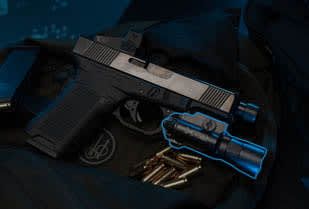
The presentation dives deeper into how zeroing is handled entirely through electronics. Using the Bluetooth-connected app, shooters select their distance to target and see exactly how much each adjustment will move point of impact, then send new pixel selections to the optic. This allows quick, tool-free zeroing and easy fine-tuning at common pistol distances. SIG details battery performance, targeting roughly 10,000 hours of runtime under normal use with MOTAC-style motion activation. Heavy Bluetooth use and advanced integrations can reduce runtime slightly, but are designed for realistic duty or carry patterns. A key feature is the “light fight” setup with the Foxtrot2R weapon light. When the light activates, it can automatically boost the XRAY5’s brightness so the reticle remains visible against a washed-out, illuminated target, tying optic intensity directly to light use for low-light defensive scenarios.
The video explains that the XRAY5 app can store numerous profiles for different ammunition and distances, allowing shooters to maintain separate zeros for 115-grain training ammo, 147-grain or +P defensive loads, and various engagement ranges. Switching profiles instantly changes which pixels are lit, so users do not need to re-confirm zero or burn extra ammunition each time they change loads. SIG confirms the XRAY5 is shipping, with pricing around $499 for the common duty “cop Glock” configuration and about $599 for SIG Glock variants, plus upcoming bundles that pair the optic with the Foxtrot2R light. The discussion then looks ahead to rifle and PCC applications, such as 300 Blackout with supers and subs, high-pressure versus standard 5.56, and USPSA PCC shooters who need different zeros for near and far stages. This multi-zero capability is positioned as a major advantage for both defensive and competition setups.
In the live demo portion, John Nichols walks through the XRAY5’s built-in round counter and how it is calibrated. After mounting the optic on a specific pistol, the shooter fires a five-shot string so the system can learn that gun’s unique recoil signature. Once learned, the optic can accurately track rounds fired and can be reset when moved to another firearm. The app interface is shown in detail, allowing users to choose distances in feet, yards, or meters and apply precise elevation and windage changes. The software translates adjustments into real-world movement, such as 1.7 inches at 10 yards, making the process intuitive even for those unfamiliar with MOA or MIL values. All adjustments are sent wirelessly, so there is no need for screwdrivers or tiny dials, and the optic confirms changes visually, including reticle feedback when new settings are applied.
The range segment shows a live-fire zeroing sequence where the shooter dials in the XRAY5 in about nine rounds, using the app to observe impacts and send incremental corrections. The optic’s reticle blinks to confirm each digital adjustment, reinforcing that no mechanical clicks are involved. A box drill demonstration highlights multiple preloaded zero profiles mapped to different corners of the display matrix, illustrating how users can jump between zeros for 115-grain practice ammo and 147-grain defensive loads without touching a tool. Instructors discuss how available point-of-impact travel changes with distance and encourage attendees to explore advanced app features later in a classroom session. The range is set up with both compact and full-size pistols so shooters can rotate safely and experience the enclosed XRAY5 on different platforms. Final impressions emphasize the novelty of fully electronic adjustments, stored multi-zeros, and the potential to extend this technology to rifle calibers like 300 Blackout and 7.62x39.















 Loading...