















WHY YOU NEED A SCOPE
No doubt that modern scopes for AR-15's add a better field of view and clear magnification, but what is the real reason you need a scope on your rifle? A responsible gun owner should be prepared for any situation. Forewarned is forearmed! Scopes are a necessary part of any tactical set-up. They are an integral piece of equipment that is necessary for any contemporary combat situation. All scopes should be considered as a tactical necessity. Whether you are neutralizing an enemy, protecting your home and family, or hunting, scopes are often the key for long-range precision shot placement.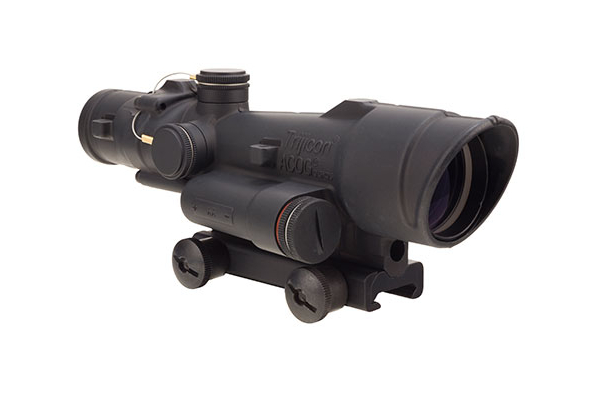
Trijicon ACOG
WHAT SHOULD I LOOK FOR IN AN OPTIC?
Not all scopes are created equally. I am not just talking about the magnification capabilities. Scopes have various equipment and features per manufacturer and model, just like our firearms do. By the way, I use the word equipment because I hate the word "furniture" when used in firearms-related written sources and conversations. Of course, variable magnification, clarity, and different apertures are subjects that you should research and consider when deciding on your scope purchase. First, define your reason for the purchase; what is your rifle most likely to be used for? Hunting, combat, protection, range only, and so on. Then consider the environment that your rifle is likely to be used in. In my opinion, the best scopes are waterproof, moisture (humidity) resistant, have coated lenses (for clarity), an internal red dot, and an anti-fog feature.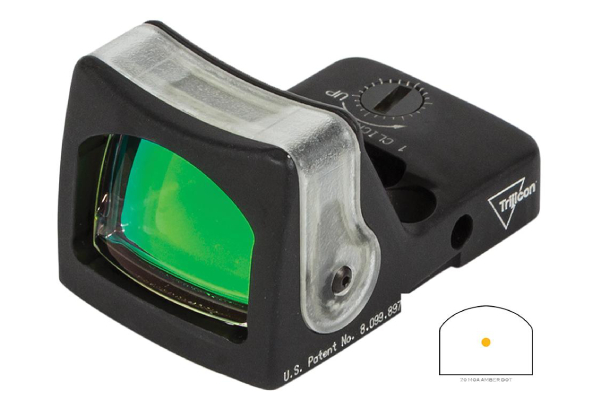
Trijicon RMR Dot Sight
DIFFERENT TYPES OF OPTICS
Okay, here is where it can get complicated. I am going to try to keep this as short and sweet as I can, but choosing your optic can be a little complicated. I'll try to help you out before you do any intensive research. First of all, there are two types of optics: telescopic sights and reflector sights, often shortened to reflex sights. For the most part, what we refer to as a "scope" is actually a telescopic sight. Telescopic sights make distant targets appear more clear and closer to the shooter. This is done by using magnification optics. The purpose of optics like this is to help the shooter make that long-distance precision shot. On the other hand, there are the reflex optics that don't magnify the target at all. These types of sights usually use an internal red dot as a single point of reference, allowing the shooter to acquire an incredibly fast sight on the target. This type of sight is most useful when there are multiple targets, moving targets, or in a close combat situation.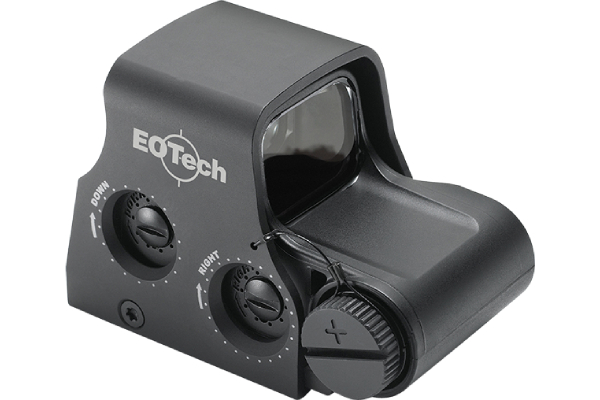
The Eotech XPS3 30x23mm 1x Optic
OTHER NOMENCLATURE
Yes, I did have to look that word up! Anyways, there is a lot associated with choosing a sight, too much to cover in just one article, in fact. Don't overthink everything because you will end up more confused than if you had no knowledge of scopes at all. Other terms that you may see when choosing a scope are words like reticle, which is simply a term used to describe what type of aiming indicator is inside of the optic. It can be anywhere from a crosshair to a red dot, and many other images. Minute of Angle or MOA is a measurement term; an MOA unit is equal to 1/60th of a degree. In less scientific terms, the measurement is equivalent to about 1 inch at 100 yards. That means that all shot placement should be within a 1-inch diameter circle at 100 yards. It goes on and on, with shot placement in a 2-inch diameter circle, 4-inch diameter circle, I hope you get the picture. Some optics feature a BDC, short for bullet drop compensator, that helps shooters hit targets far beyond the zero point of their scope. On telescopic scopes you are likely to see a series of numbers, the numbers indicate the magnification capabilities, the variable powers within that capability, and the measurement of the diameter of the lense. I could really go on and on about specific features of scopes, but we will save that for a later discussion. I have given you the basics (I hope).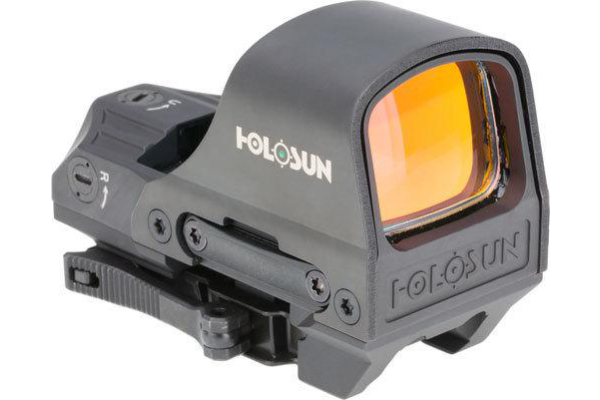
The Holosun GR Elite 510C
FINALLY MOUNTING YOUR SCOPE AND SIGHTING IT IN
The skinny of mounting your optics is to find an optic that will give you a comfortable cheek weld, which in turn gives you proper eye relief. Be sure that you have chosen the correct mount for your optics. A mounted scope on an AR-15 should clear any fold-down sights, front and rear sights. If your front sight is visible in your field of view through your scope, it is fine as long as it doesn't interfere with your red dots or crosshairs. And most importantly, make sure that you have clear access to your charging handle, and that your scope does not interfere with the charging handle function. An example to use when sighting in your new optics is, say that you go to the outside range and the maximum yardage that they allow for rifles is 100 yards. If you want to make accurate shots at that distance, you should sight your rifle in at zero on a 50 yard and 200-yard mark. At those variables, your shot placement in comparison to your aim should not be greater than 8 inches from your point of zero, up to three hundred yards. This is a safe key to use if you are looking at hitting center mass versus making a precision shot.IN THE CROSSHAIRS!
Optics can be complicated, but the most important thing is not to overthink it. Be reasonable about what you are likely going to use your optics for. Going hunting in the morning? Be sure to look for sights with an anti-fog feature. It's as simple as that. Classic Firearms has an incredible selection of scopes and optics, battery operated and manual. Remember if you have a battery operated scope, always carry extra batteries. And always have a great set of optics or sights as a backup to your battery-operated scope. Shop All Optics & MountingShop All Electronic Sights
Shop All Holographic Sights


 Loading...