The discussion opens by framing Heat as one of the most realistic depictions of gunfighting in cinema. The hosts explain that the film is reputedly used as a training aid by the Marine Corps because of its accurate portrayal of movement, reloading, and use of cover under fire. They contrast this with typical Hollywood mistakes, such as fully cased rounds visibly flying through the air, rifles shown without any sights or optics, and characters using high-magnification scopes at extremely short distances. Endless, magically refilling magazines are called out as another common trope that Heat largely avoids. Instead, the movie shows characters performing believable reloads and managing ammunition. This sets the stage for a detailed countdown of the top five guns featured in the film, emphasizing that the list is based not only on cool factor, but also on technical correctness, period accuracy, and how convincingly each weapon is handled on screen.
Attention turns to the Star Megastar, a Spanish in-house design from around 1990 built from the ground up as a 10mm pistol. The hosts highlight its rarity, noting that fewer than 1,000 were produced in 10mm and fewer than 6,000 in .45 ACP, making it an unusual and distinctive choice for a movie gun. In Heat, the character Waingro is seen using two different Megastars, one black and one chrome, a detail that can be missed on casual viewing. The conversation then shifts to the FN FNC carried by detective Vincent Hanna, played by Al Pacino. The FNC is described as a 5.56 NATO, long-stroke, rotating-bolt, gas-operated select-fire rifle adopted by the Belgian military. In the film, however, Hanna only fires it on semi-automatic during the downtown bank-robbery shootout. This deliberate choice underscores police concern over civilian casualties in a dense urban environment and sets up a later scene where Hanna makes a single, precise headshot on a robber holding a girl hostage.
The focus moves to Robert De Niro’s character and the evolution of his sidearms throughout the film. The script specifies that his pistol should be chambered in .45 ACP, but the hosts point out a production-era limitation: when Heat was filmed in 1994, the HK USP in .45 ACP was not yet available. As a result, the USP seen early in the movie must be a 9mm or .40 S&W, creating a subtle caliber discrepancy between script and screen. After De Niro’s character loses this USP in the drive-in shootout, he transitions to a SIG P220 in .45 ACP. Casual viewers may not notice the swap because both pistols share a similar silhouette, with hammer-fired designs and substantial metal frames. The hosts outline the SIG P220’s history, originating in Switzerland in 1975 as a 9mm and later imported into the United States as the Browning BDA. They note that guns like the HK USP, SIG P220, and Beretta 92 were emblematic of mid-1990s police sidearms, even though they would appear dated in a contemporary remake.
The conversation shifts to the Colt 1991 A1 Series 80 Officer ACP, essentially a compact 1911 variant in .45 ACP. The hosts joke about the unwieldy model name, contrasting it with the simplicity of just calling it a 1911. They briefly recap the 1911’s significance as a short-recoil, link-activated, single-stack .45 ACP service pistol that fought through two world wars and became a cultural icon. Colt arrived late to the compact 1911 market, finally introducing the Officer ACP in 1985 with a 3.5-inch barrel and shortened grip frame. In Heat, Al Pacino’s character, Lt. Vincent Hanna, carries a compact 1911 with distinctive ivory grips, making it visually striking whenever it appears on screen. The pistol recurs throughout the film, standing out even among the many other firearms that do not make the top five list. This segment underscores how the Officer ACP balances classic 1911 heritage with concealability, fitting Hanna’s intense, plainclothes detective persona while remaining period-correct for the mid-1990s setting.
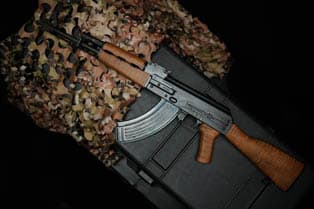
An honorable mention goes to the Israeli IMI Galil ARM, described as a 5.56mm AK derivative heavily influenced by the Finnish RK62/Valmet. The hosts explain that it retains the AK’s long-stroke gas piston and rotating bolt, along with rock-and-lock magazines, but adds features like a folding bipod, carry handle, and folding stock. The handguard can even be used as a bottle opener to prevent soldiers from damaging magazine feed lips. They note that the movie’s Galil ARM has a wood handguard, whereas the example on the table uses polymer. During the bank robbery sequence, continuity issues appear: the stock seems to vanish between shots, suggesting multiple prop configurations. The director’s commentary mistakenly refers to the weapon as a 7.62 rifle, even though the on-screen gun is clearly a 5.56 Galil ARM. Despite these quirks, the rifle earns an honorable mention rather than a numbered slot, both for its distinctive design and its role in showcasing the film’s mix of American and foreign small arms.
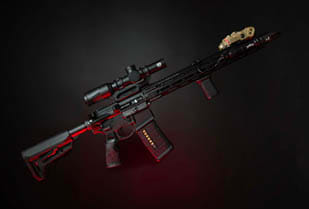
The number one spot is awarded to the Colt Model 733, often called the Colt M16A2 Commando, an AR-15–type carbine with an 11–12 inch barrel and a long muzzle device similar to what appears in Heat. The hosts emphasize that Colt did not strictly standardize parts on these carbines, leading to hybrids that might combine an A1 or Model 715-style upper with an M16A2-style lower, and sometimes a front sight base lacking a bayonet lug. The movie rifles use select-fire lowers, accurately reflecting their role as professional bank-robbery tools. Val Kilmer’s performance with the 733 is singled out for exceptional realism: his movement, use of cover, and especially his reloads look like those of a highly trained gunfighter. The hosts compare his handling favorably to modern portrayals in productions like The Terminal List and The Punisher, arguing that Heat set an early benchmark for convincing tactical choreography and weapon manipulation on screen.
The final segment broadens from specific guns to overall firearms realism in film and television. The hosts praise actors such as Chris Pratt, Jon Bernthal in The Punisher, and Leonardo DiCaprio in Blood Diamond for convincingly portraying trained shooters. They reveal a tactical Easter egg in Heat involving a car’s license plate, for example something like L2 PSU, which British special forces technical advisors used as a coded cue to indicate where Val Kilmer’s character should move and take cover during the shootout. The discussion then returns to why the AR-15 platform, represented by the Colt 733, tops their list: its adaptability, lightweight construction, and ease of use have given it a longer and more successful service life than older designs like the FNC, FAL, Galil ARM, and various AK derivatives. The hosts close by inviting viewers to comment on guns they feel were overlooked, such as the Mossberg 590 or Beretta 92 variants, and to suggest other movies or series, including The Terminal List, for future top five firearm breakdowns.










 Loading...