The video opens by revisiting the original Hudson H9, which debuted at SHOT Show 2017 and immediately drew attention for its all-metal construction and extremely low bore axis. The host explains how the pistol promised a 1911-like feel with modern striker-fired operation, but early excitement quickly faded as real-world reliability problems surfaced. A key failure point was the slide stop lever, which commonly broke between 1,000 and 2,000 rounds, undermining confidence in the platform. These persistent issues, combined with the challenges of being a small startup in a competitive handgun market, ultimately pushed Hudson into bankruptcy. This background sets the stage for understanding why the concept was compelling yet flawed, and why another company might see value in rescuing and reworking the design rather than letting it disappear entirely.
After Hudson’s collapse, Daniel Defense stepped in and purchased the rights and patents to the H9 concept. The video explains that this was not a simple rebranding exercise; Daniel Defense committed roughly four years to re-engineering the pistol from the ground up. The resulting handgun, the Daniel Defense H9, retains the recognizable profile and low bore axis idea of the original but shares virtually no parts with the Hudson version. The host emphasizes that Daniel Defense approached the project as a complete redesign, applying its established manufacturing standards and quality control processes. This acquisition and long development timeline are presented as evidence that the company intended to fix the H9’s weaknesses while preserving what made it unique, aiming to deliver a pistol that could finally live up to the original concept’s promise.
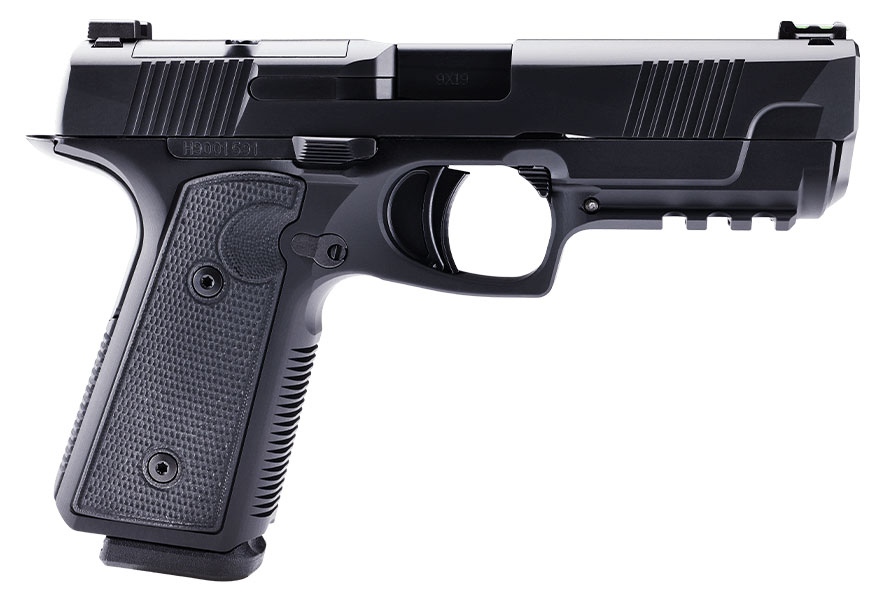
The discussion moves into how extensively Daniel Defense reworked the H9’s internals. While the external silhouette and general concept remain familiar, the internal components, geometry, and operating system have been redesigned to eliminate the Hudson’s known failure points. The host notes that the Daniel Defense H9 is essentially a new pistol that only looks related to the original. Attention is drawn to the company’s focus on durability and reliability, with redesigned small parts and revised stress-bearing areas to prevent issues like the notorious slide stop breakages. The pistol is described as an all-metal, striker-fired handgun that blends a 1911-style grip angle and feel with modern striker-fired mechanics. This segment underscores that Daniel Defense did not simply tweak the design but instead created a robust, production-ready platform intended for serious use.
To validate the new design, Daniel Defense subjected the H9 to extensive proof testing with overpressure 9mm ammunition. The host explains that the pistol was fired with high-pressure proof loads well beyond standard 9mm specifications to stress the barrel, slide, and locking system. These tests are described as part of Daniel Defense’s normal process for qualifying a new firearm, ensuring that it can safely handle extreme conditions and ammunition variances. The cold hammer forged barrel, treated with nitride and DLC coatings, is highlighted as a key durability feature. Throughout this phase, the pistol maintained structural integrity, with no catastrophic failures or critical part breakages. This segment reinforces the idea that the H9 has been vetted to a higher standard than the original Hudson, aligning it with the rigorous expectations typically associated with the Daniel Defense brand.
Beyond overpressure proof loads, the video details a brutal series of squib load tests performed on the Daniel Defense H9. Squib rounds, which lodge a bullet in the barrel, were intentionally induced and then followed by additional live rounds to simulate one of the most dangerous real-world malfunctions. The host notes that under these extreme conditions, the cold hammer forged, nitride and DLC-coated barrel did not rupture catastrophically. Instead, it bulged, containing the failure and preserving shooter safety. This outcome is presented as a significant testament to the barrel’s strength and the overall design’s safety margin. The segment emphasizes that such torture testing goes far beyond typical range use, demonstrating that the H9 is built to withstand rare but potentially disastrous events, and giving shooters added confidence in the pistol’s durability and engineering.
Attention shifts to how the Daniel Defense H9 feels in the hand and how its controls are laid out. The pistol features a 1911-like grip angle, which many shooters find naturally points well, and uses grip panels that further reinforce that classic feel on an all-metal frame. The host explains that this familiar geometry helps the gun index quickly on target and promotes consistent presentation from the holster. The low bore axis is integrated into the frame design, keeping the slide and barrel closer to the shooter’s hand. Controls such as the slide stop and magazine release are positioned for intuitive access, reflecting lessons learned from the Hudson’s shortcomings. Overall ergonomics are described as refined and deliberate, aiming to combine the comfort and pointability of a 1911 with the capacity and simplicity of a modern striker-fired 9mm pistol.
The video then focuses on the Daniel Defense H9’s distinctive trigger system. Unlike typical striker-fired pistols, the H9 uses an upside-down hinged trigger design that still incorporates a Glock-style safety tab in the center of the trigger shoe. This configuration is intended to provide a more consistent, controllable pull while maintaining drop safety and modern striker-fired reliability. The host notes that the trigger feel is one of the standout features, combining a familiar safety mechanism with a unique mechanical layout. The hinge orientation and internal geometry are part of Daniel Defense’s broader redesign, separating the H9 from both the original Hudson and common polymer striker-fired pistols. This segment underscores how the trigger contributes to the pistol’s shootability, supporting accurate, fast follow-up shots and aligning with the gun’s overall goal of delivering a refined, duty-capable sidearm.
With the design details covered, the host discusses how the Daniel Defense H9 actually performs under live fire. The pistol’s very low bore axis is highlighted as a major factor in its recoil characteristics. By keeping the barrel and slide closer to the shooter’s hand, muzzle flip is reduced, allowing faster sight recovery and quicker follow-up shots. Combined with the 1911-like grip angle and all-metal construction, the H9 is described as tracking smoothly in recoil and staying flat during rapid strings of fire. The ergonomics and trigger design work together to make the gun feel controllable and predictable. This segment ties the engineering choices—low bore axis, grip geometry, and trigger system—directly to practical benefits on the range, reinforcing the idea that the H9 is not just theoretically improved but noticeably better in real shooting conditions.
As the range session continues toward the end of the video, the shooter eventually runs out of ammunition while still actively testing the Daniel Defense H9. Another person offers more ammo so the shooting can continue, underscoring the enthusiasm for putting additional rounds through the pistol. Throughout this extended session, the host notes that the gun has been running without problems, with no malfunctions or reliability concerns surfacing. The sequence of shooting, reloading, and continuing to fire reinforces the earlier claims about the redesign’s success and the pistol’s robustness. This portion serves as a practical demonstration that the H9 can handle sustained use, supporting the earlier technical discussion with on-camera performance and setting up the final impressions and recommendations that follow.
In the closing impressions, the speaker emphasizes that the Daniel Defense H9 has run with no problems during testing, reinforcing confidence in its reliability. The host clearly states liking the pistol and expresses that there is no expectation of buyer’s remorse or regret in owning it. This sentiment is repeated to underscore satisfaction with both performance and design. The positive endorsement ties back to the earlier discussion of the Hudson H9’s failures, contrasting that troubled history with the Daniel Defense version’s solid showing. Viewers are left with the impression that the H9 is a well-sorted, durable handgun that justifies its price point and the extensive development effort. These final remarks function as a clear recommendation for those considering the pistol for purchase or further evaluation.
Following the reliability summary, the host directly encourages viewers to check out the Daniel Defense H9 for themselves. The message is that shooters who are interested in the concept of a low-bore-axis, all-metal, striker-fired pistol with a 1911-like grip angle should give this model serious consideration. The host reiterates that owners are unlikely to regret the purchase, reflecting strong confidence in the product. This encouragement is framed as an invitation to experience the pistol’s ergonomics, trigger, and recoil characteristics firsthand rather than relying solely on past perceptions of the Hudson H9. The segment serves as a call to action, connecting the detailed technical and range discussion to a practical next step for viewers who may be in the market for a new 9mm handgun.
The video concludes with the channel’s customary sign-off. The host repeatedly thanks viewers for tuning in and explicitly expresses appreciation for their business and ongoing support. A religious blessing, often phrased as “God bless,” is offered to the audience as part of the closing remarks. The outro also includes a promise to see viewers in the next video, sometimes repeated and playfully truncated as the final seconds roll. No new technical information or firearm details are introduced in this segment; it functions purely as a warm, appreciative farewell. The closing reinforces the channel’s relationship with its audience, wrapping up the in-depth look at the Daniel Defense H9 on a personal and positive note.





















 Loading...