The video opens with a lighthearted range skit where two shooters run a drill, call hits, and joke about a missing teammate who stayed behind at the studio. The scene then cuts to the host in the video room explaining that the others went to the range, filmed the intro, and left him to cover the technical details. They have brought back a new rifle from FN for discussion: the SCAR 17S DMR. The host notes that it looks like a familiar SCAR platform but is a new variant for the channel, setting up a focused breakdown of what differentiates this designated marksman rifle from the standard SCAR 17 and SCAR 20S.
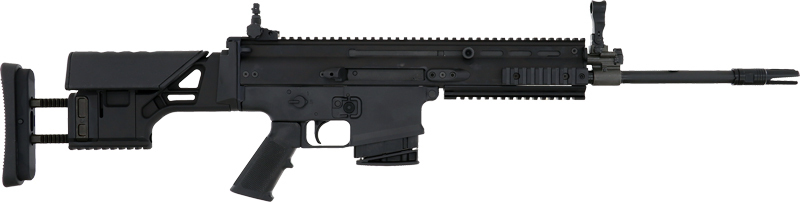
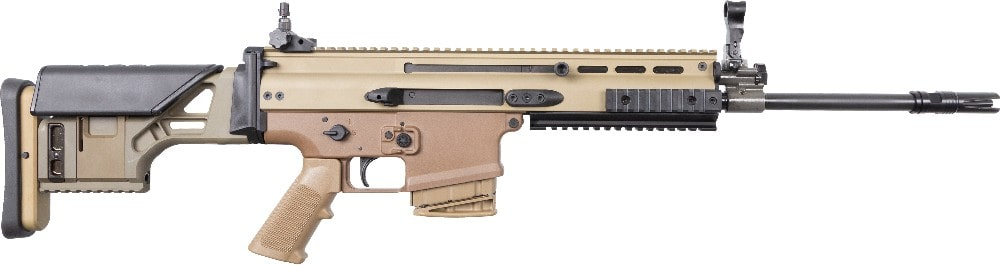
The rifle is introduced as the FN SCAR 17S DMR, with DMR standing for designated marksman rifle. The host explains that FN has made several changes compared to the basic SCAR 17. The most obvious is the stock: it uses the SCAR 20S precision stock instead of the side-folding “tactical UGG boot” found on the standard 17. This stock does not fold but offers adjustable length of pull and adjustable comb height. That adjustability is highlighted as useful when running magnified optics, such as the Leupold Mark 5HD 2-10x mounted on the rifle, allowing consistent eye relief and sight alignment suited to a marksman role.
Attention shifts to the muzzle device, which differs from the standard SCAR 17S setup. The host criticizes the original three-chamber FN proprietary muzzle brake on the 17 for being extremely loud and concussive, often requiring double hearing protection for comfort. On the SCAR 17S DMR, FN uses a three-prong device instead. The host notes from experience that the three-prong significantly reduces concussion compared to the old brake, making it more pleasant for the shooter and those nearby. However, the brake does a better job of keeping the rifle very flat under recoil. The host hints at a future comparison video between the three-prong and the brake to explore the trade-off between reduced blast and maximum recoil control.
The host points out that the trigger is another key change: the rifle uses the Super SCAR trigger found in the SCAR 20S. It is described as one of the host’s favorite triggers, with short, smooth take-up, a distinct wall, a clean break after a few pounds of pressure, and a short, audible, tactile reset. The chambering is also different from the typical SCAR 17. Instead of 7.62 NATO, this DMR is chambered in 6.5 Creedmoor. The host notes that many viewers have wanted a SCAR 17S in 6.5 Creedmoor and suggests that the DMR designation likely reflects the cartridge’s advantages. For engaging targets at 1,000 yards and beyond, 6.5 Creedmoor is described as outperforming 7.62 NATO/.308 in accuracy and downrange performance, making it well suited to a designated marksman role.
The rifle shown is set up in a relatively simple configuration. The host mentions that a DMR would typically benefit from a bipod or other front-end accessories, but the SCAR 17S DMR retains a relatively short rail compared to the long rail on the SCAR 20. The longer rail on the 20 allows bipods, grips, lasers, and IR devices to be placed further out, which is useful for various conditions and low-light engagements. Weight comparisons are provided: an unloaded SCAR 20 with no optics is about 11.6 pounds, while a standard SCAR 17S is about 8 pounds. The SCAR 17S DMR falls in between at roughly 9 to 12 pounds unloaded, depending on configuration. Added optics and accessories increase weight further, which can be noticeable when moving through terrain. The rifle in the video uses a Magpul vertical grip on the short rail, which the host finds comfortable but notes a personal preference for angled foregrips on SCAR rifles.
The host offers opinions on the non-folding precision stock. The extra weight is considered acceptable for a DMR, which is not intended to be a lighter battle rifle like the 8-pound standard SCAR 17S. The stated reasoning for the fixed stock is improved precision and stability, keeping the shooter’s head position and cheek weld consistent during rapid follow-up shots. The host, however, would still prefer a side-folding stock on a piston-driven rifle for vehicle operations, airborne use, and general compactness. Controls are then discussed. The rifle features ambidextrous, non-reciprocating charging handles, with the primary handle on the left side angled downward to clear optics and prevent knuckle impacts seen on earlier SCARs. It also has ambidextrous magazine releases and safeties. The only major omission noted is the lack of an ambidextrous bolt catch and release on the right side, which the host views as a desirable feature at this price point.
In closing, the host reiterates that the SCAR 17S DMR in 6.5 Creedmoor is a well-executed designated marksman platform with strong performance at distance. Critiques focus on details rather than function: the absence of a side-folding stock, the lack of a fully ambidextrous bolt catch and release, and the inclusion of a basic A2 pistol grip on a rifle with an MSRP around $4,000 to $5,000. The host references LMT’s ambidextrous Mars lowers as an example of the kind of control layout that would be appreciated on a rifle in this class. Despite these nitpicks, the rifle is described as very capable, with the 6.5 Creedmoor chambering, Super SCAR trigger, improved muzzle device, and NRCH (non-reciprocating charging handle) system standing out as key strengths. The video ends by inviting viewer feedback on setups and future content, and with a brief sign-off thanking viewers and customers.





















 Loading...