

















How To Choose Your First Firearm
Once you've made the decision to exercise your constitutionally protected Second Amendment rights, the next step is determining which firearm best suits your needs. There are various factors to consider when shopping for your first gun, including your planned use case as well as your budget and overall experience level.

Mission Dictates Gear
Most guns are designed to fill a specific role. For example, pump action shotguns are often recommended for home defense because they are quick to deploy and easy to use with minimal training.
They become less ideal at longer ranges, which is why most people favor a semi-auto rifle when selecting a long gun that is designated for patrol or general use, where engagements may occur at various distances.
Start by defining your mission (hunting, concealed carry, target shooting, etc.), then decide which type of firearm will be most effective at helping you achieve your goals. From there, you can choose between a rifle, shotgun, or handgun to narrow down your options - more on that later.
Invest In Success
With hundreds if not thousands of firearms to choose from in today's market, there's a gun for every budget. We recommends purchasing the most reliable model you can reasonably afford, then setting aside any additional funds to stock up on ammunition and seek training from a qualified instructor.
Even high-end firearms can jam if you load suboptimal ammo, so be sure to also select a quality round that is engineered for your intended purpose. Pairing the right gun with the right ammo is the best way to ensure your firearm goes BANG every time you pull the trigger.
And remember, a firearm is just a tool. While it's true that better tools sometimes cost more money, there's a diminishing point of returns once prices jump from the hundreds to the thousands. If you're on the fence, a mid-tier gun and training will almost always serve you better than an expensive gun with no training because you simply cannot buy your way out of a skill deficit.
Know Your Limits
If you're new to firearms in general, be sure to assess your willingness to commit to training before you decide which gun you want to purchase. Shooting is a perishable skill and requires regular practice to maintain proficiency. Moreover, certain firearms have more of a learning curve than others.
This means that some platforms are less beginner-friendly and may not be suitable for first-time gun owners. It's always a good idea to build solid shooting fundamentals with a firearm that is simple to operate and provides consistent, predictable feedback so you know what you need to work on.
Acknowledging where you're at in your firearms journey allows you to make better buying decisions. For instance, a rifle chambered in .22 LR may be a better choice for some than a bolt action chambered in the heavier-recoiling .308 Winchester, or a striker-fired pistol may be a better choice than a double / single action revolver with two distinct trigger pulls.

Glock 45 Gen 5, 9MM Semi-Auto Pistol, 4.02" Barrel, (3)17 Round Magazines, W / Front Serrations, Black Frame w/ Satin Aluminum Slide - ACG-57036AUS
Rifle, Shotgun, Or Handgun - Which Is Better?
Once you've established your criteria and set a budget, it's time to decide whether you want to purchase a rifle, shotgun, or handgun. Each type of firearm has advantages and disadvantages in certain scenarios, so it's important to weigh the pros and cons of each before making your choice.
Rifles
A rifle is a long gun that is designed to be shouldered when fired and has a barrel length of at least 16 inches. The barrel itself is rifled (features grooves that spin a single projectile as it exits), which improves accuracy and terminal ballistics.
In general, most shooters gravitate towards bolt-action or semi-automatic rifles. A bolt-action rifle features a throw lever which must be actuated in order to chamber a round and extract spent casings after each shot is fired. A semi-auto rifle utilizes a gas-operated or direct blowback system to cycle the action and chamber a new round with each pull of the trigger, negating the need for any additional manual operations on the shooter's part.
Rifles are ideal for mid-to-long-range engagements (75-300+ yards), offering a solid balance of firepower and maneuverability. They are heavier than handguns, but not nearly as heavy as the typical shotgun. Also, rifles tend to hold more rounds and can be adapted to suit any mission parameters.
A full-length rifle may not be the best choice in tight quarters or in spaces with shared walls, such as apartment buildings. Rifle rounds have greater muzzle velocity and can punch through studs and drywall, potentially injuring bystanders.
While the risk of overpenetration is present with any firearm, some experts recommend a shotgun or handgun for home defense because the perceived risk is less than with rifles chambered in an intermediate caliber. Remember, you are legally and morally responsible for every round that leaves your gun. Use your best judgement when deciding whether a rifle is the best fit for your needs.
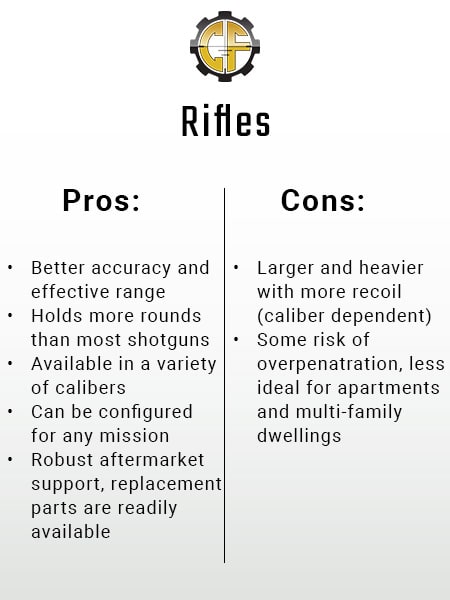
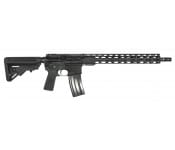
Here are some rifles that we recommend:
Shop Popular Semi-Auto Rifles


Shotguns
A shotgun is a long gun that is designed to be shouldered when fired and usually has a smooth bore (no rifling) with a barrel length of at least 18.5 inches. Shotguns can fire multiple projectiles (pellets) from each shotshell and offer tremendous stopping power, with loads designed for birds and water fowl as well as larger game and self defense environments.
Shotguns can also fire slugs (single, solid projectiles) using a slug barrel with rifling or special rifled slug ammunition. This allows shotguns to be effective at slightly longer ranges, though they do not have nearly the same range as rifles. There are several types of shotguns, including manually operated models like break-action or pump-action shotguns as well as semi-auto shotguns. Pump actions and semi-autos are by far the most popular.
Feeding from a fixed internal tube magazine or a removable box magazine, the main difference between pump shotguns and semi-autos is the action itself. Pump shotguns have a forend that must be actuated with the support hand to load and eject shells, whereas semi-auto shotguns rely on gas pistons or inertia to cycle the action with each shot.
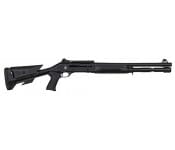
Both are popular with hunters as well as self-defense enthusiasts because they are simple and fairly straightforward to operate. Proper shotshell selection results in more immediate incapacitation, which is especially important when confronting a deadly threat. For this reason, a 12GA pump-action shotgun is one of the most commonly recommended firearms for personal protection in the home.
That said, shotguns are larger and heavier than most other firearms. They also have more recoil and may not be suitable for smaller shooters and individuals who are sensistive to "kick" when firing. This can be mitigated by selecting a model chambered in 20GA or .410GA instead of 12GA, but no matter what, a shotgun will have more substantial recoil and will hold fewer rounds than a rifle or a pistol.
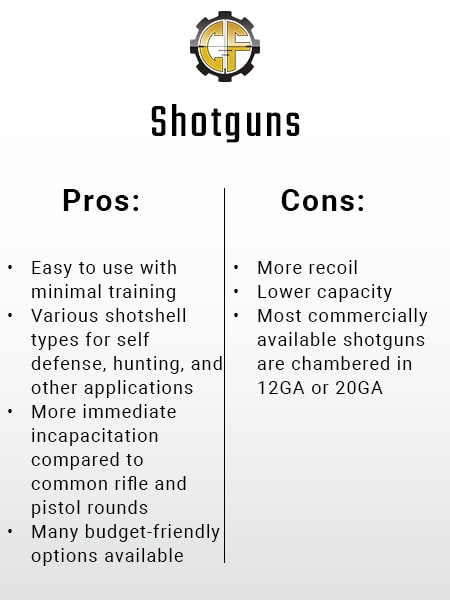
Here are some shotguns that we recommend:
Shop Popular Shotguns


Handguns
As the name suggests, a handgun is designed to be held and fired from the hand without a stock placed against the shoulder. Barrel lengths vary by application, with concealed carry models ranging from 2 inches to 4.25 inches and duty-oriented models ranging from 4.5 to 5 inches. Handguns have rifled barrels and fire single projectiles (with the exception of a few oddball models like the Taurus Judge).
Most shooters opt for semi-auto pistols, but some people still like to carry revolvers. A revolver fires from a revolving cylinder and has a fixed barrel that cannot be pushed out of battery. A semi-auto pistol feeds from a removable magazine and can feature either a tilting or fixed barrel with a reciprocating slide that cycles the action each time the trigger is pulled.
The primary advantage of handguns is that they can be concealed, meaning that lawfully armed citizens can keep a firearm on their person without advertising to the world that they have a gun. Concealed carry has become increasingly popular over the years and as a result, most modern handguns are designed with home defense and everyday carry in mind.
To accommodate shooters with different preferences, body types, and professional backgrounds, handguns come in a variety of sizes and calibers. The tradeoff is that not all calibers and barrel lengths are as easy to shoot with as others. While it may seem counterintuitive, a smaller gun can be more difficult to use for self defense because they require greater precision (and sometimes more shots on target) to be effective.
Large frame pistols are one possible remedy to this conundrum. A large frame pistol is a scaled down variant of a rifle platform (like the AR-15 or AK-47) that is designed to be fired from the hand, with or without the use of a stabilizing pistol brace. This gives you the potency of a rifle cartridge in a compact package that can be stowed in a secure vehicle compartment or a backpack, deploying in seconds.
If you're looking for a general purpose firearm, something that you can use for home defense and also occasionally carry, then a handgun might be the best option. Moreover, handguns are a great starting point for anyone new to firearms to ease into the shooting sports.
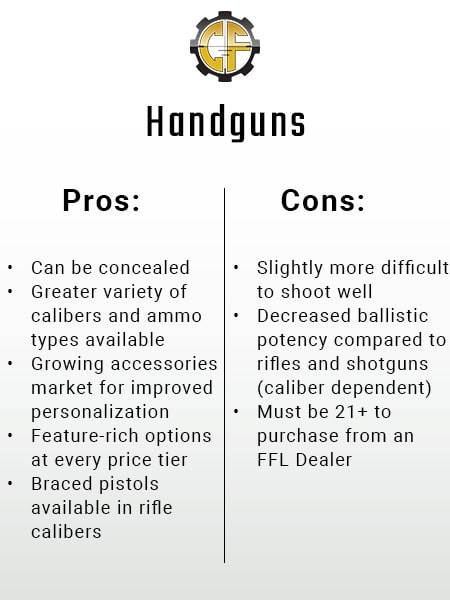
Here are some handguns that we recommend:
Shop Popular Handguns


Other Firearms
Some firearms do not fit neatly into any of the above legal buckets and are instead classified as "Other" firearms. An example of an "Other" firearm is the Mossberg Aftershock, a semi-auto 12GA that is not technically a rifle, shotgun, or a handgun as defined by federal law.
However, it is still perfectly legal to own in most states and allows you to fire shotshells in a more compact, maneuverable platform. "Other" firearms are perfect for new shooters who may not want a full-length rifle or shotgun, but do not want to go through the process of filing paperwork for a true Short Barrel Rifle (SBR) or Short Barrel Shotgun (SBS).

How To Buy A Gun Online
Once you've selected the firearm you wish to buy, purchasing online is safe and simple. For more information, read our blog here or watch our video for a detailed overview of the process from start to finish!


 Loading...